
What if planning for your business’s future still left your own retirement uncertain? Business and personal finances are connected, but planning for them together can be challenging. That’s the practical question behind financial planning for small business Sydney owners: what can a financial adviser help you plan, and where does their role stop?
This 2026 guide explains how financial advice can bring your personal superannuation, investments and retirement projections into view alongside your business ownership, without promising a particular outcome. It also clarifies what financial advice doesn’t cover: business accounting, tax-return preparation or legal services. Learn what to check when comparing an adviser’s scope, fees and authorisation, and what to prepare for an initial conversation. These steps can help you assess whether a proposed strategy reflects your circumstances and supports both your business and your future beyond it.
Key Takeaways
- Connect personal goals with the realities of business ownership while keeping accounting, tax-return preparation and legal work with the appropriate professionals.
- Use retirement projections, superannuation reviews and investment advice to explore possible scenarios, not to guarantee an outcome.
- Compare advisers by their written scope, process, fees, ongoing service and relevant experience. Check current authorisation through Australian sources.
- Prepare for an initial meeting by outlining your goals, financial position, business context and questions. Ask what information the adviser needs.
- Explore how financial planning for small business Sydney owners may support personal priorities through retirement modelling, superannuation review, tax-minimisation strategies and portfolio construction.
Financial planning for small business in Sydney: what should it cover?
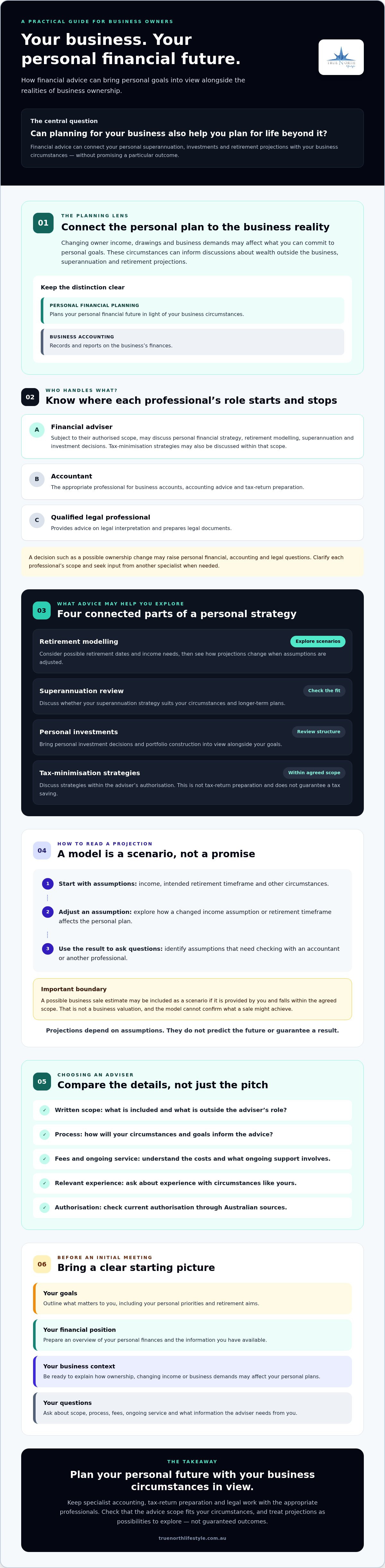
For a business owner, financial planning is personal financial advice shaped by the realities of owning and running a business. It can connect your retirement, superannuation and investment goals with circumstances such as changing income or a possible change in ownership. It doesn’t replace planning the business’s operations, and it isn’t bookkeeping, business accounting, tax-return preparation or legal work.
Financial advice helps you plan your personal financial future in light of your business circumstances. Business accounting records and reports on the business’s finances. For a broad introduction, see What is a financial plan? The distinction matters: financial planning for small business Sydney owners should consider how business ownership affects personal choices, while leaving specialist accounting and legal work to the appropriate professionals.
How can business ownership shape your personal financial plan?
Owner income may vary, drawings can change and business demands may affect what you can commit to personal goals. These are useful details to raise with an adviser. They can inform discussions about how much personal wealth sits outside the business, whether your superannuation strategy suits your circumstances and how retirement projections might change under different assumptions. They don’t, by themselves, establish a particular accounting treatment.
For example, a projection can show how changing your income assumption or intended retirement timeframe affects a personal plan. It models scenarios, rather than predicting the future or guaranteeing a result. The right advice depends on your goals, financial position and business circumstances, so an approach suited to one owner may not suit another.
Which decisions belong with an adviser, accountant or lawyer?
Keep the roles clear. Subject to their authorised scope, a financial adviser can discuss personal financial strategy, retirement modelling, superannuation and investment decisions. An accountant is the appropriate professional for business accounts, accounting advice and tax-return preparation. A qualified legal professional should advise on legal interpretation and prepare legal documents.
Some decisions involve more than one area. A proposed ownership change, for instance, may affect your personal financial projections while also raising accounting and legal questions. Ask each professional to clarify what they can advise on, what falls outside their role and when you should seek input from another specialist. This gives you a fuller picture without expecting one adviser to cover every aspect of your business and personal finances.
What financial advice can help a Sydney small business owner plan
Personal financial advice can bring several connected decisions into view: when you may want to retire, how superannuation fits your longer-term plans, how personal investments are structured and how you might preserve wealth over time. For financial planning for small business Sydney owners, the starting point is your personal goals and circumstances, not an assumption that the business will fund a particular future.
A financial adviser may also discuss tax-minimisation strategies within their authorised scope. This isn’t tax-return preparation, and it doesn’t guarantee a tax saving. Your business structure and personal situation can affect which questions need attention, so clarify the adviser’s scope and involve your accountant where appropriate. The Australian Government’s Get help with your finances resource outlines support options for businesses seeking financial guidance.
How can retirement modelling support business owners?
Retirement modelling can help you explore possible retirement dates and income needs, then see how projections change when assumptions are adjusted. If you’re considering a future business sale, an adviser may be able to include an estimate you provide as one scenario, if it falls within the agreed advice scope. This isn’t a business valuation, and the model can’t confirm what a sale might achieve.
Retirement projections are scenario-based and depend on the assumptions used. They don’t guarantee a future result. Exploring scenarios can help you identify which assumptions need checking and what questions to take to your accountant or another professional. For further reading, see our guide to retirement planning in Sydney.
Where do superannuation and investments fit?
A superannuation review considers your current position, objectives and the rules relevant to your circumstances. It can help you understand how super fits alongside other personal assets and your intended retirement timeframe. Any recommendations should reflect your situation and be confirmed within the adviser’s authorised scope.
Personal investments are another part of the picture. Bespoke portfolio advice can consider how your investments relate to your goals, time horizon and approach to risk, rather than treating business assets as your only path to future wealth. Read more in our guide to bespoke investment advice in Sydney. To explore how these areas may fit your circumstances, review the advice scope and services available from True North Lifestyle.
How to compare financial planners for small business in Sydney
Start with the written scope, not a broad label such as “business advice”. For financial planning for small business Sydney owners, check that the proposed work focuses on your personal financial priorities and explains how your business circumstances may be considered. Bookkeeping, business accounts, tax-return preparation and legal services are separate areas. An adviser should explain what’s included and when you may need another professional.
| What to compare | Questions to ask |
|---|---|
| Advice scope | Which personal decisions does the engagement cover? What sits outside it? |
| Process | How will recommendations be developed, explained and documented? |
| Fees | What will I pay, what does that cover, and how are additional services charged? |
| Ongoing service | Are reviews included? If so, what do they involve and how are they charged? |
| Relevant experience | How have you worked with business owners whose personal plans are affected by changing business circumstances? |
What should you ask before engaging a financial adviser?
Ask which decisions the engagement covers and which require an accountant or lawyer. Clarify how recommendations are explained, whether implementation is included and what any ongoing reviews involve. If your income, drawings or business plans change, ask how that information would be reflected in personal projections. These questions help you assess whether the process is specific to your circumstances, rather than relying on a general promise of tailored support.
How should you assess fees, scope and professional fit?
Compare written service descriptions and fee disclosures on a like-for-like basis. Ask for relevant disclosure documents, including information about the adviser’s services and fees, before deciding. Check the adviser’s details on ASIC’s Financial Advisers Register and confirm the authorisation under which advice is provided. Registration and disclosure are important checks, but they don’t guarantee an outcome or establish that an adviser is right for you.
Look for a proposed scope that addresses your personal priorities without suggesting the adviser will manage business accounts, prepare tax returns or provide legal interpretation. A good fit means the boundaries are clear, your questions are welcomed and you understand what you’re agreeing to before proceeding. If an answer is vague, ask for clarification in writing.
How to prepare for a financial planning meeting in Sydney
Some preparation can make an initial conversation more focused. For financial planning for small business Sydney owners, connect your personal priorities with the business circumstances that may affect them. You don’t need to bring every business record or have every answer ready.
- Set out your goals. Note what you want to clarify, such as retirement timing, superannuation or preserving personal wealth.
- Sketch your current position. Summarise relevant personal income, assets, investments, debts and superannuation, along with how business ownership affects your personal finances.
- Write down your questions. Include anything you’re uncertain about, from the advice scope to how changing business circumstances may affect personal projections.
- Gather requested documents. Ask the adviser what information is useful before sending statements or other personal financial documents. Use a secure channel agreed with the adviser.
- Agree on next steps. Before proceeding, confirm what the initial conversation covers, whether there is a cost, what happens afterwards and how further advice is scoped and charged.
What information can help an adviser understand your position?
Depending on the adviser’s instructions, relevant information may include superannuation and investment statements, a broad picture of personal income and debts, and a short summary of your business ownership. You could also note expected changes, such as a possible shift in your role or income, without sending unnecessary sensitive business records. Ask what’s needed and why before sharing documents, and confirm how to provide them securely.
How can you make the first conversation useful?
Start with the decision causing the most uncertainty and describe what a useful outcome would look like. For example, you might want to understand which personal planning questions to address before deciding when you hope to retire. Be clear about what you want the adviser to explain, and ask how personal tax-minimisation strategies differ from tax-return preparation. For background, you can also consult an Australian tax-minimisation guide. Discuss tax advice and return preparation with the appropriate professional.
True North Lifestyle is based in Miranda, NSW, serving the local Sydney area. Confirm current meeting options, the scope of any initial conversation and any applicable cost directly before making arrangements. To discuss personal priorities such as retirement modelling or a superannuation review, explore financial advice with True North Lifestyle.
How True North Lifestyle can support your personal financial strategy
Owning a business can make it harder to separate today’s demands from your personal plans for the future. True North Lifestyle provides financial advice that can help you consider personal priorities alongside your circumstances as a business owner. If you’re researching financial planning for small business Sydney, understand both the services available and the boundaries of the advice before deciding whether to proceed.
What True North Lifestyle’s financial advice covers
Retirement modelling and long-term projections are a primary part of True North Lifestyle’s work. They can help you explore how different assumptions or possible retirement timeframes may affect your personal plans. A projection is a planning tool, not a promise of a particular outcome.
Other areas include superannuation review, personal tax-minimisation strategies and bespoke portfolio construction. These services can help bring questions about your super, investments and future wealth into a considered personal strategy. Tax-minimisation advice isn’t tax-return preparation, and it doesn’t guarantee a tax saving or investment return. Any advice should reflect your individual circumstances and objectives. Confirm the scope before engaging.
True North Lifestyle is based in Miranda, NSW, and serves clients in the Sydney area. Confirm current meeting options and service availability directly rather than assuming a particular appointment arrangement.
What to expect before deciding whether to proceed
Before committing, ask for a clear explanation of the proposed advice scope and fees. Check which recommendations may be covered, whether implementation is included, what ongoing support involves and how it is charged. Ask how the advice will take your personal goals and business-related circumstances into account. Clear answers make it easier to assess whether the service fits your needs.
Keep professional roles distinct. True North Lifestyle’s listed offerings don’t include business accounting, tax-return preparation or legal document drafting. You may need an accountant for business accounts or tax returns, and a qualified legal professional for legal documents or legal interpretation.
You don’t need to decide before you understand the fit. Sydney business owners can discuss their priorities, the proposed advice scope, fees and next steps with True North Lifestyle, then decide whether to proceed. A considered conversation can help you see whether personal retirement, superannuation or investment planning belongs in your wider financial picture.
Bring your business and personal future into one clear plan
Business decisions can shape your personal future, but the advice you seek should be clear about what it covers. The right financial planning for small business Sydney owners starts with your goals, a realistic view of your circumstances and an understanding of where an adviser’s role ends. Retirement projections can help you consider possible paths, while superannuation and portfolio advice may support your wider personal strategy. None can promise a particular outcome.
True North Lifestyle’s primary service includes retirement modelling and long-term projections. Based in Miranda, NSW, the firm also provides bespoke portfolio advice, with portfolio construction and oversight involving an in-house Investment Committee. Before proceeding, discuss whether the advice fits your circumstances, and clarify its scope, fees and next steps.
If you’re ready to explore whether this approach suits your priorities, explore True North Lifestyle’s financial advice services. Contact True North Lifestyle to discuss your personal priorities, the advice available and whether it may suit your circumstances.
Frequently Asked Questions
What does financial planning for a small business owner include?
For financial planning for small business Sydney owners, advice may connect personal goals with the circumstances of business ownership. Depending on the engagement and the adviser’s authorisation, it could include retirement projections, superannuation review and investment advice. This is separate from bookkeeping, business accounting, tax-return preparation and legal services. Before proceeding, confirm what advice is included, what falls outside scope, what the fees cover and whether ongoing support is available.
Do small business owners in Sydney need a financial adviser?
No, not every small business owner needs an adviser. Advice may be useful if business decisions affect your personal retirement, superannuation or wealth goals, or if you want to explore possible futures through scenario modelling. Its value depends on your circumstances, objectives and the service offered. If you’re considering an adviser in Sydney, including near Miranda, compare the written scope, fees and professional fit before deciding.
Can a financial planner help with my business tax and tax return?
A financial adviser may discuss personal tax-minimisation strategies within an authorised advice engagement, but that’s different from preparing or lodging a tax return. Confirm the adviser’s scope and authorisation, and ask what tax-related advice is included. True North Lifestyle lists tax-minimisation strategies among its offerings, but not tax-return preparation. For business accounts or tax-return work, speak with an appropriately qualified accountant who can advise on your specific needs.
How can retirement modelling help a small business owner?
Retirement modelling can test possible scenarios using assumptions about retirement timing, income needs, superannuation and other relevant resources. Comparing scenarios may help you frame questions and consider different paths, but a projection isn’t a prediction or a guarantee. If you’re considering a business sale, discuss any proceeds as an assumption for modelling, not as a promised outcome or business valuation. Results depend on the assumptions and information used.
What should I bring to a financial planning meeting?
Ask the adviser what information they need before sending documents. Depending on the discussion, it may help to outline your goals and gather relevant superannuation details, investment information, income and liabilities. Prepare a concise summary of your business ownership and any expected changes that could affect your personal plans. Don’t send sensitive records through unsecured channels. The adviser can confirm what’s necessary for an initial conversation and any later work.
How do I compare financial advisers for a small business in Sydney?
Compare written advice scopes, disclosed fees, the advice process, implementation support and review arrangements. Ask how the adviser accounts for business ownership in personal financial planning, and which services sit outside their remit. Check current authorisation and relevant disclosures through appropriate Australian sources, including ASIC’s Financial Advisers Register. Choose based on clear answers and suitability for your circumstances, not on a promised investment return, tax saving or particular financial outcome.
Does True North Lifestyle provide business accounting or tax-return preparation?
No. True North Lifestyle’s listed services include financial advice, retirement modelling, superannuation review, tax-minimisation strategies and portfolio services, but not business accounting or tax-return preparation. Legal document drafting isn’t listed either. If you’re considering advice in Miranda or the wider Sydney area, confirm the proposed engagement’s scope and fees directly. For business accounts or tax returns, consult an appropriately qualified accountant. Seek a lawyer for legal documents or interpretation.


