

What if your SMSF’s investments look sensible on paper but don’t support the retirement its members want? A sound SMSF investment strategy Sutherland Shire trustees can rely on connects member goals with the fund’s risk, liquidity and documented investment decisions. It reflects the people behind the numbers, rather than simply repeating a generic template.
It’s understandable to be unsure what the strategy needs to cover, how often to review it or whether a concentrated portfolio suits your fund. These questions matter because trustees need to consider investment risk and return, diversification, liquidity, fund liabilities and each member’s insurance needs. The rules apply nationally, but members’ circumstances and retirement plans are personal.
This guide explains the practical purpose of an SMSF investment strategy, the key considerations to document and the changes that may prompt a review. It also sets out questions to discuss with fellow trustees and a qualified adviser, including how to weigh income, growth and access to cash. Retirement modelling and a superannuation review can help connect investment decisions with longer-term goals. For trustees around the Sutherland Shire, including Miranda 2228 and Sydney 2000, a considered local discussion can help bring the fund’s broader retirement plan into focus.
Key Takeaways
- An SMSF investment strategy should guide decisions about members’ goals, risk tolerance, liquidity and investment time horizons.
- Use this SMSF investment strategy Sutherland Shire guide to identify questions for trustees and a qualified adviser, rather than copying another fund’s portfolio.
- Compare investment approaches by their trade-offs, including diversification, access to cash and volatility, not returns alone.
- When circumstances change, review member needs, investments and liquidity, then record the reasons for decisions.
- Before seeking local advice, check the adviser’s authorisations, SMSF experience and advice scope. Ask how modelling and risk management inform recommendations.
What an SMSF investment strategy means for Sutherland Shire trustees
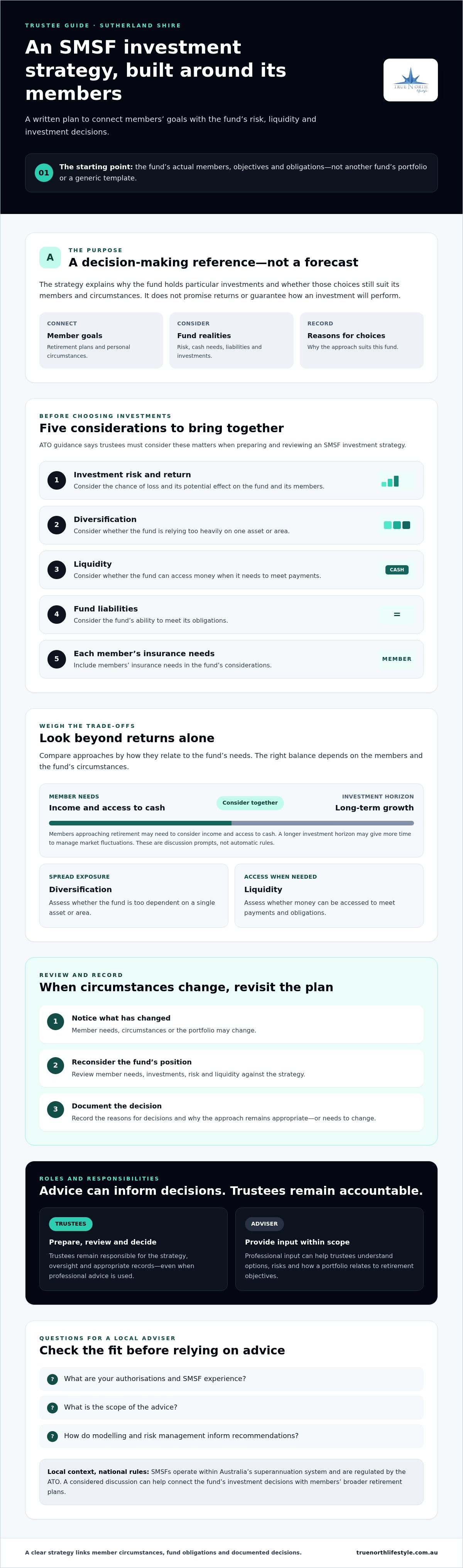
For trustees, a clear strategy is a reference point when markets move or members’ needs change. In practical terms, an SMSF investment strategy is a written plan that guides how a fund’s investments are chosen and managed in light of its members’ circumstances and objectives. This is a plain-English summary, not a direct quotation from the ATO. Its guidance requires SMSF trustees to have a written strategy and consider matters such as risk and return, diversification, liquidity, fund liabilities and members’ insurance needs.
The setting is local, but the rules are national. Sutherland Shire trustees operate within Australia’s superannuation system, where SMSFs are regulated by the ATO. For broader background, read this overview of Superannuation in Australia.
What is the purpose of an SMSF investment strategy?
A strategy connects the fund’s investments with the people they are intended to support. Members approaching retirement may need to consider access to cash and income, while members with a longer investment horizon may give different weight to long-term growth. These are prompts for discussion, not automatic rules. The appropriate approach depends on the fund’s circumstances.
Think of the document as a decision-making reference, not a forecast. It doesn’t promise returns or guarantee that an investment will perform as hoped. Instead, it helps trustees explain why the fund holds particular assets and whether those choices remain appropriate. Trustees should document their approach and revisit it as circumstances or the portfolio change. A generic template may not show how the strategy relates to the fund’s actual members and obligations.
Who is responsible for the strategy?
Trustees remain accountable. The ATO’s guidance makes clear that trustees are responsible for preparing and reviewing their fund’s investment strategy. Professional input can help trustees understand options, risks and how a portfolio relates to retirement objectives, but engaging an adviser doesn’t transfer trustees’ decision-making or oversight responsibilities.
That distinction matters. An adviser may provide analysis or recommendations within their authorised scope. Trustees still need to consider the advice, decide whether it suits the fund and keep appropriate records of their decisions. A strategy is not a product recommendation by itself. It sets out the fund’s investment approach, while each particular investment must be assessed against that approach and the members’ circumstances.
For an SMSF investment strategy Sutherland Shire trustees can use as a practical guide, start with the fund’s actual objectives and obligations, then document the reasons for its investment choices. This gives trustees a clearer basis for review and informed conversations with fellow trustees or a qualified adviser.
What an SMSF investment strategy should consider before choosing investments
Start with the members and the fund, not a list of popular investments. A sound strategy brings together the fund’s objectives, members’ circumstances, investment time horizons and capacity to manage risk. The Australian Taxation Office says trustees must consider investment risk and return, diversification, liquidity, the fund’s ability to meet its liabilities and each member’s insurance needs. Its SMSF investment rules provide current guidance to check when shaping and reviewing the strategy.
How do member goals and risk tolerance shape the strategy?
Members’ ages, retirement intentions, financial circumstances and time horizons help frame the discussion, but they don’t automatically dictate particular investments. Trustees should consider risk both as the chance of an investment loss and as the potential effect of that loss on the fund and its members. A longer time horizon may allow more time to manage market fluctuations, while an upcoming need to pay benefits may make access to funds more pressing. Each fund’s circumstances are different.
Why consider diversification and liquidity together?
Diversification spreads exposure across investments, so the fund isn’t relying too heavily on one asset or area. Liquidity is about whether the fund can access money when it needs to meet expenses, liabilities or benefit payments. These considerations can interact: a portfolio may have varied holdings, yet still be difficult to access quickly if much of its value is tied up in less liquid assets.
Liquidity matters because a fund needs accessible resources to meet expenses and benefit payments without being forced to sell investments at an unsuitable time.
Educational checklist, not personal financial advice:
- What are the fund’s objectives, and how do they relate to members’ retirement intentions?
- What kinds of investment losses could the fund face, and how might they affect members?
- Is the portfolio diversified, or does it depend heavily on one investment or asset type?
- Can the fund access enough money to meet expected expenses, liabilities and benefit payments?
- Have the investment time horizons and insurance needs of each member been considered?
Use these prompts to assess your own fund, not to reproduce another SMSF’s portfolio. An approach that appears suitable for one fund may not reflect another fund’s member needs, liabilities or access to cash. For trustees considering an SMSF investment strategy Sutherland Shire, retirement modelling can help explore how the fund’s approach relates to broader retirement objectives. You could discuss this through retirement modelling and superannuation review, while confirming that the adviser’s authorisations and advice scope suit the discussion you need.
SMSF investment strategy choices: compare the trade-offs, not just returns
Investment choices are easier to assess when trustees compare what each may contribute to the fund with the risks and practical limits involved. Shares, property, cash and other assets can differ in how their value moves, how readily they can be accessed and how closely they fit the fund’s objectives. No broad approach is automatically right for every SMSF.
The table is a discussion tool, not a ranking or recommendation. Actual risk, liquidity and asset exposure vary between investments, so review specific investment choices with an appropriately authorised professional before acting.
| Broad asset or approach | Potential role and trade-offs to assess |
|---|---|
| Shares and other growth-oriented assets | May contribute to long-term growth objectives, but values can fluctuate. Consider the fund’s time horizon, tolerance for losses and exposure across holdings. |
| Cash and cash-like assets | Can support ready access to funds and near-term needs, though holding a large share in cash may not align with every fund’s longer-term objectives. |
| Property | May provide a distinct asset exposure, but can concentrate fund assets and may be less straightforward to sell quickly. Assess ongoing costs, responsibilities and the fund’s ability to meet liabilities. |
| Other assets or blended approaches | May broaden exposure or serve a particular fund objective. Examine underlying holdings, liquidity, risks and how each investment behaves within the overall portfolio. |
How do growth, income and defensive assets differ?
These labels describe broad investment roles, not guaranteed outcomes. Growth-oriented assets generally involve greater exposure to changing market values. Income-focused assets aim to provide distributions or interest, which can vary. Defensive assets are often used to help manage fluctuations or preserve access to capital. An asset can have more than one characteristic, and its actual risk depends on the investment itself. Members’ time horizons matter because a fall in value may have a different impact if the fund needs to sell soon.
Is property a suitable SMSF investment?
It depends on the fund’s objectives, members’ circumstances, diversification and liquidity needs, as well as applicable rules. Ask whether a property holding would leave the fund heavily reliant on one asset, how expenses and benefit payments would be met, and what ongoing responsibilities ownership may involve. Check current ATO and legal requirements before making property-related decisions. Don’t assume another fund’s approach can be copied.
For an SMSF investment strategy Sutherland Shire trustees are reviewing, the useful question isn’t simply which asset has performed best. It’s how each option fits the fund’s purpose, risks, cash needs and members’ time horizons, considered together rather than in isolation.
How to review an SMSF investment strategy when circumstances change
A useful review starts with what has changed, then tests whether the fund’s existing approach still makes sense. A member moving closer to retirement, a new member joining the fund or a shift in expected cash-flow needs could all prompt trustees to take another look. These are practical examples, not an exhaustive list of events that require a review.
The ATO’s current guidance should inform trustees’ review process. Its SMSF investment guidance explains relevant investment strategy considerations. Check the latest official information when reviewing the fund, as requirements can change.
What changes can prompt a strategy review?
Look for changes that could affect the fund’s objectives, members’ needs or ability to meet expenses. If a member’s retirement timing changes, for instance, trustees may need to reconsider the fund’s investment time horizon and access to cash. A new member can bring different circumstances and needs into the discussion. A change in investments or expected cash flow may also be a reason to reassess the strategy.
Record the reasoning, not just the outcome. If trustees decide the current approach remains suitable, note why it still fits the members and the fund. If they decide it needs reconsideration, document the factors behind that conclusion and the steps agreed for further assessment.
What questions should trustees ask during a review?
Work through the fund’s position in sequence. A clear record makes the discussion easier to revisit and supports informed trustee oversight.
- Member circumstances: Have retirement intentions, membership or other relevant needs changed?
- Investments: Do the fund’s current holdings still align with its objectives and risk considerations?
- Liquidity: Can the fund meet foreseeable expenses, liabilities and benefit payments?
- Decision record: What did trustees consider, and why does the strategy remain appropriate or need further review?
If trustees can’t confidently assess the implications of a change, seek appropriately qualified advice and confirm the adviser’s authorisations and advice scope. Retirement modelling can help test how the fund’s approach relates to members’ broader retirement plans. For additional local context, read this guide to superannuation advice in the Sutherland Shire.
For support connecting fund decisions with longer-term retirement objectives, explore retirement modelling and superannuation review with True North Lifestyle. The firm provides strategic advice, not SMSF administration, audit, accounting or legal services.
Finding SMSF investment strategy advice in the Sutherland Shire
Local access can make it easier to have a considered conversation, but proximity alone doesn’t establish whether an adviser’s experience and advice scope suit your needs. For an SMSF investment strategy Sutherland Shire discussion, look for a clear explanation of how the advice will relate to your fund, its members and your broader retirement objectives. Trustees in the area, including those near Miranda 2228 and Sydney 2000, can also ask how the adviser’s local office arrangements suit the conversation they need.
What should you ask an SMSF adviser before engaging them?
Start by clarifying what the engagement includes and what sits outside it. Ask who is responsible for decisions and implementation, and whether other professionals may need to be involved. You can also ask how the adviser explains investment assumptions, possible risks and any relevant conflicts, so you understand the basis for recommendations before deciding what to do.
Check the adviser’s relevant qualifications and authorisations using appropriate official registers, such as the ASIC Financial Advisers Register. Confirm their experience with SMSF-related advice and whether their authorisations cover the specific advice you’re seeking. An adviser may provide strategic input, but trustees retain responsibility for the fund’s decisions and oversight.
How can retirement modelling support fund decisions?
Retirement modelling can help test how different assumptions relate to retirement timing and potential income needs. For example, trustees might explore how a change in expected retirement timing affects their thinking about the fund’s investment horizon or access to cash. A projection is a scenario to support discussion, not a prediction or guarantee of future outcomes.
Ask how investment analysis and risk management inform recommendations, and how those recommendations connect with the wider retirement plan. For further context, see this guide to retirement planning in Sydney and this article on wealth preservation strategies.
True North Lifestyle provides superannuation review and optimisation, retirement modelling and bespoke portfolio construction. It can be an advice option for discussing how superannuation and portfolio decisions relate to broader retirement goals. The business does not provide SMSF administration or auditing, so confirm that any other required fund services are covered by appropriately qualified professionals.
Local trustees looking to understand how their superannuation strategy fits longer-term plans can discuss their retirement and superannuation goals with True North Lifestyle.
Bring your SMSF strategy into focus
A considered SMSF investment strategy Sutherland Shire is more than a selection of assets. It connects the fund’s investment decisions with members’ retirement goals, balances trade-offs such as risk and access to funds, and gives trustees a reasoned basis for reviewing their approach as circumstances evolve.
The next step is to look at the wider plan. Retirement modelling and long-term projections can help explore how different assumptions relate to retirement timing and income needs. A superannuation review can bring the fund’s current position into that discussion, while bespoke portfolio construction supported by an in-house Investment Committee offers a structured perspective on investment choices. Projections are scenarios, not promises of future outcomes.
True North Lifestyle works with local clients on retirement modelling, superannuation review and portfolio advice. It doesn’t provide SMSF administration or auditing, so confirm the scope of any advice and arrange other fund services separately where needed.
If you’re ready to connect your superannuation decisions with your broader retirement plans, discuss your superannuation and retirement strategy with True North Lifestyle. The firm is based in Miranda, with local relevance for trustees around Miranda 2228 and Sydney 2000.
Frequently Asked Questions
What must an SMSF investment strategy include?
An SMSF investment strategy must be documented and consider the fund’s circumstances and members’ needs. The ATO says trustees must consider expected risk and return, diversification, liquidity, the fund’s ability to meet liabilities and each member’s insurance needs. The strategy should explain the thinking behind the fund’s investment approach, rather than simply list assets. Check current ATO guidance when preparing or updating the document, as requirements may change.
How often should an SMSF investment strategy be reviewed?
Trustees should review the strategy regularly and reconsider it when circumstances may affect whether it remains suitable. There isn’t a single review timetable that fits every fund. Changes such as a member approaching retirement, a new member joining or different cash-flow needs may prompt an earlier review. Record what trustees considered and why the strategy remains appropriate or needs to change. Check current ATO guidance for the latest requirements.
Can an SMSF invest in property?
Yes, an SMSF can invest in property, subject to applicable rules and the fund’s circumstances. Trustees should assess how the property fits the strategy, affects diversification and liquidity, and relates to ongoing fund obligations. Under changes effective 10 August 2026, SMSFs can’t enter new limited recourse borrowing arrangements to buy residential property, although existing arrangements are grandfathered. Outright residential purchases and borrowing for business real property are not affected by this change. Confirm current requirements before acting.
Is an SMSF investment strategy the same as a portfolio?
No. The strategy is the documented framework for investment decisions, while the portfolio is the fund’s actual mix of investments. The strategy considers matters such as the fund’s objectives, risk, liquidity and diversification. The portfolio shows how trustees have put their approach into practice. Reviewing both helps trustees assess whether current holdings still align with the documented plan. A portfolio change doesn’t automatically mean the strategy itself needs rewriting, but trustees should assess the fit.
Do SMSF trustees need to document investment decisions?
Trustees should keep the written investment strategy and records explaining decisions about the fund’s investments. Clear documentation helps show how choices relate to the fund’s objectives, members’ circumstances and relevant risks. For example, if trustees retain a concentrated holding after considering diversification, they should record their reasoning. Keep records in line with current ATO requirements, and seek accounting or legal assistance separately if the fund needs services outside an adviser’s scope.
Can a financial adviser help with an SMSF investment strategy?
Yes, an appropriately authorised financial adviser may help trustees assess investment options, risk and how fund decisions relate to retirement goals. Confirm the adviser’s authorisations, SMSF experience and advice scope before engaging them. Trustees remain responsible for the fund’s decisions. True North Lifestyle, based in Miranda, offers superannuation review and optimisation, retirement modelling and portfolio advice, but doesn’t provide SMSF administration or auditing. Ask whether the specific advice you need falls within the adviser’s scope.
What should Sutherland Shire trustees ask before changing SMSF investments?
Before making a change, ask whether it still supports the fund’s objectives and members’ needs, what risks or concentration it may introduce, and whether the fund can meet foreseeable expenses and benefit payments. Consider how the change fits the strategy and whether current rules allow it. Trustees discussing an SMSF investment strategy Sutherland Shire should also clarify who will provide advice, what falls outside its scope and what reasoning should be recorded before acting.


