

What if the most critical phase of your wealth journey isn't what happens after you pass away, but what occurs when you're still here yet unable to speak for yourself? Most Australians believe a valid Will is the final word in estate protection, but a Will only speaks once you're gone. It's natural to feel a sense of unease regarding who might step into your shoes if your health falters. You've worked hard to build a legacy; the thought of family conflict or the high costs of aged care in Sydney eroding your capital is a heavy burden to carry. Comprehensive financial planning for incapacity Australia requires a more robust, strategic architecture to ensure your lifestyle remains uninterrupted.
You deserve the quiet certainty that your autonomy will be preserved and your assets shielded from mismanagement. This guide provides a clear roadmap to secure your financial future, moving beyond simple legal documents to a sophisticated strategy for capital preservation. We'll explore how to model your long-term care needs, optimise your portfolio for longevity, and structure your affairs so that your family is guided by clarity rather than confusion. By establishing a structured path now, you can ensure your care is fully funded without depleting the inheritance you intend to leave behind.
Key Takeaways
- Understand why a standard Will is insufficient for life-based contingencies and how a dedicated strategy preserves your decision-making power while you're still here.
- Establish a secure framework for financial planning for incapacity Australia by identifying the critical role an Enduring Power of Attorney plays in protecting your wealth.
- Utilise technical retirement modelling to project the long-term costs of aged care, ensuring your lifestyle needs are met without depleting the capital intended for your legacy.
- Align your superannuation and Binding Death Benefit Nominations with your broader strategy to prevent these significant assets from becoming trapped or contested during a health crisis.
- Learn how to coordinate your financial architecture with legal triggers to ensure a seamless, dignified transition of control that respects your personal wishes.
Beyond the Will: Why Incapacity Planning is Critical in Australia
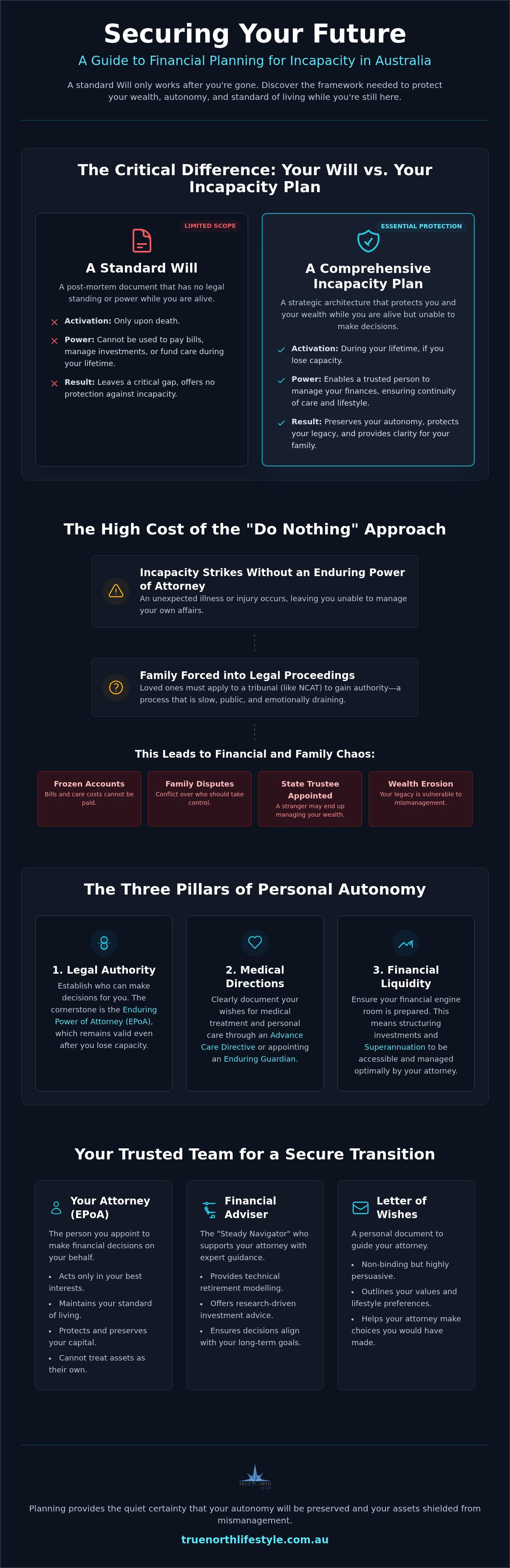
Control is fragile. Incapacity occurs when an illness or injury prevents you from making or communicating your own decisions. It's a state of being "in-between," where your life continues but your voice is silenced. While many believe their estate planning is complete once a Will is signed, this is a dangerous misconception. A Will is a post-mortem document; it has no legal standing while you are alive. Effective financial planning for incapacity Australia ensures that your lifestyle is protected and your bills are paid while you are still here to benefit from your hard-earned wealth.
Order replaces chaos. For families in Sydney, where the cost of living and aged care is significantly higher than the national average, the absence of a plan creates immediate chaos. A strategic architecture replaces this anxiety with order. It ensures that your partner or children aren't left guessing about your preferences or struggling to access the funds required for your care. By moving beyond the Will, you're not just planning for an end; you're planning for a continuation of your dignity and your standard of living.
The Three Pillars of Personal Autonomy
Planning for the future rests on three distinct foundations: legal authority, medical directions, and financial liquidity. While lawyers focus on the documents, financial planning for incapacity Australia focuses on the engine room of your life: the cash flow. It involves ensuring that your investment structures and Superannuation in Australia remain accessible and optimised even if you aren't at the helm. Financial Autonomy is the legal and structural right to have your wealth managed according to your pre-defined values and lifestyle requirements when you can no longer personally oversee them.
The Risks of the "Do Nothing" Approach
Silence is not a strategy. If you lose capacity without an Enduring Power of Attorney, your family may be forced to apply to the NSW Civil and Administrative Tribunal (NCAT) to manage your affairs. This process is often slow, public, and emotionally draining for loved ones. It can lead to bitter disputes over who is best suited to manage your money, potentially resulting in the appointment of a state-based trustee rather than a trusted family member. Such mismanagement can derail long-term wealth preservation strategies, leaving your portfolio vulnerable to market volatility or inappropriate drawdowns during a crisis.
The Legal and Financial Framework: Powers of Attorney and Beyond
Control requires structure. An Enduring Power of Attorney (EPoA) is the cornerstone of financial planning for incapacity Australia. Unlike a General Power of Attorney, which ceases to operate the moment you lose mental capacity, an Enduring Power remains valid through your most vulnerable times. This distinction is vital. Without an EPoA, your financial accounts may be frozen at the exact moment funds are required for medical intervention or household maintenance, leaving your family in a state of administrative paralysis.
Choosing an attorney is a decision of profound trust. It's not just about finding someone honest; it's about finding someone who understands your bespoke investment philosophy and lifestyle values. A financial adviser acts as the "Steady Navigator" in this relationship, providing the technical modelling and research-driven evidence that allows an attorney to make confident, informed decisions. This collaborative framework ensures that planning for unexpected illness remains a proactive exercise rather than a reactive crisis.
The Role of the Attorney in Wealth Management
An attorney's power is broad but not absolute. They are legally required to act in your best interests, which includes maintaining your existing standard of living and protecting your capital. They cannot treat your assets as their own or make speculative gambles with your inheritance. To avoid ambiguity, we recommend drafting a "Letter of Wishes." This document provides non-binding but highly persuasive guidance on how you want your money spent. We work directly with your attorney to ensure they have the liquidity needed for your care while maintaining the long-term integrity of your portfolio.
Bespoke Portfolios and Incapacity
Managing wealth for someone who cannot provide feedback requires a shift in strategy. In these circumstances, bespoke investment advice Sydney focuses on capital preservation and low-volatility outcomes. We employ an institutional-grade oversight model that doesn't rely on the owner's constant monitoring. This committee-led approach ensures that trust assets are managed with the same rigour as a large-scale pension fund, protecting your legacy from emotional or impulsive decision-making during volatile market cycles. If you are seeking to fortify your financial architecture, our team can help you design a portfolio that remains resilient regardless of who is at the helm.
Funding Care and Managing Cash Flow During Incapacity
Costs are substantial. In Sydney, the financial reality of aged care is stark, with the average Refundable Accommodation Deposit (RAD) reaching A$723,111 in 2026. This represents a significant capital requirement that can destabilise even a well-constructed portfolio if it's not planned for well in advance. Beyond the initial deposit, residents face a Basic Daily Fee of A$66.80, alongside means-tested care fees that can reach an annual cap of A$33,575. Effective financial planning for incapacity Australia requires a proactive cash flow strategy that accounts for these specific, high-cost environments without forcing a fire sale of family assets.
Strategic choices define your legacy. Decision-making regarding the family home is often the most emotional aspect of this phase. Choosing whether to sell, rent, or keep the residence involves complex Centrelink asset test considerations and tax implications. For many, the home is a primary wealth vehicle, and its treatment can significantly impact Age Pension eligibility and care subsidies. We act as the strategic architect in these moments, providing the logical grounding needed to make a choice that preserves both your dignity and your family's future financial security.
Retirement Modelling for Longevity and Care
Projections provide clarity. Sophisticated retirement planning Sydney must explicitly model "Stage 3" of life, where healthcare costs often spike while discretionary spending on travel or leisure declines. We stress-test your portfolio against scenarios involving 10 or more years of high-level care, ensuring you have sufficient liquidity to meet immediate bills. This modelling moves you from a state of anxiety toward a structured path where your lifestyle is funded by design, not by chance.
Tax Minimisation During the Care Phase
Efficiency preserves capital. Liquidating assets to fund a RAD or ongoing care fees can trigger significant Capital Gains Tax (CGT) liabilities if the timing isn't optimised. By integrating tax planning for retirement Australia, we can explore strategies like the "Re-contribution Strategy" to manage the tax components of your superannuation. This process can reduce the tax burden on your estate, allowing for a more efficient wealth transfer to your beneficiaries while ensuring your own care needs are met with the highest level of professional oversight.
Protecting Your Superannuation and Investment Portfolios
Asset protection matters. Superannuation is more than a retirement fund; it's a vital insurance policy during health crises. In the context of financial planning for incapacity Australia, your super provides a critical liquidity buffer. Accessing these funds under "Permanent Incapacity" requires meeting specific "condition of release" criteria. This typically involves medical evidence proving you're unlikely to engage in gainful employment for which you are reasonably qualified. It's a technical process that requires careful coordination between your medical practitioners and your financial architect.
Nominations require precision. A Binding Death Benefit Nomination (BDBN) is often viewed through the lens of estate distribution, yet its validity is equally crucial during incapacity. If a nomination lapses while you lack the capacity to renew it, the trustee of the fund gains discretion over your life's savings. This can lead to your wealth being distributed in ways you never intended, potentially sparking avoidable family conflict. We perform an incapacity "audit" as part of our strategic oversight, ensuring all nominations are non-lapsing or regularly updated to prevent administrative overreach during a transition of power.
Superannuation and Disability Access
Total and Permanent Disablement (TPD) definitions vary significantly between retail, industry, and self-managed funds. Understanding whether your policy covers "any" or "own" occupation is a nuance that determines your financial survival. For those under age 60, disability super benefits are subject to complex tax calculations involving a "tax-free" and "taxable" component. Professional superannuation advice Sutherland Shire ensures these tax implications are modelled well before a claim is ever lodged, protecting your capital from unnecessary erosion.
SMSF Succession Planning
Complexity creates risk. If an individual trustee of a Self-Managed Super Fund (SMSF) loses capacity, the fund may become non-compliant if a replacement director isn't appointed immediately. This can trigger significant penalties from the ATO. Utilising a Corporate Trustee is a superior structural choice; it allows the company to continue operating even if one director is sidelined. As your "Steady Navigator," we facilitate the transition of control to your Enduring Power of Attorney, ensuring that investment strategies remain aligned with your research-driven goals. This structural foresight prevents the fund from being frozen during a time when liquidity is most needed.
To ensure your superannuation architecture is resilient enough to withstand a health crisis, you can book a comprehensive superannuation review with our strategic team today.
The True North Approach: A Stabilising Strategy for Uncertain Times
Complexity requires coordination. At True North Lifestyle, we act as the strategic architect of your future, ensuring that every financial lever is aligned with your personal values. While legal professionals provide the necessary documentation, our role is to ensure the capital is structured to meet those legal triggers. This holistic approach to financial planning for incapacity Australia replaces the inherent anxiety of the unknown with a disciplined, research-driven framework. We provide the logic and the modelling so that you can step into a role of confident oversight, knowing your affairs are being managed by a steady hand.
Regularity builds resilience. A strategy is only as effective as its most recent update, especially given the frequent shifts in Australian aged care legislation and superannuation thresholds. We conduct regular reviews at our offices in Miranda and the Sydney CBD to ensure your plan remains current. These sessions allow us to adjust your projections based on real-world market performance and changes in your personal circumstances. By integrating these contingencies into your broader wealth transfer strategies Australia, we ensure that your legacy isn't just protected upon death, but fortified during your lifetime.
Coordinating the Professional Circle
Expertise works best in tandem. We collaborate closely with specialist estate lawyers to verify that the "money matches the law," ensuring your investment structures don't inadvertently conflict with your medical directives or Power of Attorney. A critical component of this process is the family meeting. We facilitate these discussions to explain the strategy to your loved ones, reducing the potential for future friction and ensuring everyone understands the roadmap. We also ensure that all critical financial data is organised and accessible, allowing your appointed attorney to act swiftly and decisively when the need arises.
The Strategy Session
Clarity begins with a conversation. During an initial incapacity planning consultation, we move beyond surface-level discussions to perform deep retirement modelling and stress-testing of your current portfolio. You can expect a no-nonsense evaluation of your asset protection levels and a clear breakdown of how your cash flow will be managed during a health crisis. This is a bespoke service designed for those who value proven outcomes and institutional-grade rigour. We invite you to gain the quiet certainty you deserve by visiting us in our Miranda or Sydney offices to begin constructing your resilient financial architecture.
Securing Your Financial Autonomy Today
Your legacy deserves a steady hand. True North Lifestyle acts as the strategic architect, ensuring your wealth remains a tool for your comfort even when you can't personally oversee its management. We've explored how moving beyond a simple Will to establish an Enduring Power of Attorney and a robust investment framework prevents family conflict while protecting your capital. Comprehensive financial planning for incapacity Australia is about replacing the anxiety of "what if" with a research-driven roadmap that secures your financial autonomy.
Our specialist retirement and care modelling provides the logical grounding needed to protect your lifestyle without depleting your family's inheritance. With a research-driven wealth preservation approach, we help you navigate the technical complexities of superannuation audits and SMSF succession. Whether you visit our local advisers in Miranda or our Sydney CBD office, you'll receive the bespoke oversight required for long-term stability.
Take the first step toward quiet certainty. Book a Strategic Consultation for Incapacity Planning to fortify your financial architecture today. You've worked hard to build your wealth; now, let's ensure it works just as hard to protect you.
Frequently Asked Questions
What is the difference between a Will and an Enduring Power of Attorney?
A Will only takes effect upon your death, whereas an Enduring Power of Attorney is designed to operate while you are still alive but lack the capacity to manage your own affairs. It provides your chosen attorney with the legal authority to pay bills, manage investments, and handle property transactions on your behalf. Without this document in place, your financial accounts could be frozen, leaving your family unable to access funds for your care.
How much does aged care actually cost for a self-funded retiree in Sydney?
Residential aged care costs in Sydney are among the highest in Australia, with the average Refundable Accommodation Deposit reaching A$723,111 in 2026. Beyond this capital outlay, you will encounter a Basic Daily Fee of A$66.80 and potentially a means-tested care fee, which is capped at A$33,575 annually. Self-funded retirees must use precise retirement modelling to ensure these ongoing expenses don't prematurely deplete the capital intended for their family legacy.
Can I access my superannuation early if I become incapacitated?
Yes, you can access your superannuation if you meet the "Permanent Incapacity" condition of release. This typically requires two medical practitioners to certify that you are unlikely to ever engage in gainful employment for which you are reasonably qualified by education, training, or experience. The tax treatment of these disability benefits varies, particularly for those under age 60, making a strategic superannuation review essential to minimise the impact of any lump-sum withdrawals.
Who should I choose as my financial attorney in Australia?
Your financial attorney should be someone who possesses both unquestionable integrity and a clear understanding of your personal investment philosophy. While many people choose a spouse or adult child, it is vital that they are capable of working with professional advisers to execute complex financial planning for incapacity Australia. They must be comfortable overseeing bespoke portfolios and making logical, research-driven decisions during periods of high emotional stress to ensure your wealth remains protected.
What happens to my SMSF if I can no longer manage it?
If you are an individual trustee of an SMSF and lose capacity, the fund may become non-compliant unless a successor is appointed immediately. This is why we recommend a Corporate Trustee structure; it allows your legal personal representative to step in as a director of the company without disrupting the fund's operations. Failure to plan for this transition can lead to the ATO imposing significant penalties or freezing the fund's assets at a critical time.
Is incapacity planning only for the ultra-wealthy?
No, incapacity planning is a fundamental pillar of wealth preservation for any Australian who owns assets or has specific lifestyle expectations. Whether you own a family home in Miranda or a diverse investment portfolio in the Sydney CBD, the lack of a plan can lead to administrative chaos and state-appointed management. Every individual needs a strategy to ensure their bills are paid and their medical preferences are respected, regardless of the total size of their estate.
How often should I review my incapacity and estate plan?
We recommend reviewing your incapacity strategy every three to five years, or whenever a significant life event occurs, such as a change in health, family structure, or financial position. Legislative shifts in Australian aged care or superannuation rules can also render an older plan less effective. Regular consultations at our Sydney offices ensure your retirement modelling remains accurate and your portfolio is still optimised for the current economic environment and regulatory landscape.
Can an Enduring Power of Attorney be contested in NSW?
Yes, an Enduring Power of Attorney can be challenged through the NSW Civil and Administrative Tribunal if there are concerns about the document's validity or the attorney's conduct. Common grounds for contesting include claims that the principal lacked mental capacity when signing or that the attorney is not acting in the principal's best interests. Maintaining clear documentation and a research-driven financial strategy helps provide evidence of your original intentions, reducing the likelihood of successful legal disputes.


