

The room price is only part of the decision. Aged care accommodation costs in Miranda can be paid as a refundable lump sum, non-refundable daily payments, or a combination. Under arrangements introduced on 1 November 2025, accommodation costs may be paid as an accommodation payment, an accommodation contribution, or both. Residents generally have 28 days after moving in to choose how to pay. Comparing aged care accommodation costs in Miranda means looking beyond the room price to understand how each payment option fits the wider financial picture.
It’s understandable if aged care accommodation costs in Miranda feel difficult to compare, especially when accommodation is only one part of the total fees. This guide explains payment options, how other aged care fees and the means-tested care fee work, and how income and assets can affect what you pay. You’ll also learn when financial advice can help you weigh the impact of a payment choice on your retirement plans, superannuation and longer-term financial security. A clear view of the costs can help families approach the decision with greater confidence.
Key Takeaways
- Compare a refundable lump sum with daily payments, then consider how each option may affect your cash flow and estate plans.
- Separate the basic daily fee, accommodation costs and income- and asset-tested contributions to understand what makes up the total.
- Your means assessment and the fee arrangements that apply to your circumstances can shape what you pay, so understand these before making financial decisions.
- Room prices must be agreed in writing before entering care; knowing the Government’s pricing rules can help you assess the accommodation terms.
What are my accommodation payment options?
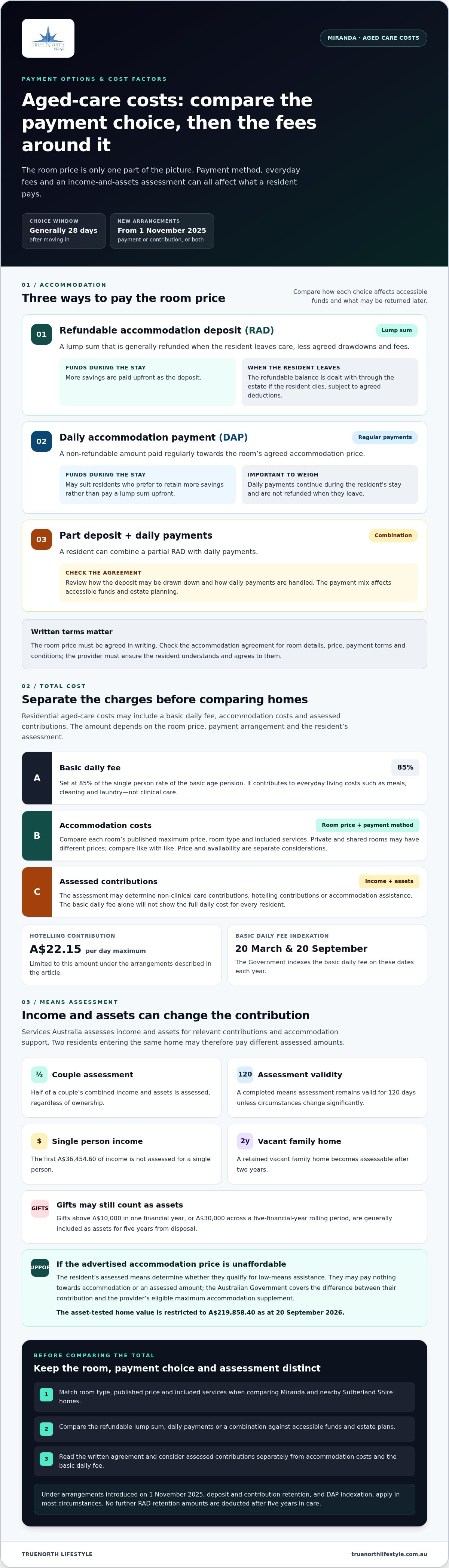
Residents can pay accommodation costs through a lump sum, daily payments or a combination. Since 1 November 2025, arrangements may involve an accommodation payment, an accommodation contribution or both.
Daily accommodation payment methods
A daily accommodation payment (DAP) is a non-refundable amount paid regularly towards a room’s agreed accommodation price. It may suit residents who prefer to retain more savings rather than pay a lump sum upfront. Consider how the payment method affects accessible funds, since daily payments continue during the resident’s stay.
Refundable deposits and daily payments
A refundable accommodation deposit (RAD) is a lump sum that is generally refunded when a resident leaves care, less agreed drawdowns and fees. By contrast, a DAP isn’t refunded when the resident leaves. A resident may also combine a partial RAD with daily payments. If the resident dies, the refundable balance is dealt with through their estate, subject to agreed deductions. The choice affects accessible funds and estate planning.
When comparing aged care homes in Miranda, including Scarborough and Mason, review each room’s published maximum price, services and current availability. Price and availability are separate considerations, so read the written accommodation terms alongside details of the room and services offered.
Residents generally have 28 days after moving in to choose how to pay accommodation costs. The accommodation agreement sets out the room details, price and conditions, and the provider must ensure the resident understands and agrees to its terms. Services Australia assesses income and assets for relevant accommodation contributions. For a family comparing options, the agreement and payment mix clarify what is payable and when.
Under arrangements introduced on 1 November 2025, refundable deposit and contribution retention, and DAP indexation, apply in most circumstances. No further RAD retention amounts are deducted after five years in care. Read the agreement’s payment terms carefully, especially where a deposit is partly drawn down or combined with daily payments.
How much does aged care actually cost?
Residential aged care costs can include a basic daily fee, accommodation costs and assessed contributions. For Miranda families, the amount depends on the room price, payment arrangement and resident’s assessment.
Basic daily care fees
The basic daily fee is the standard contribution towards everyday living costs in residential aged care. It helps cover services such as meals, cleaning and laundry, rather than clinical care. The fee is set at 85% of the single person rate of the basic age pension. This distinction helps separate the basic daily aged care fee from accommodation charges.
Comparing costs across the Sutherland Shire
To compare Miranda with nearby Sutherland Shire suburbs, match room type, published room price and included services. A private room and a shared room may have different accommodation prices, so compare like with like. The suburb alone doesn’t determine the total: room choice, payment method and assessed contributions also affect the amount. Compare accommodation prices with each home’s service details to understand the differences.
Current daily and means-tested fees
The hotelling contribution is limited to A$22.15 per day under those arrangements. Income and assets can also determine a non-clinical care contribution. These are separate charges, so adding the basic fee alone won’t show the full daily cost for every resident.
The Government indexes the basic daily fee on 20 March and 20 September each year. Means-tested contributions depend on assessed circumstances, while accommodation depends on the room price and payment choice. Compare those components separately to build a clearer estimate for a resident entering care in Miranda.
Means-tested care fee
Income and assets help determine some residential aged care contributions and accommodation assistance. The applicable assessment also depends on the resident’s fee arrangements.
Means-tested assets and income
A means assessment considers a resident’s income and assets to establish contributions and accommodation support. For a couple, half of their combined income and assets is assessed, regardless of ownership. A retained vacant family home becomes assessable after two years. Gifts above A$10,000 in one financial year, or A$30,000 across a five-financial-year rolling period, are generally included as assets for five years from disposal.
Means assessments and government support
Services Australia assesses income and assets and advises whether a resident must pay a Non-Clinical Care Contribution or Hotelling Supplement. A completed means assessment remains valid for 120 days unless circumstances change significantly. For a single person, the first A$36,454.60 of income isn’t assessed. These rules help explain why two residents entering the same Miranda home may have different contributions.
If a resident can’t afford the advertised accommodation price, their assessed means determine whether they qualify for low-means assistance. They may pay nothing towards accommodation or contribute an assessed amount; the Australian Government covers the difference between their contribution and the provider’s eligible maximum accommodation supplement. The asset-tested home value is restricted to A$219,858.40 as at 20 September 2026.
For residents entering under arrangements from 1 November 2025, the Non-Clinical Care Contribution is means-tested against income and assets. It stops after four years of cumulative contributions or when the applicable lifetime cap is reached, whichever comes first. The Hotelling Contribution has no annual or lifetime cap, effective 1 July 2026. These contributions are separate from the basic daily fee and accommodation payment.
Residents protected by the 1 July 2014 fee arrangements may instead pay a Means Tested Care Fee, subject to annual and lifetime caps. Under those arrangements, the fee can reach A$380.46 per day, with an annual cap of A$37,055.98 and lifetime cap of A$88,934.57. The fee arrangement that applies affects how income, assets and government assistance shape total costs.
What are the Australian Government rules for setting aged care accommodation prices?
Government rules set disclosure and approval requirements, while each home publishes its own room prices. For Miranda residents, written prices and applicable fee arrangements provide a basis for comparing accommodation costs.
Before entering care, residents must agree to a room price in writing with their provider. Providers must publish the maximum price for each room they offer. If a price exceeds A$184.11 per day, or an equivalent refundable accommodation deposit of A$789,686, it needs approval from the Aged Care Pricing Commissioner. These thresholds are currently stated rates, so compare the room’s published price with the written agreement.
The arrangements applying to a resident depend on their entry circumstances. People entering residential aged care on or after 1 November 2025 generally fall under the arrangements introduced on that date. Some people entering earlier may remain under the 1 July 2014 arrangements. People receiving a Home Care Package, or approved and waiting for one on or before 12 September 2024, are protected by the no worse off principle and pay under the 1 July 2014 fee arrangements if they later enter residential care.
Rules also shape payment limits. A resident’s maximum refundable accommodation deposit must leave them with at least A$66,500 in assets. The Government reviews the Maximum Permissible Interest Rate quarterly, and daily accommodation payments are adjusted every six months in line with the Consumer Price Index. Providers index these payments on 20 March and 20 September each year.
For eligible residents receiving government assistance with accommodation costs, indexation doesn’t apply to daily accommodation contributions. For new or significantly refurbished facilities covered by the rule, the maximum accommodation supplement is A$73.73 per day from 20 September 2026. This supplement helps define the Government’s contribution, not the room’s advertised price. Consider how your payment choice fits your wider retirement finances by reviewing your aged care financial position.
True North Lifestyle: Retirement modelling & long-term projections
True North Lifestyle helps you model how aged care payments may affect retirement income, savings and longer-term plans. Retirement modelling and long-term projections can compare the impact of a lump-sum accommodation payment with ongoing daily payments, alongside other expected costs.
This can be useful when weighing payment options, reviewing superannuation or considering how to preserve assets over time. A tailored assessment can put these decisions in the context of your broader financial position, including tax-minimisation strategies and bespoke portfolio construction where relevant.
To consider how aged care costs fit your retirement plans, contact True North Lifestyle or visit truenorthlifestyle.com.au.
Make your next decision with clarity
Planning for aged care accommodation costs in Miranda is also an opportunity to consider the life you want your finances to support after the move. Which assets need to remain accessible? How might ongoing care expenses fit alongside income, family commitments and future plans? These questions can help place an accommodation decision within a considered retirement strategy.
True North Lifestyle supports this broader view through retirement modelling and long-term projections, tax-minimisation strategies, and superannuation review and optimisation. These services help you examine how financial choices interact, rather than treating accommodation funding in isolation. The right focus depends on your goals, circumstances and existing arrangements, so thoughtful planning is more useful than rushing towards a single payment approach.
If you’re ready to explore how these decisions fit your retirement plans, contact True North Lifestyle. A clearer financial picture can help you move forward with confidence and keep attention on what matters most.
Frequently Asked Questions
How do these fees work?
Residential aged care charges cover different things, so identify each component separately rather than treating the total as a single fee. Accommodation pays for the room, while daily fees and assessed contributions relate to everyday living or non-clinical care. The payment option affects whether accommodation is paid upfront or over time. In Miranda, comparing written fee details helps families distinguish fixed costs from those that depend on an assessment.
How does a means assessment work?
Services Australia uses a resident’s income and assets to assess whether income- and asset-tested contributions apply. A completed assessment is generally valid for 120 days unless circumstances change significantly. For a couple, half of their combined income and assets is assessed, regardless of which partner owns an asset or receives income. This means a partner’s finances can affect the assessment, even if only one person enters residential care.
How is my means status determined, and can it change?
Your means status is determined from your financial circumstances when you enter the aged care home. A resident’s low-means status is fixed at entry and doesn’t change if their financial position later improves. That timing matters: a later change in savings or income doesn’t automatically change the status already set. Keep assessment information accurate, particularly if circumstances change significantly during the assessment’s validity period.
What does the government contribute?
Under the fee arrangements introduced on 1 November 2025, the Australian Government fully funds residents’ clinical care costs. For eligible residents receiving accommodation assistance, the Government also covers the difference between the resident’s contribution and the provider’s eligible maximum accommodation supplement. These supports are distinct: clinical care funding doesn’t remove accommodation or other applicable fees. The resident’s assessment and applicable arrangements determine which assistance applies.
What fees might I have to pay?
Depending on your entry arrangements and assessment, charges may include a basic daily fee, accommodation payment or contribution, and income- or asset-tested contributions. A resident may also choose higher everyday living services, which can involve an additional fee. From 1 November 2025, residents have a 28-day cooling-off period to cancel or vary those services without a cancellation fee. Read the agreement to distinguish optional services from assessed charges.
What if I can’t afford it?
Low-means residents may pay nothing towards accommodation or contribute an assessed amount, with the Australian Government covering the eligible difference. The Government pays full accommodation costs for residents with income below A$36,454.60 and assets below A$66,500.00. If you decline a means assessment, you may be asked to pay the full room price and applicable hotelling and non-clinical care contributions. Assessment can therefore clarify what assistance applies.


