
A pristine trust deed tucked away in a cabinet cannot safeguard your legacy if your underlying strategy is flying blind. Across the Shire, successful business owners and high-net-worth families often establish discretionary trusts expecting an impenetrable fortress. Yet, mounting ATO scrutiny and fragmented professional advice leave many wondering whether their personal wealth is genuinely protected. Securing strategic family trust financial advice Sutherland Shire families can trust bridges this vital gap, turning static paperwork into an active wealth preservation engine.
Structure demands direction. You want the reassurance that your hard-earned wealth remains shielded from commercial liabilities, without running afoul of complex distribution rules or leaving estate planning disconnected from superannuation. In this 2026 strategic guide, discover how a tailored family discretionary trust structure protects Shire family wealth, optimises tax, and secures seamless intergenerational succession. We preview the disciplined governance, portfolio modelling, and coordinated Miranda advisory approach required to anchor your family's financial security for decades to come.
Key Takeaways
- Clarity over control: Discover how delineating the roles of trustee, appointor, and beneficiary establishes genuine asset protection against commercial litigation.
- Coordinated local strategy: Learn how engaging tailored family trust financial advice Sutherland Shire professionals rely on unifies tax minimisation, investment modelling, and estate planning into a single roadmap.
- Active portfolio governance: Understand why preserving multi-generational wealth requires research-driven portfolio construction rather than letting trust capital sit idle.
- ATO compliance confidence: Unpack the mechanics of Section 100A and annual distribution resolutions to safeguard your family structure from aggressive regulatory scrutiny.
- Seamless wealth succession: Master the integration of discretionary trusts with SMSFs and successor appointor provisions to transfer control smoothly without probate delays.
Understanding Family Trusts: Strategic Asset Protection and Flexibility
Separation builds resilience. Under Australian law, a trust isn't a separate legal person like a company; it is a binding relationship where a trustee holds legal ownership of property for the benefit of chosen beneficiaries. Unlike unit trusts with fixed entitlements or standard company setups that pay non-discretionary dividends, an Australian discretionary trust gives trustees absolute annual leeway over which family members receive distributions of net income and capital.
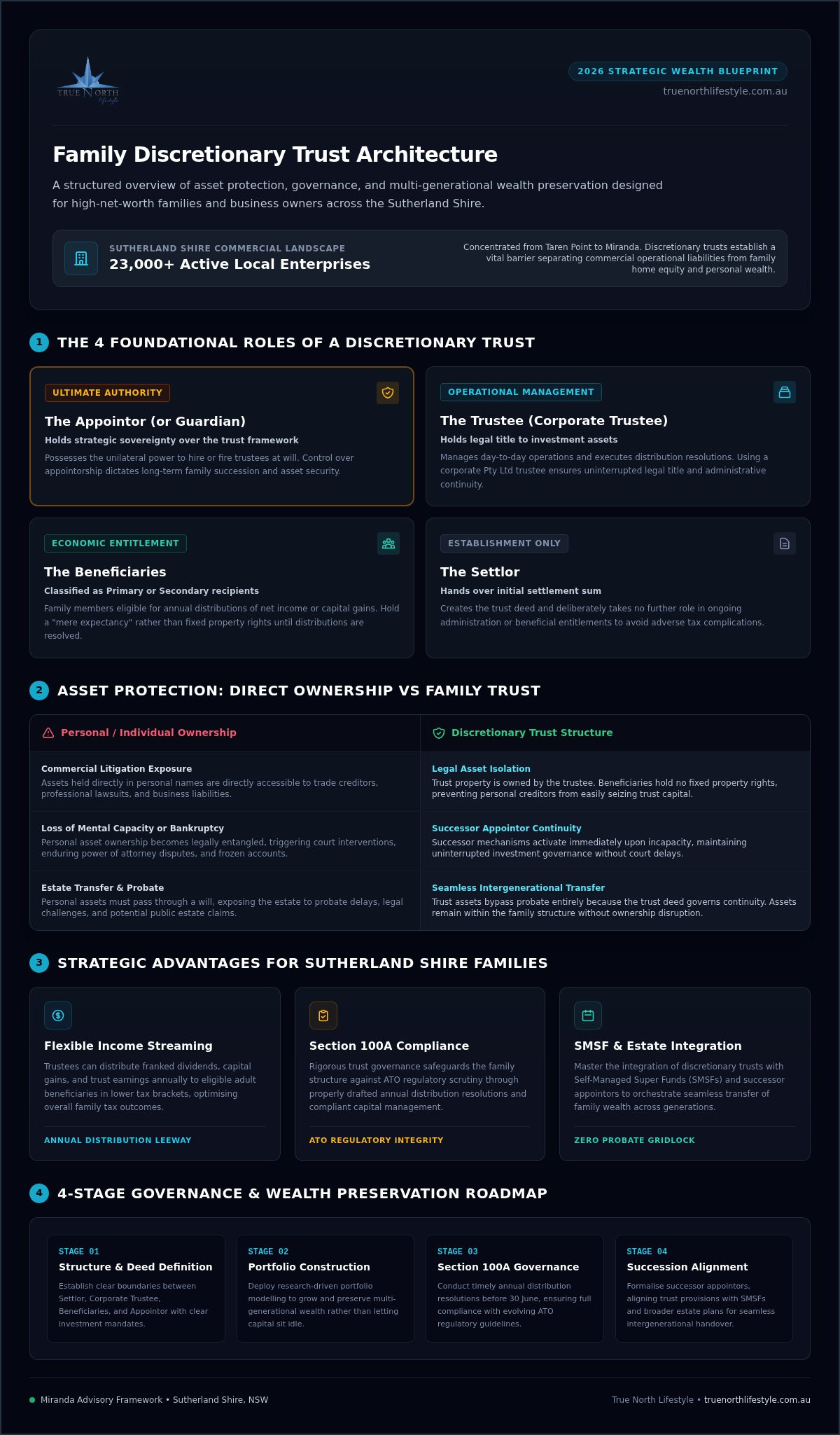
Securing strategic family trust financial advice Sutherland Shire families rely on ensures these formal boundaries are established correctly from the outset. Four foundational roles govern this relationship:
- The Settlor: Establishes the trust by handing over the initial settlement sum, deliberately taking no further part in administration to avoid tax complications.
- The Trustee: Holds legal title to the trust's investment assets and manages day-to-day operations according to the governing deed.
- The Beneficiaries: Family members eligible to receive annual distributions of income or capital gains, classified as either primary or broad secondary beneficiaries.
- The Appointor (or Guardian): Holds ultimate administrative authority, possessing the unilateral power to hire or fire trustees at will.
The Core Architecture of an Australian Discretionary Trust
Real power rests with the appointor. While trustees manage assets, the appointor exercises strategic sovereignty over the entire framework. Structuring your trust with a corporate trustee, rather than individual trustees, creates unbroken administrative continuity. When an individual trustee faces sudden health decline or bankruptcy, asset ownership becomes entangled. In contrast, a proprietary limited company maintains uninterrupted legal title, protecting family wealth while the underlying trust deed defines clear investment mandates and distribution powers.
Why Family Trusts Outperform Individual Ownership for Wealthy Families
Wealth creates visibility. Holding investment portfolios or commercial property personally exposes those assets to professional lawsuits, trade creditor claims, and sudden operational liabilities. A family discretionary trust isolates wealth legally; because discretionary beneficiaries possess a mere expectancy rather than fixed ownership rights, personal creditors cannot easily seize trust assets to settle individual debts.
This flexibility also offers stability during unforeseen family events. If a patriarch or matriarch loses mental capacity, a well-orchestrated structure continues to run smoothly. Through ongoing family trust financial advice Sutherland Shire wealth owners can ensure succession mechanisms, such as successor appointor nominations, step in immediately. This orderly transition prevents court interventions, sidesteps probate gridlock, and shields the family balance sheet across changing generations.
Key Advantages of Family Trust Financial Advice for Sutherland Shire Residents
Context dictates design. Across the Sutherland Shire, wealth is rarely abstract; it is concentrated in thriving family enterprises, commercial property, and substantial residential real estate equity. With over 23,000 local businesses active across precincts from Taren Point to Miranda, local founders often face an uneven risk landscape. When substantial home equity sits alongside commercial enterprise, the barrier between business exposure and family security can easily blur. Tailored family trust financial advice Sutherland Shire families implement creates a structural buffer, aligning daily operational risks with long-term asset security.
According to the Australian Taxation Office guide to trusts, the fundamental utility of a trust involves managing capital and income flows responsibly. When paired with deliberate financial planning, discretionary trusts offer three clear wealth-building advantages for Shire families:
- Flexible Income Streaming: Trustees can allocate franked dividends and trust earnings annually to adult beneficiaries in lower personal tax thresholds, reducing the overall family tax burden.
- Preserved CGT Concessions: The 50% Capital Gains Tax discount flows straight through to eligible individual beneficiaries upon the sale of trust-held investment assets.
- Independent Wealth Succession: Trust assets do not form part of an individual's personal estate, ensuring capital passes according to trust rules rather than stalling in probate.
Shielding Personal Wealth from Commercial and Professional Risk
Liabilities should never spill into family living rooms. For Shire directors and trade professionals, ring-fencing non-business assets inside an investment trust ensures that sudden creditor claims, tenant disputes, or corporate insolvencies do not jeopardise personal property. Establishing this separation well before signing commercial contracts or taking equity positions secures that your private wealth stays quarantined from unforeseen litigation.
Flexible Income Streaming and Tax Optimisation
Tax efficiency requires proactive modelling. Rather than pushing passive investment returns into a working spouse's top marginal tax rate, trustees can distribute income across adult children pursuing university studies or channel surplus yields into a corporate beneficiary (bucket company) to cap intermediate tax rates. Miranda-based strategic advisory teams, like True North Lifestyle, coordinate closely with your family tax accountant to model distribution outcomes alongside broader tax planning for retirement Australia frameworks. If your family balance sheet needs this level of integrated oversight, exploring tailored wealth preservation strategies ensures all moving parts work in unison.
Intergenerational Continuity and Estate Planning Synergies
Wills invite litigation; structured trusts avoid it. In New South Wales, personal estates face frequent Family Provision claims under the Succession Act. Because trust property is legally owned by the trustee, it sidesteps personal probate entirely. Linking your trust deed with comprehensive wealth transfer strategies Australia guarantees that multi-generational family capital remains intact, protected, and guided by clear successor appointor directives.
Managing and Growing Wealth Inside a Family Trust: Investment Strategies
Capital requires momentum. While establishing a discretionary trust isolates family assets, an empty or passive entity cannot combat inflation. True multi-generational wealth preservation demands an active, research-driven investment framework designed to compound capital steadily across economic cycles. Seeking comprehensive family trust financial advice Sutherland Shire families rely on turns a static legal structure into a resilient, income-generating balance sheet.
Effective trust portfolio construction differs fundamentally from managing personal savings. Because discretionary trusts cannot retain taxable earnings without penalty, your investment engine must generate the right balance of liquidity, franked yields, and discounted capital gains. Grounded wealth governance focuses on three key execution areas:
- Direct Imputation Flow-Through: Franking credits attached to Australian dividend shares flow directly through the trust to named beneficiaries, generating immediate tax offsets or cash refunds.
- Tax-Efficient CGT Distribution: Trustees can selectively stream net capital gains to individual beneficiaries who qualify for the 50% discount, preserving capital after taxes.
- Mandatory Liquidity Timing: Aligning investment turnover and cash reserves ensures the trust holds physical cash to settle mandatory 30 June distribution resolutions without forced asset sales.
Constructing Resilient Portfolios via an In-House Investment Committee
Precision beats speculation. Managing significant family capital requires disciplined asset allocation overseen by a dedicated Investment Committee. Portfolios are constructed using high-quality Australian equities, defensive fixed income, and global infrastructure assets engineered to withstand fluctuating market cycles. Stress-testing these holdings against sharp market drawdowns, sticky inflation, and shifting interest rates delivers low volatility, providing Shire families with the certainty that their wealth foundation remains secure over decades.
Balancing Growth, Franked Income, and Capital Gains
Cash distributions require real liquidity. If a trustee fails to distribute trust earnings by the end of the financial year, the ATO taxes that retained income at the highest marginal rate of 47% including Medicare. Balancing liquid dividend distributions with capital accumulation requires proactive financial modelling. Coordinating your trust investments with disciplined bespoke investment advice Sydney professionals provide helps you allocate franking credits smoothly and prevent trapped earnings. When executing these strategies, trustees must also remain aligned with current compliance boundaries, such as those set out in the ATO Taxation Ruling on Section 100A, to ensure that distributed income genuinely benefits chosen family members.
Navigating ATO Regulations, Section 100A, and Trust Governance
Scrutiny is rising. The Australian Taxation Office maintains an active compliance focus on discretionary trusts, examining whether distributions reflect genuine economic substance rather than mere paper tax shifts. For family offices and business proprietors across Cronulla, Gymea, and Miranda, informal trust governance is no longer an option. Securing proactive family trust financial advice Sutherland Shire leaders trust ensures that your structure complies with evolving regulatory integrity benchmarks while protecting underlying capital.
Sound trust governance revolves around three fundamental integrity mechanisms:
- Section 100A Reimbursement Rules: Invalidates arrangements where trust income is appointed to a beneficiary with a lower tax rate, but the financial benefit flows to another party.
- Division 7A Integrity Measures: Regulates transactions between private companies and trusts, requiring formal loan agreements when funds are retained rather than physically paid.
- Mandatory Annual Resolutions: Demands that trustee distribution determinations are formally documented in writing on or before 30 June each financial year.
Demystifying Section 100A: Genuine Benefit vs Tax Avoidance
Tax benefits must match reality. Under current ATO guidance, distributions to adult student children trigger severe scrutiny if the funds are immediately redirected back to parents or retained indefinitely by the trust. If an arrangement fails the "ordinary family or commercial dealing" exception, the ATO applies Section 100A. The consequence is severe; the trustee is assessed on that income at the top marginal rate of 47% rather than the beneficiary's marginal rate. Genuine payment, clear banking records, and documented beneficiary consent prevent these costly compliance audits.
Managing Division 7A and Corporate Beneficiaries
Retaining earnings requires strict protocol. When a trust distributes taxable income to a corporate beneficiary to cap intermediate tax rates, those funds must either be physically transferred or documented as a compliant loan. Unpaid present entitlements left unmanaged risk being deemed unfranked dividends by the ATO under Division 7A. While recent legal precedents like the Bendel High Court ruling continue to shape this regulatory space, best practice requires managing interest obligations and principal amortisation schedules methodically alongside your long-term wealth preservation strategies.
Annual Governance Checklist for Trust Trustees
Deadlines are absolute. Missing the 30 June resolution deadline automatically results in untaxed trust earnings being taxed at 47%. Beyond annual minutes, trustees must verify Family Trust Elections to ensure franking credits pass through without triggering Family Trust Distribution Tax. If you want to audit your trust governance framework or model upcoming tax cash flows, book a strategic consultation with True North Lifestyle to align your structure with current regulations.
Structuring Your Family Legacy: Integrating Trusts with Retirement and Estate Plans
Silos fracture wealth. When high-net-worth families manage their family discretionary trusts, SMSFs, and personal estates in isolation, critical planning blind spots emerge. A will cannot distribute assets held inside a trust, just as an SMSF trust deed operates independently of personal testamentary intentions. Engaging integrated family trust financial advice Sutherland Shire families rely on ensures these parallel structures coordinate smoothly, creating an enduring multi-generational legacy.
A comprehensive wealth framework balances existing structures against future estate transfers:
- Inter Vivos Trusts: Discretionary trusts operational today that protect wealth, stream income, and accumulate assets outside personal estates during your lifetime.
- Testamentary Trusts: Trusts activated via a Will upon death, providing tax concessions for minor beneficiaries and shielding inherited wealth from relationship breakdowns.
- Self-Managed Super Funds: Tax-concessionary vehicles whose death benefit nominations must align tightly with broader family trust succession mechanisms.
Harmonising Family Trusts with Superannuation and SMSFs
Tax brackets shift across life stages. Coordinating asset placement between a family trust and concessionally taxed superannuation allows you to draw income efficiently while protecting underlying capital. For Shire business owners transitioning toward retirement, managing trust equity also avoids unexpected complications under Centrelink private trust attribution rules. Linking your trust management with dedicated superannuation advice Sutherland Shire specialists offer ensures investment strategies work harmoniously across both tax environments.
Succession of Control: Securing the Appointor Role
Control outlives ownership. In a discretionary trust, the appointor holds ultimate authority, including the power to replace the trustee. If an appointor dies without executing a valid successor appointor deed, control can trigger bitter disputes or fall into legal limbo. Establishing unambiguous, binding successor appointor designations keeps control within the family, shields vulnerable heirs, and reduces the likelihood of trust assets becoming entangled in matrimonial or estate litigation.
Your Strategic Pathway with True North Lifestyle in Miranda
Clarity replaces complexity. At our Miranda 2228 offices, True North Lifestyle serves as the steady strategic navigator for families holding significant wealth across the Sutherland Shire. We begin with a rigorous diagnostic review of your family trust deeds, asset registry, and multi-generational goals. While we do not draft legal deeds or lodge tax returns, our advisory team conducts advanced cash flow modelling and portfolio sustainability stress tests alongside your trusted commercial lawyer and accountant. To bring order and stability to your family balance sheet, book a confidential strategic consultation at our Miranda office through True North Lifestyle today.
Anchoring Your Family Wealth in the Sutherland Shire
Order creates endurance. A family trust should never sit as an isolated legal deed; it functions best as an active, integrated wealth preservation engine. Safeguarding enterprise equity, navigating complex ATO compliance benchmarks, and aligning distributions with retirement goals demands disciplined strategic oversight. Backed by decades of combined experience in multi-generational wealth preservation, True North Lifestyle serves as your steady guide. From our centrally located Miranda 2228 advisory office, our in-house Investment Committee crafts bespoke, low-volatility portfolios engineered to protect family purchasing power across economic cycles.
Lasting security requires unified direction. When looking for authoritative family trust financial advice Sutherland Shire families rely on to coordinate investment modelling, tax minimisation, and estate succession, our local team provides the clarity you need. Step into confident oversight of your family balance sheet today. Book a Strategic Consultation with Our Miranda Financial Advisers and secure your family's financial legacy for the generations ahead.
Frequently Asked Questions
What is the difference between a family discretionary trust and a unit trust in Australia?
The main difference lies in entitlement flexibility. In a unit trust, beneficiaries hold fixed units akin to company shares, dictating exact entitlements to income and capital. In a discretionary trust, the trustee decides annually how income and capital gains are distributed among eligible beneficiaries. Discretionary trusts provide superior flexibility for family tax planning and asset protection, whereas unit trusts typically suit unrelated parties investing together.
Can a family trust protect my assets if my business faces financial or legal trouble in NSW?
Yes, provided the structure is established before commercial liabilities arise. Because trust assets belong legally to the trustee and beneficiaries hold no fixed property rights, personal creditors or litigants cannot easily claim trust property. However, assets transferred into a trust to deliberately defeat existing creditors can be unwound under NSW insolvency laws. Engaging timely family trust financial advice Sutherland Shire business owners rely on ensures your protective boundaries remain legally sound.
How does the ATO Section 100A ruling impact distributing trust income to my adult children?
Section 100A targets arrangements where income is appointed to an adult child on a lower tax bracket, but the economic benefit flows back to the parents. To satisfy ATO integrity rules, the adult child must genuinely receive and control the funds, or the distribution must fall under the ordinary family dealing exception. Otherwise, the trustee faces assessment on that income at the top marginal rate of 47%.
Can I transfer an existing Sutherland Shire investment property into a family trust without paying stamp duty?
Generally, no. In New South Wales, transferring real estate from individual ownership into a trust triggers transfer duty based on the property's current market value. The transfer also triggers a Capital Gains Tax event for the individual owner. While the ongoing asset protection and estate planning benefits may justify the transition, trustees must model these upfront transaction costs carefully before moving established Shire property holdings.
Who ultimately controls a family trust: the trustee or the appointor?
The appointor holds ultimate structural control. While the trustee handles day-to-day administration and investment management according to the deed, the appointor possesses the unilateral authority to remove and replace the trustee at any time. If a dispute or conflict arises, whoever holds the office of appointor controls the destiny of the trust. That is why defining clear successor appointor provisions is vital for multi-generational wealth continuity.
Do family trusts expire, and what is the rule against perpetuities in New South Wales?
Yes, family trusts cannot last indefinitely under New South Wales law. Under the Perpetuities Act 1984 (NSW), a trust generally has a statutory lifespan of up to 80 years from its establishment date. Once this vesting date arrives, the trust must wind up and distribute its remaining capital and assets to the beneficiaries. Trust deeds require regular strategic review to prepare for this eventual vesting without triggering unexpected tax liabilities.
Does True North Lifestyle draft legal trust deeds or prepare annual trust tax returns?
No. True North Lifestyle specialises in strategic wealth preservation, retirement modelling, bespoke portfolio construction, and estate planning strategy. We do not provide direct legal document drafting or annual tax return preparation. Instead, our Miranda team orchestrates your overarching wealth strategy, collaborating directly with your trusted commercial lawyer and family accountant to ensure your trust deeds and annual tax filings align perfectly with your multi-generational objectives.
How does a family trust interact with my personal superannuation and retirement modelling?
Trusts complement superannuation by holding surplus wealth beyond strict super contribution caps. Because trusts lack the restrictive preservation age rules of superannuation, they provide flexible bridge income for early retirement. When seeking specialised family trust financial advice Sutherland Shire pre-retirees learn how to model trust drawdowns alongside super pensions. This coordinated approach balances tax-free super income with flexible trust distributions, optimising tax thresholds and longevity outcomes across retirement.


