

A will alone doesn’t cover every decision your family may face. An estate planning checklist for NSW should consider what happens to your assets, who can make financial or health decisions if you lose capacity, and how dependants may be provided for. Superannuation and life insurance usually sit outside your will, so their nominations and ownership arrangements also matter.
It’s understandable to focus first on who inherits what. A thoughtful estate plan also prepares for the period before and after death, clarifying responsibilities and helping reduce uncertainty for the people close to you.
This guide explains what estate planning covers in Australia, how a power of attorney differs from an enduring guardian and an advance care directive, and what an executor may need to manage. It also explores how dependants’ needs, superannuation, asset ownership and potential family provision claims can shape decisions, so you can understand the key parts of an estate planning checklist for NSW.
Key Takeaways
- Separate financial authority from health and lifestyle decisions, and consider who should act if you lose capacity.
- Before transferring assets during your lifetime, weigh how ownership changes may affect tax, Centrelink, control and future estate arrangements.
- Choose an executor who can manage practical tasks such as collecting assets, paying debts and distributing the estate in line with your will.
- Plan for dependants’ immediate cash needs after a death, and consider how superannuation and life insurance nominations fit with the wider plan.
1. Powers of Attorney
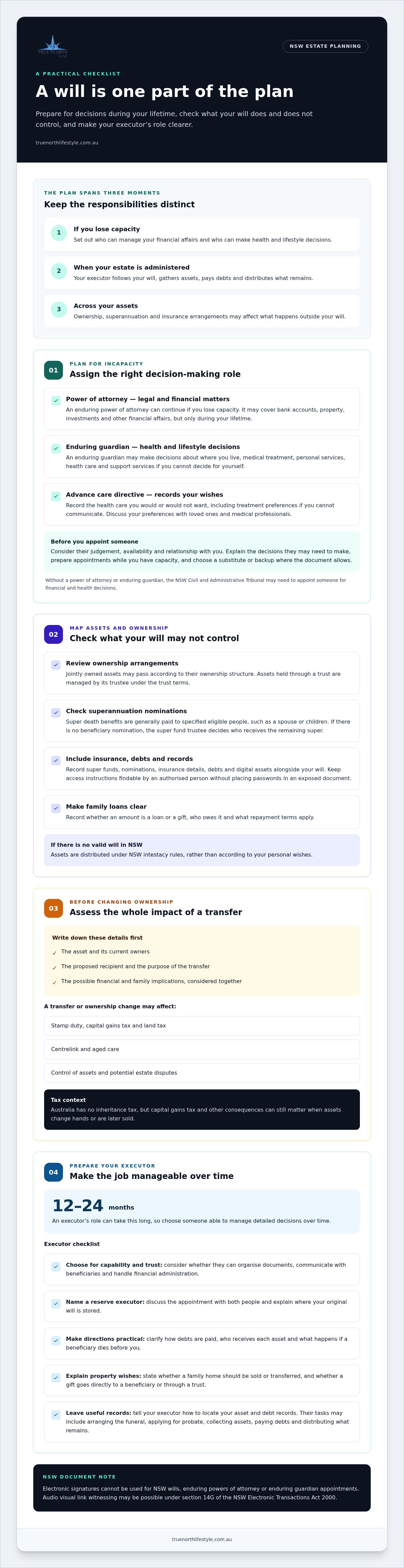
In NSW, a power of attorney lets someone make legal and financial decisions for you. An enduring power of attorney can continue to operate if you lose capacity. It may authorise your attorney to manage bank accounts, property, investments and other financial affairs. This authority applies during your lifetime, not after death.
Choose your attorney carefully. Consider their judgement, availability and relationship with you, then explain the decisions they may need to make. For example, someone managing property and investments may need clear records of bills, income and your preferences. A will serves a different purpose: it directs what happens to your estate after death and can name an executor.
Health and lifestyle decisions need separate planning. In NSW, you can appoint an enduring guardian to make decisions if you cannot decide for yourself. The appointment may cover where you live, medical treatment, personal services, health care and support services. An advance care directive records the health care you would or would not want, including treatment preferences if you cannot communicate.
Keep the roles distinct: an attorney handles legal and financial matters, a guardian handles lifestyle and health matters, and an advance care directive records your wishes. Discuss your health preferences with loved ones and medical professionals, and ask a GP to assist with preparing an advance care directive. This gives someone making decisions practical guidance instead of leaving them to guess.
If incapacity occurs without a power of attorney or enduring guardian, the NSW Civil and Administrative Tribunal may need to appoint someone for financial and health decisions. Prepare appointments while you have capacity, and select a substitute or backup where the document allows. Electronic signatures cannot be used for NSW wills, enduring powers of attorney or enduring guardian appointments, although audio visual link witnessing may be possible under section 14G of the NSW Electronic Transactions Act 2000.
2. What does estate planning cover in Australia?
An estate plan brings together your will, ownership arrangements, superannuation, insurance, debts and records. In NSW, assets without a valid will are distributed under the rules of intestacy, rather than according to your personal wishes. A will may not control jointly owned assets, superannuation or life insurance, so review each asset’s ownership and beneficiary arrangements separately.
Ownership matters. An asset held jointly may pass according to its ownership structure, while assets held through a trust are managed by its trustee under the trust terms. Superannuation death benefits are generally paid to specified eligible people, such as a spouse or children. If a member hasn’t nominated a beneficiary, the super fund trustee decides who receives the remaining super. Record the fund, nominations and insurance details alongside your will.
Transfers during your lifetime need careful consideration. Giving away property or changing ownership can affect stamp duty, capital gains tax, land tax, Centrelink, aged care, control of assets and potential estate disputes. For example, a transfer intended to help a family member may also change who controls the asset. Before acting, list the asset, its current owners, proposed recipients and the purpose of the transfer, then assess the financial and family implications together.
Australia has no inheritance tax, but capital gains tax and other consequences can still matter when assets change hands or are later sold. Keep clear records of family loans: note whether an amount is a loan or a gift, who owes it and what repayment terms apply. Include digital assets, such as online financial accounts, in your inventory. Record how an authorised person can find access instructions without putting passwords in an exposed document.
There is no single NSW fee for preparing a will and related estate planning documents; the cost depends on complexity, the documents required and the advice involved. A practical estate planning checklist for NSW should connect these decisions with your wishes, power of attorney arrangements and broader wealth plans.
They are distributed according to NSW intestacy rules, rather than the deceased person’s stated wishes.
3. Executor asset-sale and distribution decisions
Your executor is appointed in your will to administer your estate according to its instructions. Their work may include arranging the funeral, applying for probate, collecting assets, paying debts and distributing what remains. If the estate includes a property but beneficiaries are to receive cash, the executor may need to consider a sale to carry out the will’s directions. The role can take 12-24 months, so choose someone able to manage detailed decisions over time.
Start by considering capability and trust. Can your proposed executor organise documents, communicate with beneficiaries and handle financial administration? Name a reserve executor in case your first choice cannot act. Discuss the appointment with both people, explain where your original will is stored, and tell them how to locate your asset and debt records.
Make your wishes practical. A will can set out how debts are paid, who receives each asset and what happens if a beneficiary dies before you. For example, clarify whether a family home should be sold or transferred, and whether a gift goes directly to a beneficiary or through a trust. Clear directions help your executor understand your intentions, while family discussions can reduce surprises after death.
Keep execution and review on the checklist. Electronic signatures cannot be used for NSW wills, enduring powers of attorney or enduring guardian appointments. Audio visual link witnessing may be possible under section 14G of the NSW Electronic Transactions Act 2000. For formal amendments to an existing will, section 6 requires the testator’s signature and attestation by two witnesses. Revisit your will after marriage, separation, a birth, a beneficiary’s death or a major change to assets, then store the original securely and tell your executor where it is held.
4. Financial provision for dependants
Dependants may need practical support before an estate is distributed. Plan for your family’s cash needs during the first 30-90 days after a death, including regular household expenses, care costs and urgent bills. List who relies on your income, what resources they can access, and which expenses cannot wait. This short-term view can help identify whether your existing savings, superannuation and life insurance arrangements align with their needs.
If you have children, consider who should care for them and how funds should support their upbringing. A will can nominate a guardian and establish a testamentary trust, created by the will, to provide a structure for managing an inheritance for younger beneficiaries. Set out the trust’s purpose and consider how the trustee would manage funds for education, living costs or other needs.
In NSW, certain eligible people may make a family provision claim against a deceased person’s will. A clear, valid and carefully drafted plan can reduce the likelihood of disputes by addressing potential claims and explaining the intended provision. Consider each dependant’s circumstances, including financial reliance, health needs and existing support. Record the reasoning behind significant decisions so your wishes are clear to those administering the estate.
Review superannuation and life insurance nominations after major life events, especially marriage or divorce. A nomination may no longer reflect who depends on you or how your family’s circumstances have changed. Check each fund’s nomination details alongside your will, rather than assuming the will controls those benefits. An enduring guardian appointment can also identify someone to make health and lifestyle decisions if you’re unable to decide. Discuss care preferences with that person and your family, then revisit the arrangements as dependants’ needs change.
True North Lifestyle: Retirement modelling & long-term projections
True North Lifestyle can connect estate planning decisions with your broader financial position through retirement modelling and long-term projections. This can help you assess how assets, superannuation and support for dependants fit together over time.
When your plan involves financial trade-offs, a superannuation review, tax-minimisation strategies and bespoke portfolio construction can bring those considerations into a considered strategy. The focus is on how your resources may support your longer-term goals and the people who depend on you.
Financial planning complements, rather than replaces, legal documents such as a will or power of attorney. For a clearer view of how your financial strategy can align with your estate plan, contact True North Lifestyle.
Give your plan a clear next step
Your estate plan should move with your life, not sit untouched as circumstances change. Treat an estate planning checklist for NSW as a working record: note decisions still to make, documents to review and financial arrangements that need to align with your wishes. That gives you a practical starting point for future conversations with your family and professional advisers.
Financial planning can connect your long-term goals with the resources you intend to preserve for others. True North Lifestyle offers retirement modelling and long-term projections, tax-minimisation strategies, and superannuation review and optimisation. These services can help you consider how your retirement outlook and financial arrangements fit with your estate planning intentions.
If you’re ready to bring those considerations together, contact True North Lifestyle today. A thoughtful next step can make your wider financial plan clearer and easier to revisit.
Frequently Asked Questions
What does estate planning cover in Australia?
Estate planning brings together documents and financial arrangements that guide decisions during incapacity and after death. Alongside a will, consider superannuation nominations, insurance beneficiaries, care preferences and records of assets and debts. Include details of a family trust or business interest so the people administering your affairs can identify relevant obligations and instructions. Store access information securely, and tell a trusted person how to locate it.
Can a will be registered in NSW?
NSW no longer operates its former Wills Register. The NSW Registry of Births, Deaths and Marriages ran the register from 2002 until 28 March 2014, when the service ended. Instead of relying on registration, make sure your executor can locate the original will and knows which solicitor or secure location holds it. Tell them how to access it, while keeping the document itself protected from damage or unauthorised changes.
How do you build an estate plan, step by step?
Gather information before making decisions. Start with an inventory of assets, debts, ownership and superannuation accounts, then identify who relies on your income. Decide who should handle financial matters, health decisions and estate administration. Record your intended beneficiaries and care preferences, then align your will, appointments and nominations. Finally, store documents securely and note when to review them after major changes, such as a new relationship or property purchase.
In what order should an executor pay things out?
An executor should identify and collect estate assets, establish outstanding debts and administration obligations, then distribute the remaining estate under the will. They may need to apply for probate before dealing with particular assets. For instance, a bank or property transaction may require evidence of authority. The executor should keep clear records of money received, bills paid and distributions made, and avoid paying beneficiaries before assessing the estate’s obligations.
Is it better to make a new Will, alter an existing Will or make a codicil?
The right approach depends on the extent of the changes and whether the existing will remains clear as a whole. A codicil records an addition or amendment, while a new will can replace earlier instructions and consolidate changes. In NSW, a formal amendment to an existing will must be signed by the testator and attested by two witnesses. For substantial changes, consider whether separate amendments could create uncertainty about which instructions apply.
What documents should be included in an estate planning checklist in NSW?
Include documents that explain who can act, what you want and where your financial arrangements sit. A practical file may contain your will, power of attorney, enduring guardian appointment, advance care directive, superannuation nomination records, insurance details and an asset-and-debt inventory. Add relevant trust or business documents, funeral preferences and secure instructions for digital accounts. Keep a dated index so your executor can identify current documents without opening every file.


