

Turning 60 can open the door to your super, but it doesn’t automatically make retirement financially sustainable. If you’re asking, “can I retire at 60 in Australia?”, the answer depends on more than your age: you’ll need to meet a super condition of release and have a plan to fund the years before the Age Pension may be available.
It’s reasonable to feel uncertain. Super preservation age is 60, while Age Pension eligibility starts at 67, leaving a potential seven-year gap to plan for. Reaching 60 alone doesn’t guarantee access to your super, and the Age Pension isn’t automatic at 67. Eligibility also depends on income, assets and other requirements.
This guide explains the difference between accessing super and qualifying for the Age Pension, and how super, savings, investments or part-time work could help fund your income from 60. It also outlines what to model, including spending needs, tax, investment risk and how long your retirement savings may need to last, before deciding whether leaving work at 60 fits your circumstances.
Key Takeaways
- To answer “can I retire at 60 in Australia?”, assess both your super access pathway and whether your resources can support the lifestyle you want.
- Compare retirement, a transition-to-retirement income stream and working longer, as each pathway has different access conditions and cash-flow effects.
- Map expected spending, reliable income, accessible assets and how long your savings may need to last instead of relying on a universal super target.
- Before leaving work, review debt, insurance, dependants and any planned changes to your hours or income.
- Use personalised projections to compare retiring at 60 with reducing your hours or working longer, and test how super, tax and investment assumptions affect the plan.
Can I retire at 60 in Australia? Separate eligibility from affordability
Yes, retiring at 60 may be possible, but two separate questions matter: can you access your super, and can your income and assets support the life you want? Leaving work is a personal decision. Accessing super is governed by release conditions, while financial readiness depends on spending, other resources and how long your retirement may last.
A useful distinction is this: retirement eligibility is whether you meet the rules to access super; financial readiness is whether your resources can sustainably fund your plans. Meeting one test doesn’t automatically satisfy the other. You might be able to stop working but need another income source, or have savings that could support you while you don’t yet meet a condition to withdraw super.
What turning 60 does, and doesn’t, mean for your super
In 2026, the preservation age is 60. That’s the minimum age at which you may access preserved super, but reaching it doesn’t automatically make every super account available. You must also meet a condition of release, and the pathway depends on your circumstances and the rules that apply to your fund.
Common pathways include permanently retiring after reaching preservation age, ending an employment arrangement after turning 60, or reaching age 65. These are distinct conditions, so stopping work at 60 isn’t, by itself, proof that you’ve met a release condition. A transition-to-retirement income stream is another arrangement, but it isn’t the same as unrestricted access to your entire super balance. The broader system is outlined in Superannuation in Australia.
Before making a decision, identify which condition applies to you and how it relates to each super account. Your age, employment history and intended work arrangements can all matter. Treat access as something to establish, not an assumption based on your birthday.
Why the Age Pension is a separate milestone
Age Pension age is 67 for men and women in 2026, according to the current rules. Reaching 67 means you can meet the age requirement to apply, but it doesn’t guarantee a payment. Services Australia also assesses eligibility under rules that include income and assets, along with other requirements.
If you retire at 60 and expect to rely on the Age Pension later, you’ll need to plan for the years in between. You may draw on accessible super, savings, investments or other income, while allowing for the possibility that your eventual pension will be partial or unavailable. Consider not just whether money is accessible today, but how withdrawals and other income could support you over time.
Break the decision into steps: establish your super access pathway, estimate potential Age Pension eligibility, then consider how you’ll fund the years between. This gives you a clearer starting point for testing whether retirement at 60 is workable in practice.
How super access works at 60: retirement, continued work and transition options
Turning 60 may create more than one possible route to super, but the rules depend on what you do next. Preservation age is the age threshold; a condition of release determines whether you can access benefits; Age Pension age is a separate milestone. These terms aren’t interchangeable, and access isn’t automatic. Your fund’s rules and processes also affect how you make a withdrawal or start an income stream.
Retirement condition: If you’ve reached preservation age and retire, you may meet a condition of release. The meaning of retirement depends on your circumstances and work intentions.
Transition-to-retirement income stream: If you’ve reached preservation age but continue working, you may be able to draw a limited income stream from super. This isn’t unrestricted access to your whole balance.
Age 65: Reaching 65 is a separate condition of release. You can generally access super then, whether or not you’ve retired.
If you stop working at 60
Under the retirement pathway, reaching preservation age isn’t enough on its own. You generally need to retire after reaching that age and satisfy the applicable retirement condition. A separate pathway may apply if you cease an employment arrangement after turning 60, even if you later work again. The details matter, so don’t assume that leaving one job gives you unrestricted access to every super benefit.
Before acting, review the current ATO guidance and the process for your fund and circumstances. Establish which condition of release applies, what evidence or forms are required, and whether the benefit you intend to access is in the account you expect.
If you want to keep working or reduce your hours
A transition-to-retirement income stream can provide access to some super income while you remain employed, potentially helping you reduce hours without relying only on wages. It differs from fully retiring: it doesn’t generally let you withdraw the entire super balance as a lump sum. Review the stream’s terms and how its payments fit your cash-flow plan.
Your wages and super payments are separate income sources, and their tax treatment may differ. From age 60, payments from a taxed super fund are generally tax-free, but exceptions and fund arrangements can affect the outcome. Check your circumstances against current ATO guidance before choosing a payment strategy. For broader scenario planning, the retirement planning guide for Sydney explores how timing, income and longevity assumptions fit together.
So, can I retire at 60 in Australia? Start by identifying your access pathway, then test how continued work, super income and other resources could support your plans. Personalised retirement modelling can bring these choices and assumptions together; retirement modelling and long-term projections can help you compare the options.
Can your savings support retirement at 60? Test income, spending and longevity
There’s no single super balance that makes retirement at 60 affordable for everyone. Readiness depends on the income you can draw, the spending you want to support, which assets are accessible and how long those resources may need to last. A projection can connect these factors and show when money may need to come from different sources.
Map income by source and timing. For example, you might combine part-time earnings with accessible savings before drawing on super, then reassess your income when you reach Age Pension age. Any pension estimate should account for eligibility rules rather than assume a full payment.
Part-time work: May provide income in the early years, depending on your work plans and earnings.
Cash savings and investments: Can help cover spending when needed, subject to access and investment performance.
Super: May provide income once you meet the relevant access conditions and choose how to draw on it.
Age Pension: May contribute from age 67 if you meet the applicable eligibility requirements.
This is a timing map, not a ranking. The right sequence depends on your circumstances, including tax, investment mix and how much flexibility you have to adjust spending.
Build a realistic picture of retirement spending
Start with your own records, not a generic retirement budget. Separate essentials such as housing, utilities, food and debt repayments from discretionary goals such as travel, renovations or helping family. Include health costs and consider how household spending could change if a partner’s circumstances, living arrangements or work plans shift. Mark which expenses are ongoing and which are one-off.
This detail matters. A budget that leaves out a future renovation or family support may understate withdrawals; one that treats every optional expense as fixed may overstate them. Use realistic amounts in Australian dollars and revisit your assumptions as your plans become clearer.
Model the bridge before Age Pension eligibility
A year-by-year projection can show how super and other assets may change between retirement at 60 and age 67, when you may be able to seek the Age Pension. Test different spending levels, a longer retirement, weaker investment returns and higher-than-expected costs. This can reveal which assumptions have the greatest effect and where you may need a contingency.
Returns won’t arrive evenly. A market fall early in retirement can affect a portfolio differently from the same fall later, especially if withdrawals continue. Inflation can reduce what a fixed income buys, while unexpected costs may require larger withdrawals. Avoid relying on a universal withdrawal rate or a single optimistic forecast. Compare less favourable and more favourable scenarios, and consider how you could respond if results differ from plan. Wealth preservation strategies can help frame related questions about risk and longevity.
So, can I retire at 60 in Australia? A projection won’t remove uncertainty, but it can make the trade-offs visible: how much income you need, which resources fund it and how sensitive the plan is to changing conditions.
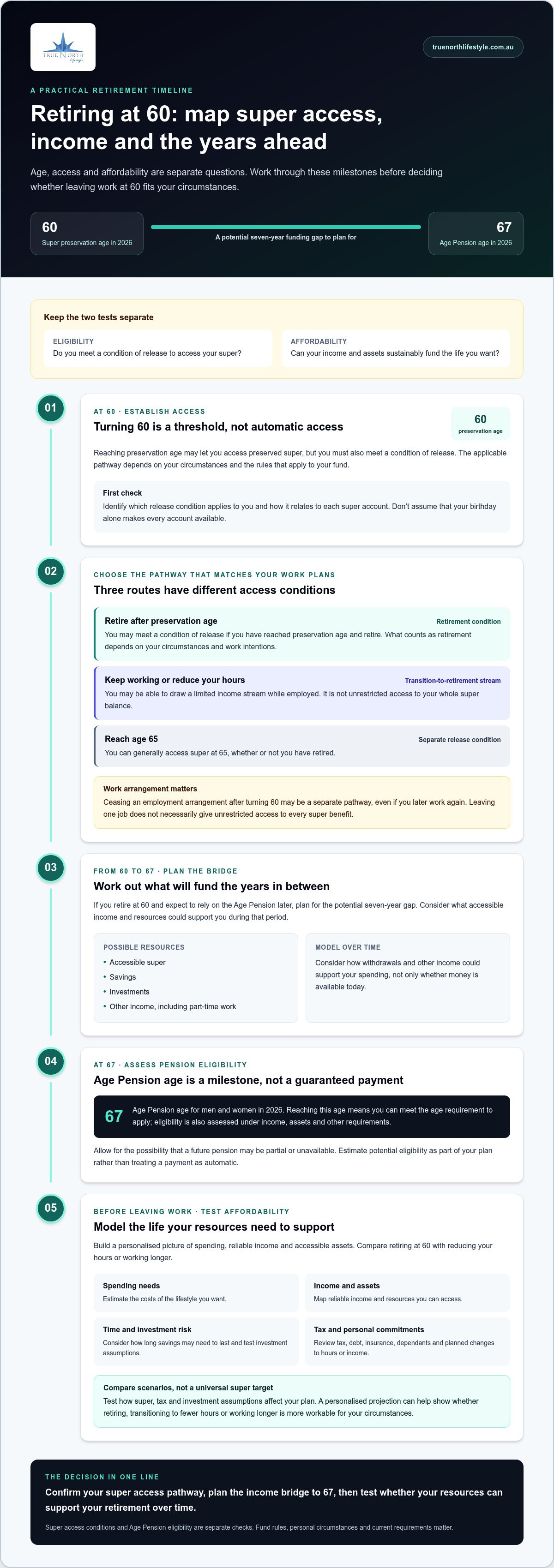
A practical readiness check before leaving work at 60
A clear checklist can turn a major decision into manageable questions. It won’t tell you what you must do, but it can reveal where the plan is supported and where you need more information. Test more than one retirement date, too: leaving at 60, reducing your hours first or working longer may lead to different outcomes.
Five questions to answer before setting a retirement date
Work through these questions using your current figures, then revisit them under less favourable assumptions. If an answer exposes a gap, treat it as a planning question, not a verdict on whether retirement is possible.
- Can you access the resources you’re counting on? Identify the super or other assets you intend to use, and establish whether access conditions apply to each one.
- Does projected income cover essential spending? Separate core costs from optional plans, then see whether the essentials remain covered if investment returns are weaker or expenses rise.
- What debts will continue into retirement? Include repayments and consider how your plan changes if you pay debt down before leaving work.
- What happens if your work plans change? Compare retiring fully with part-time work, reduced hours or delaying your retirement date. Consider how each choice affects income and the timing of withdrawals.
- Do you have room for unexpected changes? Review insurance, dependants and likely one-off expenses, such as a move or major home repairs. Consider who relies on your income and what support they may need.
Documents and assumptions to gather for a useful projection
Bring together a current snapshot of your finances rather than relying on memory. Gather super balances, cash and investment assets, debts, income details and records of household spending. Add expected one-off costs, such as planned renovations, and note possible changes to housing, health needs or family support.
Write down the assumptions behind your preferred retirement date: whether you’ll keep working, how much you expect to spend, and how you’ll respond if costs or returns differ from expectations. Review your superannuation strategy alongside these assumptions, as choices about super can affect how your broader retirement plan is structured.
A useful projection compares the same household across different dates and work patterns. For example, test what changes if you stop at 60, reduce your hours first or work longer. Look at the effect on cash flow, super balances and the resources available later, rather than judging a plan by one balance on one day. A superannuation strategy review can help clarify how your super fits your plans.
If you’ve gathered your figures and want to test those retirement-date options, explore personalised retirement modelling to bring income, spending and super assumptions into one considered projection.
Turn a retirement-at-60 question into a personalised plan with True North Lifestyle
General rules can show when super might be accessible, but they can’t tell you whether a particular retirement date fits your household. That depends on how your income, spending, assets and priorities work together. A personalised projection can organise those factors into a clear view of the choices ahead, helping turn “can I retire at 60 in Australia?” into practical scenarios to consider.
What a tailored retirement projection can help you understand
A projection can map expected cash flow and asset balances across different retirement dates. Compare stopping work at 60 with reducing your hours or staying employed longer, then examine how each path may affect income, super withdrawals and the assets available later. This makes the trade-offs easier to see, rather than treating one retirement date as the only option.
Superannuation, planned spending, tax considerations and investment assumptions can be reviewed together. For example, changing the timing or level of withdrawals may affect how long assets are projected to last, while a different investment return assumption can alter the forecast. Longevity and portfolio sustainability modelling can test how a plan responds to a longer retirement or less favourable conditions. These are planning tools, not promises: outcomes depend on assumptions, and actual markets, costs and personal circumstances can change.
Revisit projections when something material shifts, such as your work plans, household spending, investment mix or family responsibilities. Comparing scenarios can help identify which assumptions matter most and where you may have flexibility. It can also highlight questions that need further attention without suggesting that a forecast removes uncertainty.
Plan your next conversation in Miranda or Sydney
Preparation can make a planning discussion more focused. Bring your latest super statements, details of cash and investments, a household budget, debt information and a list of retirement goals. Note any planned one-off expenses, changes to housing or work, and people who depend on your income. If a figure is approximate, label it as an estimate.
An adviser can help organise these details into relevant questions and assumptions, then consider how super, tax strategy, investments and longevity fit together. You don’t need to arrive with a perfect forecast. A clear sense of what you hope to do, what feels uncertain and which choices you want to compare is a useful starting point.
True North Lifestyle provides retirement modelling and long-term projections for Australian clients, including people in Miranda and Sydney. If you’re ready to explore your options, discuss your retirement strategy and take the next step at a pace that suits your circumstances.
Make your next step a considered one
The question “can I retire at 60 in Australia?” doesn’t need an immediate yes-or-no answer. Turn it into a decision you can examine: which retirement date feels right, what flexibility you have, and what would need to be true for the plan to feel comfortable?
Bring your priorities and uncertainties into the same conversation as your financial assumptions. Retirement modelling can help compare possible paths while considering superannuation, tax strategy, investments and longevity together. The purpose isn’t to promise a particular result, but to give you a clearer basis for choosing what to do next.
If you’re ready to explore your options, discuss your retirement-at-60 plans with True North Lifestyle. Retirement modelling and long-term projections can help you compare practical choices and move forward one decision at a time.
Frequently Asked Questions
Can I access my super at 60 if I am still working?
You may be able to access some super while still working at 60, but it isn’t automatic or necessarily available as a lump sum. A transition-to-retirement income stream may let you draw an income from super while employed, subject to its rules. A separate release condition may apply if you cease an employment arrangement after turning 60. Review the conditions that apply to your circumstances and account.
Is super tax-free when I withdraw it after turning 60?
Withdrawals from a taxed super fund are generally tax-free from age 60, but the answer can differ for an untaxed scheme or particular components of a benefit. The way you take super, such as a lump sum or income stream, can also affect what you need to consider. Before making a large withdrawal, review your fund’s information and current Australian Taxation Office guidance for your specific benefit. If your transition into retirement involves business assets or complex income arrangements, consulting tax advisers like The Sphere Group can help ensure reporting remains compliant and avoids unexpected tax office scrutiny.
Can I retire at 60 if I still have a mortgage?
Yes, having a mortgage doesn’t automatically rule out retiring at 60. The question “can I retire at 60 in Australia” depends partly on whether your projected income can cover repayments alongside everyday and irregular costs. Compare your budget with the remaining loan term, possible interest-rate changes and any plans to repay, refinance or move; reviewing loan features such as offset accounts with The Home Loan Partners can help manage interest costs. Include housing costs in your cash-flow projection before settling on a retirement date.
What if I was born before 1 July 1964?
Your preservation age depends on your exact date of birth. If you were born before 1 July 1960, your preservation age is between 55 and 59, depending on your birth date. If you were born from 1 July 1960 to 30 June 1964, it is 60. Being born before 1 July 1964 doesn’t by itself determine whether you can access super now; check your date against the applicable ATO rules.
Can I receive the Age Pension as soon as I turn 60?
No. Turning 60 doesn’t make you eligible for the Age Pension. The qualifying age is 67, and reaching it only meets the age requirement, not every eligibility test. Services Australia also assesses factors such as income and assets, and other requirements may apply. If you’re planning ahead, treat any future Age Pension as an estimate until your circumstances and eligibility are assessed under the rules then in force.
Will retiring at 60 affect my private health insurance?
Retiring doesn’t automatically cancel a private health insurance policy you hold yourself, but the cost and value of cover may feel different once employment income changes. If your cover is arranged or subsidised through an employer, review how leaving work affects that arrangement. Also compare your premium with your retirement budget and consider whether changes in household income affect any rebate or tax considerations relevant to your circumstances.
How can I compare retiring at 60 with working part-time for longer?
Compare projections for the same household under both options. Include expected part-time earnings, changes to spending, super access and withdrawals, and how long assets may need to last. For a household in Miranda or elsewhere in Sydney, include work-related travel costs that may change if you reduce your hours. Testing weaker returns and unexpected expenses alongside the main forecast can make the trade-offs clearer.


