

Could reducing your work hours be financially sustainable without placing too much pressure on your super? A transition to retirement strategy Sydney workers consider can help bridge that gap, but it needs to fit your income needs now and your longer-term retirement plans.
It’s understandable to be cautious. A transition to retirement income stream can provide payments from super while you’re still working, but it also changes how much remains invested for later. Once you’ve reached preservation age and meet the relevant rules, payments generally need to fall between 4% and 10% of the account balance each financial year. The right approach depends on your age, income, super balance, tax position and plans for work.
This guide explains how TTR works, its limitations and what to weigh up before making changes. You’ll see how to compare work, income and super scenarios, including their potential effect on retirement savings. We’ll also cover the information to gather for a personalised advice discussion, whether you’re planning in Miranda or elsewhere in Sydney.
Key Takeaways
- Start with the work decision: connect your preferred hours and lifestyle with the retirement income you may need later.
- Consider how employment income and super payments could work together, then assess the potential effect on your super over time.
- Compare continuing full-time, reducing hours and stopping work using consistent assumptions in a transition to retirement strategy Sydney plan.
- Gather your super statements, income details, household spending estimates and likely retirement timing to make planning more focused.
- Retirement modelling can bring work choices, super, tax and longer-term income needs into one considered plan.
What a Sydney TTR Strategy is Designed to Do
How can you balance paid work today, a possible change in hours and the retirement income you’ll need later? A transition to retirement strategy Sydney workers may consider brings these decisions together, rather than treating work, super and retirement timing as separate choices.
A transition to retirement (TTR) strategy coordinates your employment income, superannuation and intended retirement timing, so you can assess whether a gradual change to work is financially workable. It may involve using a super income stream to supplement employment income. It doesn’t mean you’ve fully retired or can withdraw all your super whenever you choose.
The aim is to understand the trade-offs before changing course. For background on the Australian super system and TTR terminology, see this overview of Superannuation in Australia. Access conditions and tax treatment can change, so check current ATO guidance for the rules that apply to your circumstances before acting.
Who might consider a transition to retirement strategy?
A TTR strategy may be relevant if you’re approaching preservation age and want to reduce your hours, reshape your workload or move out of full-time employment gradually. For example, a Sydney professional considering a four-day week might explore whether a super income stream could help bridge some of the income change, while also assessing the potential effect on their super over time.
It isn’t suitable by default. Your age, employment income, super balance, spending needs and retirement plans all matter, as do the rules in force when you’re considering the strategy. Preservation age and Age Pension age are different milestones, so reaching one doesn’t automatically mean you’re eligible for the other.
What a TTR strategy can and cannot do
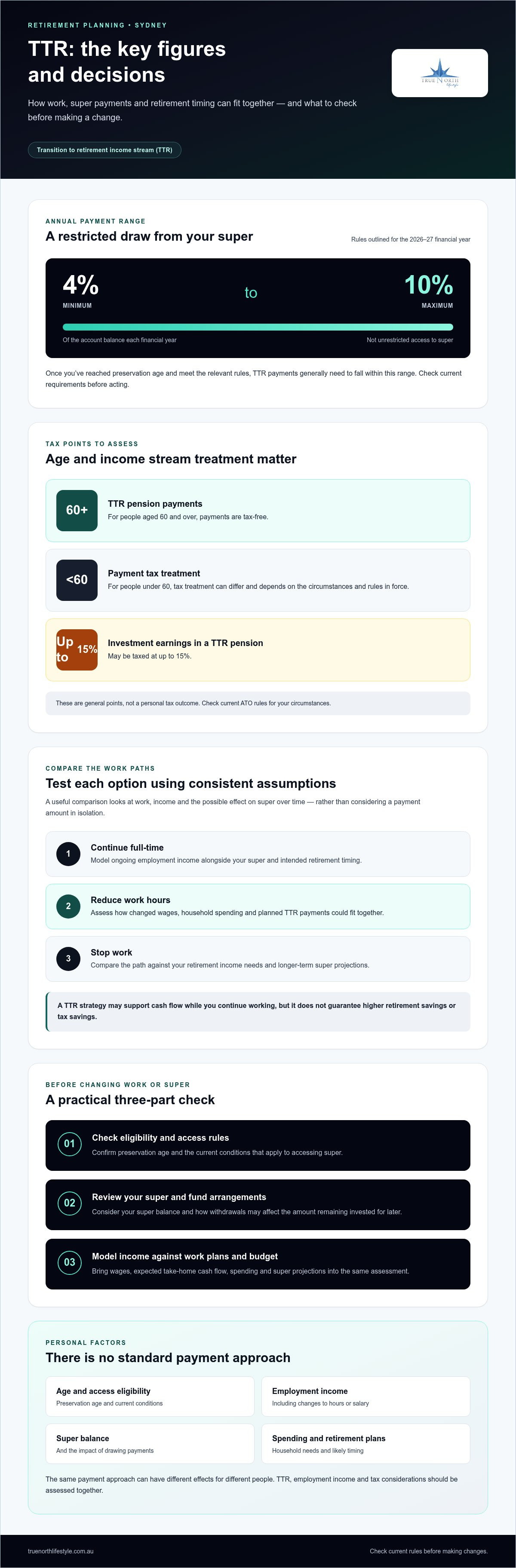
A TTR income stream may support cash flow while you continue working, giving you another option to consider when planning reduced hours. Under the rules outlined for the 2026-27 financial year, payments generally have a minimum of 4% and a maximum of 10% of the account balance each year. This is a restricted income stream, not unrestricted access to your super.
That distinction matters. Drawing payments may help manage a change in take-home income, but it doesn’t guarantee higher retirement savings or tax savings. The effect depends on your circumstances and how your super is invested and managed. For people aged 60 and over, TTR pension payments are tax-free; for those under 60, tax treatment can differ, while investment earnings in a TTR pension may be taxed at up to 15%. Check current ATO rules and consider the broader impact before making a decision.
How a TTR income stream works alongside work and super
A TTR income stream adds another moving part to your household finances: alongside wages, you may receive regular payments from a superannuation income stream. The practical question is how those sources fit your spending needs now, while accounting for what withdrawals could mean for your super later.
A considered approach follows a clear sequence: check whether you meet the current eligibility and access rules, review your super balance and fund arrangements, then model an income approach against your work plans and household budget. Consider these figures together, rather than as separate decisions. A transition to retirement strategy Sydney residents explore should reflect their circumstances, not rely on a standard payment amount or assumed tax outcome.
How employment income and TTR payments fit together
Imagine someone whose salary currently covers household costs but who wants to reduce their working hours. Their wages may fall as their hours change, while planned TTR payments could contribute towards the resulting cash-flow gap. A useful model would also account for regular spending and the super balance from which payments are drawn.
Gross income alone won’t show the whole picture. Take-home cash flow can be affected by tax, employment arrangements, super contributions and the amount and timing of pension payments. A change in salary or hours may alter several of these figures. Compare expected income after relevant deductions with spending and super projections. This is an illustration of how to frame the assessment, not a prediction of a particular household’s outcome.
TTR outcomes depend on your employment income, super balance and individual circumstances, so the same payment approach can have different effects for different people.
Which TTR rules need checking before a decision?
Eligibility and access depend on rules, not preference. Preservation age and the conditions that apply to accessing super are set by legislation, while payment conditions and tax treatment also need to be assessed against current requirements. Check the latest Australian Taxation Office guidance before making decisions, especially if your age, work situation or intended withdrawal approach may affect how the rules apply.
General tax concepts can help you identify questions, but they can’t establish your personal tax outcome. That depends on your circumstances and the rules in force at the time. A careful review brings super, employment income and tax considerations into one set of projections. For a clearer view of these moving parts, explore retirement modelling and long-term projections as part of a broader financial plan.
Compare TTR scenarios before changing your work or super
A useful TTR comparison tests more than one path before you change your hours or begin drawing from super. Model continuing full-time, reducing hours and stopping work using the same assumptions. Then compare how each option may affect household cash flow and your longer-term super position.
Look at the measures together. Lower employment income may change the amount needed from savings or a super income stream, while withdrawals may affect the balance available to support you later. Household spending helps show whether the income in each scenario is workable, rather than whether figures look favourable in isolation.
What to include in a TTR scenario comparison
Start with a consistent set of personal inputs, such as:
- Current super balances and expected employment income under each work arrangement
- Intended working hours, household spending and planned retirement timing
- Other assets, relevant partner circumstances and any expected changes to income or expenses
Make the assumptions visible. For example, use the same spending estimate and investment assumptions across all three work options, changing only the work pattern and related income or super payments. You can then see how changing one input, such as retirement timing or planned spending, affects the results and identify which assumptions matter most to your decision.
Consider longevity, investment variability and unexpected expenses, too. Assess a plan across different plausible conditions, not only a smooth path where income, spending and investment performance behave exactly as expected. Retirement modelling can help compare these moving parts and test how a plan may respond to change.
Projections are estimates based on assumptions, not guaranteed outcomes, and actual results can differ as your circumstances and investment conditions change.
When the apparent tax benefit may not settle the decision
A possible tax advantage is only one part of the comparison. Weigh potential tax effects against super withdrawals, ongoing contributions and applicable fees. A favourable tax result by itself doesn’t establish that a strategy can support your spending needs over the long term.
For a transition to retirement strategy Sydney workers can assess with greater clarity, personalised modelling should connect employment income, household costs, super and tax considerations. The aim isn’t to find a single attractive figure, but to understand the trade-offs between work choices today and financial flexibility later.
Plan the practical steps for a TTR strategy in Sydney
Good preparation makes a TTR discussion more useful. Start with the life you want your plan to support, then gather the information needed to test whether your preferred work pattern and income approach fit your broader retirement outlook.
Prepare your information before reviewing options
Before exploring a transition to retirement strategy Sydney, work through these steps:
- Define your lifestyle priorities. Note what you want more or less of, such as time for family, travel, health or other commitments.
- Set out your preferred work path. Record the hours you’d like to work and when you may want to retire, even if those plans are flexible.
- Gather your financial records. Bring recent super statements, employment income details and a realistic estimate of regular household spending.
- Include the wider household picture. Note other assets, debts, partner circumstances and any expected changes that could affect income or spending.
These details help turn a broad goal, such as “work less”, into a scenario that can be assessed. For a wider view of how retirement modelling fits into long-term planning, read this Sydney retirement planning guide.
Use advice and modelling to test the plan
With your information organised, retirement projections can compare different retirement dates, working hours and income assumptions. Changing one assumption at a time helps show what is driving the result. Considering spending needs and super together keeps the focus on practical sustainability.
A tailored review can also consider how super fund arrangements, tax and investment risk interact. Centrelink structuring may be relevant to the broader retirement picture, but eligibility and payment effects depend on current rules and personal circumstances. Assess these details before implementation rather than assuming they will match a general example. For related fund-planning considerations, see this superannuation advice guide.
True North Lifestyle provides retirement modelling to connect work choices with super, tax and longer-term income needs. Explore personalised retirement planning to assess your options before making a change.
Build a Sydney transition to retirement strategy around your longer-term plan
A TTR decision sits within a broader retirement plan. The right balance between work, super and income depends not only on what you need now, but also on how your choices may affect financial flexibility over time. A personalised transition to retirement strategy Sydney workers can consider should connect these parts, rather than focus on a single payment or tax outcome.
True North Lifestyle uses research-driven retirement modelling to examine work choices alongside super, tax, investment risk and longer-term income needs. Projections can clarify possible trade-offs under different assumptions. They’re decision-support tools, not promises: your circumstances and investment conditions can change, and no projection can guarantee a particular result.
How ongoing review can keep a transition plan relevant
A plan may need another look if your employment, spending, family circumstances or retirement timing changes. Market movements can also affect super balances and the assumptions used in projections. Updating the model helps you assess whether your preferred income approach still fits, rather than relying on an earlier set of figures.
Reviewing the plan also keeps longevity and risk in view. Sustainable income planning considers how your resources may need to support you over time, alongside the uncertainty of investment performance and changing needs. The aim is to understand where a plan may be sensitive to change and which assumptions deserve attention.
What to expect from a tailored TTR planning discussion
A focused discussion starts with your priorities: what you’d like your working life to look like, when you hope to retire, and what income and spending needs matter to your household. Retirement modelling can then test different work patterns, timing and income assumptions, bringing super and relevant tax considerations into the same view.
Bespoke projections can make trade-offs clearer before implementation decisions are made. They can also be revisited as your circumstances evolve, keeping the plan connected to your goals rather than treating TTR as a one-off calculation.
If you’re considering a gradual change to work, a measured conversation can help clarify the questions to resolve and the scenarios worth testing. Discuss your retirement strategy with True North Lifestyle.
Take your next retirement step with clarity
A transition to retirement strategy Sydney planning can help you assess whether changing your work pattern is compatible with your income needs and longer-term retirement goals. Consider employment income, super payments and household spending together, then compare realistic options before making changes.
A TTR approach is not unrestricted access to super, and a tax benefit alone doesn’t determine whether a plan is sustainable. Your circumstances, current rules and the assumptions behind any projection all matter. Reviewing those assumptions as work, spending or family needs change can help keep the plan relevant.
True North Lifestyle’s retirement modelling and long-term projections bring superannuation, tax considerations, investment risk and wealth preservation into a considered view. This evidence-led process can help clarify trade-offs, without treating estimates as guaranteed outcomes.
For a personalised assessment of your options in Miranda or Sydney, discuss your retirement strategy with True North Lifestyle.
Frequently Asked Questions
What is a transition to retirement strategy in Australia?
A transition to retirement strategy links your employment income, superannuation and planned retirement timing to help assess options for gradually changing your work pattern. It may use a transition to retirement income stream to supplement wages, subject to eligibility and payment rules. It isn’t full retirement or unrestricted access to super. A transition to retirement strategy Sydney residents consider should reflect their income needs, super position and longer-term plans.
Who is eligible for a transition to retirement income stream?
You generally need to have reached your preservation age to start a transition to retirement income stream while continuing to work. For people born on or after 1 July 1964, preservation age is 60; people born earlier have already reached it. Reaching preservation age doesn’t mean you can freely withdraw all your super. Eligibility and applicable conditions depend on current rules and your circumstances, so check the latest Australian Taxation Office guidance before acting.
Can I keep working while drawing a transition to retirement pension?
Yes. A transition to retirement income stream is designed for eligible people who have reached preservation age and want to access some super while remaining employed. Payments may sit alongside wages and contribute to household cash flow. The amount you receive is subject to payment rules, and drawing from super can affect the balance available for later retirement. Consider your work income, spending needs and super together before deciding whether this arrangement fits.
Does a transition to retirement strategy reduce tax?
Not necessarily. Tax outcomes depend on your age, employment income, contributions, super arrangements and the rules that apply. Investment earnings in a TTR pension are taxed at up to 15%; pension payments are tax-free for people aged 60 and over. A strategy may help with cash-flow planning, but it doesn’t guarantee tax savings or improved retirement savings. Have potential tax effects modelled alongside withdrawals, contributions and longer-term income needs.
How much can I withdraw through a transition to retirement income stream?
For the 2026-27 financial year, a TTR income stream generally has a minimum payment of 4% and a maximum of 10% of the account balance each year. The amount you can receive depends on the balance and applicable payment settings. These are annual limits, not permission to withdraw all your super as a lump sum. Check current ATO guidance and your fund’s requirements before arranging payments.
Is a transition to retirement strategy suitable if I want to work fewer hours?
It may be worth assessing if you’ve reached preservation age and want to reduce your hours without an abrupt change to household income. Suitability depends on how lower wages, any TTR payments, household spending and future super balances work together. Compare reduced hours with continuing full-time work and other realistic options using consistent assumptions. A transition to retirement strategy Sydney plan should reflect your circumstances, not rely on a general example.
Will a transition to retirement strategy affect my Centrelink entitlements?
It could affect an assessment, but the outcome depends on your circumstances and the Centrelink rules in force. Age, income, assets, relationship status and how your super and payments are treated may all be relevant. Don’t assume a TTR income stream will leave your entitlements unchanged or automatically make you ineligible. Before making a decision, assess the potential interaction using current Services Australia guidance and your household’s full financial picture.
What should I bring to a TTR strategy discussion in Sydney?
Bring recent super statements, employment income details and an estimate of regular household spending. Note your preferred working hours, likely retirement timing, other assets and debts, plus relevant partner or household circumstances. These details help make projections more specific and allow different work and income options to be compared. If you’re meeting with True North Lifestyle in Miranda or Sydney, write down your main questions and any changes you’re considering.


