

Could selling the family home to fund aged care create more financial pressure than it relieves? For Sutherland Shire families, the answer depends on care needs, payment choices and how decisions affect cash flow and Centrelink considerations. The right aged care financial solutions Sutherland Shire households need start with their own circumstances, not a rushed decision about where the money should come from.
It’s understandable to feel uncertain. A care transition can bring important financial decisions at the same time as practical and emotional demands on the family. The rules also matter: residential care entrants from 1 November 2025 are subject to a different fee structure from people who entered earlier, while Support at Home has replaced the previous Home Care Package program.
This 2026 guide explains key payment considerations and how keeping, renting or selling a home may affect a financial plan. It also shows how tailored modelling can compare scenarios, including potential cash-flow and Centrelink implications, alongside retirement income, superannuation and longer-term goals. A clear comparison of these trade-offs can help you make a considered plan that supports the person’s care needs and the family’s financial wellbeing.
Key Takeaways
- Understand how care type, personal circumstances and current Australian rules shape aged-care fees and contributions.
- Compare a Refundable Accommodation Deposit with Daily Accommodation Payments by considering liquidity, income needs and longer-term plans.
- Model keeping, renting or selling a home alongside partner security and Centrelink considerations.
- Prepare for an advice discussion by gathering financial details, clarifying care preferences and listing the questions your family needs answered.
- Connect aged care financial solutions Sutherland Shire families can use with retirement income, superannuation and asset planning.
Aged care financial solutions in the Sutherland Shire start with the right questions
A change in care needs can bring several decisions into focus at once. A loved one’s preferences and wellbeing come first, but families may also need to consider how ongoing expenses fit with income, savings, superannuation, property and other household commitments. The financial details can be difficult to untangle while everyone is adjusting to a new situation.
Aged-care financial planning connects care choices with a household’s wider financial position, so decisions can be considered together rather than in isolation. Care selection and financial strategy are separate processes, but they influence one another. The type of support chosen can affect spending needs, while available resources and family priorities may shape which options feel sustainable. For families seeking aged care financial solutions Sutherland Shire, the starting point is a clear picture of the people, preferences and finances involved, not a standard formula.
What financial decisions can arise when care needs change?
Different care settings raise different financial questions. Support at home may involve planning for regular service contributions and household expenses. Respite care may create a shorter-term funding decision. Residential care can bring accommodation payment choices as well as ongoing costs. The Australian system combines government funding with individual contributions, as outlined in this Aged care in Australia overview.
Useful planning inputs include regular income and expenses, savings, superannuation, property and other assets. The order of questions depends on care preferences and household circumstances. For one family, maintaining a partner’s financial security may be the immediate priority. For another, the focus may be understanding how income and available savings could support a change in care.
Why local families may need a whole-of-household view
Sutherland Shire households have different family structures, resources and goals, so a decision that suits one person may not fit another. Where appropriate, include the person receiving care, their partner and family members involved in decisions. This brings personal preferences into the same conversation as cash flow, asset choices and longer-term plans, without assuming every family has the same priorities.
A financial adviser can model scenarios and consider how care-related decisions interact with retirement income, superannuation and Centrelink structuring. This is financial planning, not care provision or placement, and it does not replace legal advice. The aim is to make the financial trade-offs clearer so families can approach care decisions with a considered view of their wider household position.
How aged-care fees, payment choices and assessments fit together
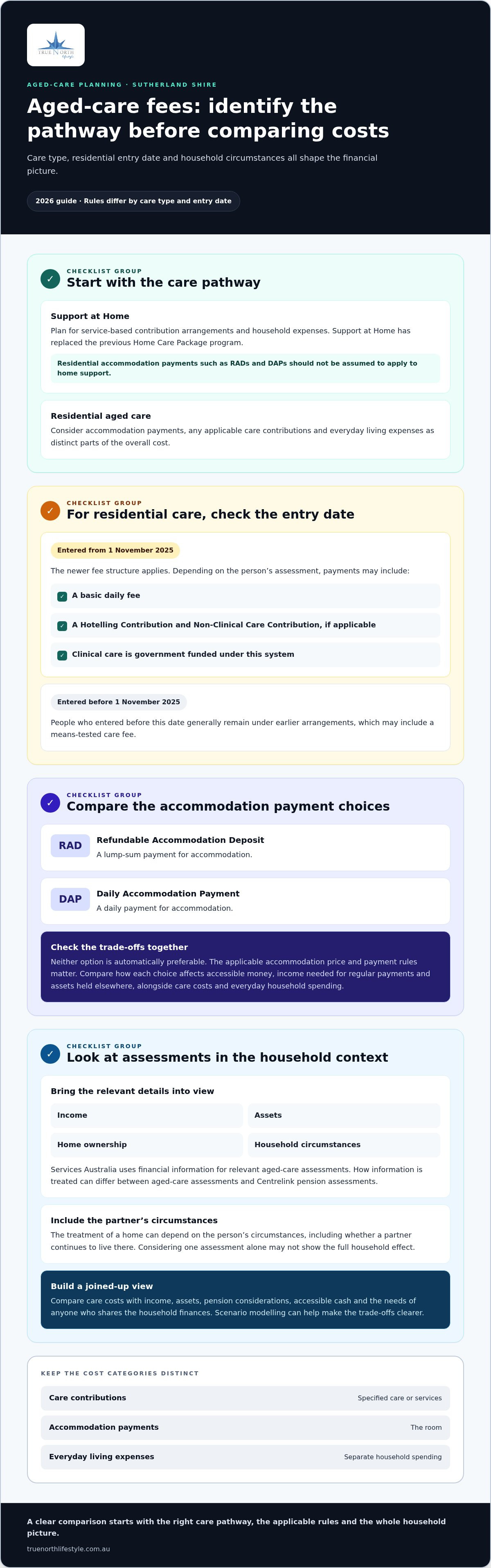
There isn’t one set of costs for every person entering care. Amounts and contribution arrangements depend on the type of care, individual circumstances and the rules that apply. In 2026, it’s important to distinguish Support at Home from residential aged care, and to identify when someone entered residential care because different fee arrangements may apply.
For residential care, the system changed for people entering from 1 November 2025. Under the newer arrangements, residents may pay a basic daily fee and, depending on their assessment, a Hotelling Contribution and Non-Clinical Care Contribution. Clinical care is government funded under this system. People who entered before that date generally remain under earlier arrangements, which may include a means-tested care fee. Current details are available through My Aged Care financial support.
What do RAD and DAP mean in residential aged care?
A Refundable Accommodation Deposit (RAD) is a lump-sum payment for accommodation. A Daily Accommodation Payment (DAP) is a daily payment for accommodation. The applicable accommodation price and payment rules determine how these options work. Neither should be treated as automatically preferable.
The choice can affect how much money remains accessible, the income needed to meet regular payments and the assets held elsewhere. Compare those effects with care costs and everyday household spending to understand the practical trade-offs.
Keep the categories distinct: care contributions relate to specified care or services, accommodation payments cover the room, and everyday living expenses are separate. Support at Home has its own service-based contribution arrangements, so residential payment concepts such as RADs and DAPs shouldn’t be assumed to apply to home support.
How can assessments connect with Centrelink and cash flow?
Services Australia uses financial information for relevant aged-care assessments. Income, assets, home ownership and household circumstances may all matter, but their treatment can differ between aged-care assessments and Centrelink pension assessments. A home’s treatment can also depend on the person’s circumstances, including whether a partner continues to live there. Looking at one assessment in isolation may not show the full household effect.
Aged-care costs make more sense when viewed alongside income, assets, pension considerations and the needs of anyone who shares the household finances. Scenario modelling can compare payment choices against accessible cash, ongoing income and longer-term plans without assuming a particular outcome. This is a practical way to assess the financial implications that matter to your household.
For a considered view of how care-related decisions interact with retirement projections and Centrelink structuring, explore retirement financial planning with True North Lifestyle.
Compare aged-care financial strategies against your household priorities
There’s no single payment or property decision that suits every family. Look beyond the immediate accommodation cost to compare accessible cash, regular income, assets, care preferences and a partner’s financial security. Tailored modelling can show how different choices may affect the household over time, using assumptions that reflect the family’s circumstances rather than relying on a one-size-fits-all answer.
Should a family retain or sell the home?
Start with the people who rely on the home. Does a partner need to continue living there? Is retaining the property consistent with the person’s care plans and family priorities? If the home is kept, consider how ongoing costs and available cash will be managed. If it’s sold, consider how the proceeds might be used, alongside any potential effects on assets and entitlements under current rules.
These are financial and personal questions. A decision that improves liquidity may not align with a partner’s housing needs or the family’s wishes. Wider wealth preservation strategies can help put property choices in context alongside other assets and longer-term plans. ASIC’s Moneysmart guide to aged care also outlines key considerations around aged-care costs and the family home.
How should families compare accommodation payment options?
A Refundable Accommodation Deposit (RAD) uses a lump sum for accommodation, while a Daily Accommodation Payment (DAP) involves regular payments. Their practical trade-offs depend on the household’s income, assets, expected time horizon and need to keep funds accessible. A side-by-side comparison can make those differences visible without assuming one option is best.
| Consideration | RAD | DAP |
|---|---|---|
| Liquidity | A lump sum may reduce accessible cash while it is paid. | More capital may remain available initially, subject to ongoing payments. |
| Cash flow | Consider the effect of using funds upfront on income and reserves. | Plan for regular payments from available cash flow. |
| Retained capital | Assess what assets remain after the lump sum is paid. | Consider how retained assets may support payments and other needs. |
Superannuation can form part of this analysis, particularly where retirement assets may support income or payments. Reviewing the broader position helps families compare scenarios rather than view an accommodation choice on its own.
Financial advice can clarify trade-offs, but it can’t guarantee lower aged-care fees or a higher pension. Assessments and entitlements depend on applicable rules and individual circumstances. The aim of aged care financial solutions Sutherland Shire families consider is to understand those variables and make a considered choice, not to promise a particular result.
Prepare for aged-care financial advice with a practical decision checklist
A little preparation can make a complex discussion more focused. You don’t need every answer before beginning. A clear snapshot of the household and the questions causing the most uncertainty is a useful start.
What information helps build a useful aged-care financial model?
Gather what’s available and note anything that still needs confirming:
- Income and regular expenses: Include pension or other income, household bills and ongoing commitments.
- Assets: Summarise superannuation, savings, investments and property, including whether the home is occupied or rented.
- Care preferences: Record the support being considered, the person’s priorities and any likely timing.
- People affected: Identify a partner or family members whose housing, income or financial responsibilities may be affected.
- Key questions: Write down what the family needs to understand, such as how a payment choice could affect accessible funds or regular cash flow.
These details help shape scenarios around the household’s actual priorities. A model uses assumptions, such as expected expenses or the timing of a change in care. Make those assumptions clear and revisit them if circumstances change.
What should a considered advice process make clear?
Useful advice should explain the scenarios being compared, the assumptions behind them, the risks and the possible implications in plain language. Retirement modelling can show how an aged-care decision may interact with income, superannuation, assets and longer-term plans. True North Lifestyle brings these factors together through retirement modelling and broader financial strategy, including Centrelink structuring where relevant.
Keep the roles clear. Financial strategy examines the household’s money decisions; it doesn’t select a care provider or arrange placement, and it’s distinct from legal documentation. For a wider view of how retirement projections fit into long-term planning, the retirement planning Sydney guide provides useful context.
For families considering aged care financial solutions Sutherland Shire, an organised discussion can turn a long list of concerns into practical questions and comparable options. The aim is clarity, not a guaranteed financial outcome.
Discuss your aged-care financial planning
Aged care financial solutions in Miranda and the Sutherland Shire
For local families, an aged-care decision can affect more than the person receiving support. It may also shape a partner’s financial position, household income and plans for property or superannuation. Bringing these considerations into one discussion can help clarify how a care preference fits with the wider financial picture.
True North Lifestyle’s Miranda location is convenient for Sutherland Shire households seeking financial guidance through this transition. Retirement modelling, Centrelink structuring and superannuation review can help families examine how different choices may interact, while keeping the person’s needs and family priorities in view. This is financial planning, not care provision or placement.
How can local financial modelling support a family decision?
Scenario comparisons can turn broad concerns into practical questions. For example, a model might compare the potential cash-flow implications of different accommodation payment approaches, or show how retaining an asset could affect available income and reserves. The discussion can include the older person, their partner and family decision-makers, so the analysis reflects the people who will live with the decision.
A model is a planning tool, not a promise about future fees, Centrelink outcomes or investment performance. Its value lies in making assumptions visible, illustrating possible trade-offs and helping the family consider choices with greater clarity.
When is it useful to review an aged-care financial plan?
Revisit the plan when care needs or preferences change, household income or assets shift, or family circumstances evolve. A discussion before a major financial decision can also give the family more room to compare options, where practical. Update the model with new information rather than relying on assumptions that no longer fit.
There’s no need to solve every question at once. A structured plan can bring care decisions, income planning and asset considerations into a clearer sequence, helping families approach complex choices with steadier footing. For aged care financial solutions Sutherland Shire households can consider alongside their longer-term goals, a thoughtful financial discussion is a practical next step.
Talk with True North Lifestyle about your financial strategy.
Make your next aged-care decision with greater clarity
Aged-care decisions are easier to assess when care preferences and household finances are considered together. Applicable fees and payment choices depend on individual circumstances, so compare their potential effects on cash flow, assets and a partner’s security before committing funds.
For families exploring aged care financial solutions Sutherland Shire, tailored retirement modelling can make these trade-offs easier to understand. Centrelink structuring and superannuation review can contribute to a broader view of income and assets, while long-term projections place today’s choices in the context of future plans.
True North Lifestyle provides financial planning from its Miranda base for Sutherland Shire clients. A considered discussion can help organise the questions, assumptions and options that matter to your family, without promising a particular fee or entitlement outcome.
With a clearer framework, you can take the next step with greater confidence and keep the person’s care needs and household priorities in view. Discuss your aged-care financial planning with True North Lifestyle.
Frequently Asked Questions
What are aged care financial solutions?
Aged care financial solutions are strategies that connect care choices with income, assets, superannuation, cash flow and relevant government assessments. The questions to consider differ depending on whether someone needs support at home, respite or residential aged care. Financial modelling can compare possible scenarios using a household’s circumstances and priorities. It can inform financial decisions, but it doesn’t arrange care placement or guarantee a particular fee or government entitlement.
Can a financial adviser help with aged care costs in the Sutherland Shire?
Yes. A financial adviser can help you understand how care-related choices may interact with retirement income, assets, superannuation and Centrelink considerations. True North Lifestyle provides financial planning and modelling from its Miranda base for local households. For aged care financial solutions Sutherland Shire families are considering, advice should reflect the person’s circumstances and current rules. It can clarify trade-offs, but can’t guarantee lower costs or a specific government payment.
How much does aged care cost in Australia?
Aged-care costs vary according to the type of care, a person’s circumstances and the rules that apply. Residential accommodation payments and contributions for Support at Home are different arrangements, so they shouldn’t be treated as interchangeable. Rather than relying on a general figure, identify the relevant fee components for the care being considered and check current amounts against official information. A household plan can then account for those costs alongside income and regular expenses.
What is the difference between a RAD and a DAP?
A Refundable Accommodation Deposit (RAD) is a lump-sum accommodation payment in residential aged care. A Daily Accommodation Payment (DAP) is paid daily under applicable arrangements. These options can affect accessible cash, retained assets and the income needed for ongoing expenses in different ways. The practical trade-offs depend on your household’s finances and circumstances. Check the current rules and compare both approaches with your care needs and longer-term plans before deciding.
Will aged care affect my Age Pension or Centrelink entitlements?
It may, depending on your income, assets, living arrangements and the assessment rules that apply. Aged-care assessments and Centrelink pension assessments serve different purposes, and information may be treated differently under each. A change in care or accommodation can also make earlier assumptions outdated. Review current Services Australia information and consider how a potential change fits your broader cash-flow plan. A general example isn’t a reliable estimate of your personal entitlement.
Should I sell my home to pay for aged care?
There’s no single answer that suits every household. Consider the person’s care plans, a partner’s housing needs, available cash, ongoing income and personal wishes. The home may also have implications for relevant assessments, depending on current rules and household circumstances. Selling, retaining or otherwise using a property can involve financial and personal trade-offs. Compare these scenarios against your family’s priorities before making a major or difficult-to-reverse decision.
When should we seek aged-care financial advice?
Consider advice when care needs are changing, residential care is being considered, or your family is weighing a major decision about a home or other assets. A timely discussion can help you compare options before committing funds, where practical. Retirement modelling can bring income, assets and possible cash-flow needs into one view. Review the plan if care needs, household finances or family circumstances change, so its assumptions continue to reflect the situation.


