

Could moving your super into pension phase improve your retirement income, or create new risks if the timing and withdrawals aren’t right? For anyone considering the superannuation pension phase in Miranda, the decision is more than a switch from saving to spending. It can affect how your super is invested, the income you draw and how your wider financial position fits together.
It’s understandable to want clarity before starting an income stream. Pension phase doesn’t automatically make every withdrawal or investment earning tax-free, and drawing too much could put pressure on your savings over time. Eligibility and tax treatment depend on your circumstances and the type of super arrangement you have.
This guide explains the practical difference between accumulation and retirement phase, what can influence when you’re able to start, and the personal, tax and fund details to review first. You’ll also see how modelling different income and longevity scenarios can help you compare options. For Miranda and Sutherland Shire residents, the aim is a considered retirement strategy shaped around your needs, not a one-size-fits-all pension choice.
Key Takeaways
- Check whether you meet the relevant conditions of release before asking your fund to start a retirement income stream.
- Compare accumulation, an account-based pension and a combined approach. Pension phase isn’t automatically the right fit for everyone.
- With superannuation pension phase Miranda planning, review your fund’s investment options, fees, insurance and payment rules before deciding.
- Gather your super balances, fund statements and income estimates to assess your choices with a clearer picture of your finances.
- Retirement modelling can help test different income and longevity scenarios before you decide how much super to move into pension phase.
Superannuation pension phase in Miranda: what changes when retirement income begins?
Moving some or all of your super into a retirement income stream is a choice, not an automatic step when you retire. If you’re considering the superannuation pension phase in Miranda, first identify what would change, what would remain invested and which rules apply to your circumstances. A structure that suits one person may not suit another.
Accumulation phase and pension phase: the practical difference
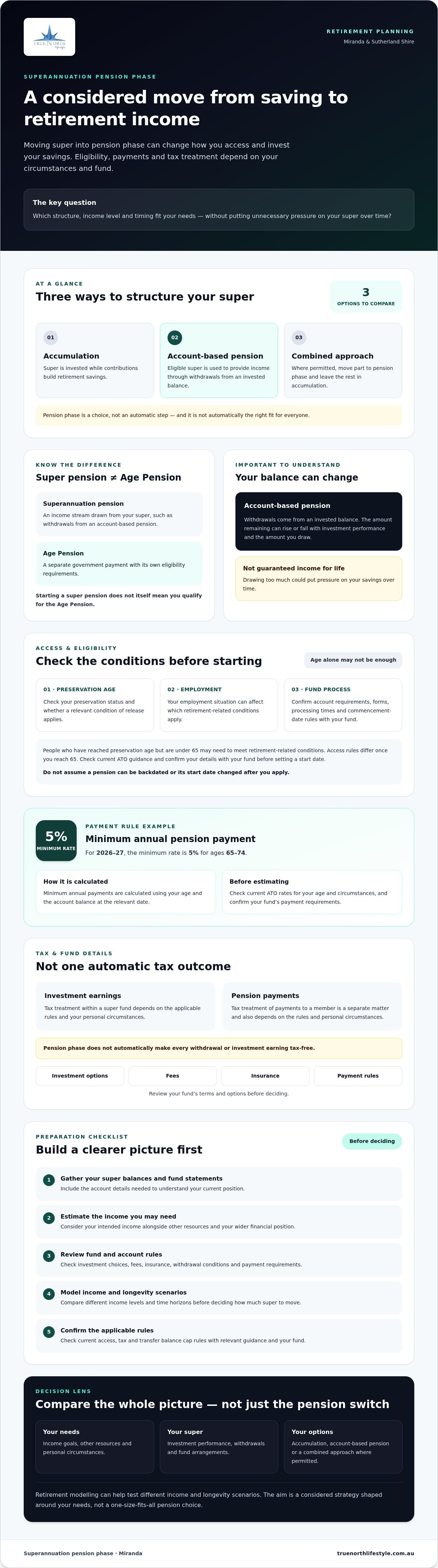
Accumulation phase is generally when super is invested and contributions build your retirement savings. In pension phase, eligible super is used to provide an income stream, typically through regular withdrawals from an invested account balance. For a foundational overview of the system, see Superannuation in Australia.
An account-based pension pays withdrawals from your invested balance. The amount remaining can change with investment performance and withdrawals, so it isn’t a guaranteed income for life. Depending on the rules and your fund’s options, you may be able to move part of your super into a pension and leave the rest in accumulation.
A superannuation pension is an income stream drawn from your super, while the Age Pension is a separate government payment with its own eligibility requirements. Starting a super pension does not itself mean you qualify for the Age Pension.
What changes, and what stays dependent on your circumstances?
The transition can affect how you access your savings, how your money is invested, the payments you receive and how your fund administers your account. Before proceeding, check your fund’s rules, investment choices, fees and any withdrawal conditions.
- Access: You generally need to meet the relevant superannuation conditions of release before accessing your super. The applicable condition depends on your circumstances.
- Payments: An account-based pension involves withdrawals from your balance. Payment requirements and flexibility depend on current rules and your fund’s terms.
- Tax: Tax treatment isn’t the same for every balance or withdrawal. It depends on applicable rules, account details and your personal circumstances.
Pension phase isn’t simply a tax switch or a guaranteed improvement. Miranda residents can compare keeping super in accumulation, starting an account-based pension, or combining the two where permitted. Consider your intended income, other resources and fund arrangements together before giving your fund instructions.
How super pension phase works: eligibility, payments and tax rules
Starting an account-based pension involves more than choosing a payment amount. You need to meet a condition of release, follow your fund’s process and understand how access, minimum withdrawals and tax rules apply to your super.
Eligibility and starting an account-based pension
Age alone may not give you access. Your preservation age, employment situation and whether you meet a relevant condition of release all matter. For example, people who have reached preservation age but are under 65 may need to meet retirement-related conditions; access rules differ once you reach 65. Check the current ATO guidance on accessing super, then confirm the details with your fund before setting a commencement date.
Ask your fund which forms, processing times and account requirements apply. Check your preservation status and employment circumstances first. Don’t assume you can backdate a pension or change its start date after submitting an application.
Minimum payments, tax and the transfer balance cap
An account-based pension pays withdrawals from an invested super balance. The balance can rise or fall with investment performance and the amount you draw, so the income isn’t guaranteed. Minimum annual payments apply and are calculated using your age and the account balance at the relevant date. For 2026-27, the minimum rate is 5% for ages 65-74; check the current ATO rates for your age and circumstances before estimating payments.
Tax on investment earnings within a super fund and tax on pension payments to a member are separate matters, and the treatment of each depends on the applicable rules and personal circumstances. Retirement-phase earnings may receive concessional tax treatment within the rules, but this doesn’t mean every earning or withdrawal is automatically tax-free. Your age and the taxable and tax-free components of your super can affect how payments are treated.
The general transfer balance cap is A$2.1 million for 2026-27, but it is not a universal limit on how much super you can hold. It limits the amount that can be transferred into retirement-phase income streams, and your personal cap may be lower if you’ve previously started a pension. Check your own cap and transfer balance history before moving funds.
Also consider how super may interact with government support. The Age Pension eligibility rules are separate from super pension rules, and Services Australia assesses eligibility under its own requirements. To understand how payment choices may affect your longer-term position, retirement income modelling can help you test different scenarios before deciding.
Is pension phase always better? Compare the trade-offs before deciding in Miranda
No. Moving super into pension phase isn’t automatically the best choice, even if you’re eligible or want regular retirement income. The right structure depends on your income needs, work plans, fund features and how your super fits with your other resources. For people considering superannuation pension phase Miranda, comparing practical trade-offs is more useful than focusing on tax treatment alone.
| Option | Access and income | Investment, tax and administration |
|---|---|---|
| Keep super in accumulation | Generally remains invested for retirement; withdrawals depend on access rules. | May suit eligible members continuing contributions. Check investment choices, fees, insurance and applicable tax rules. |
| Start an account-based pension | Provides withdrawals from an invested balance, subject to payment rules. | Investment risk remains, and payments and fund administration may change. Tax treatment depends on the rules and your circumstances. |
| Combine both, where permitted | May provide income from one portion while keeping another in accumulation. | Can offer flexibility, but may mean managing different account settings, requirements and fees. |
When keeping some super in accumulation may be worth considering
If you’re still working or expect to make further contributions, retaining an accumulation account may be worth exploring, subject to eligibility and your fund’s rules. It may also keep options open for money you don’t need to draw as income yet. Before moving funds, compare your fund’s fees, investment menu, insurance arrangements and any features you’d lose or need to maintain. Accumulation isn’t automatically more tax-effective; assess its treatment under current rules and your circumstances.
When a retirement income stream may fit your plans
An account-based pension may be worth considering if you need regular payments and have assessed how they would work alongside employment income, other retirement income and cash reserves. Consider payment flexibility and how much of your balance should remain invested. Market movements can reduce the value of an invested pension account, and withdrawals also lower the balance. Test whether your planned income could remain sustainable over time.
Suitability depends on your whole retirement plan, not tax treatment alone. Compare options against your spending needs, time horizon and fund arrangements rather than assuming one structure suits everyone. Retirement modelling can help you test different income and longevity scenarios before deciding whether to move some or all of your super.
A Miranda checklist: what to prepare before starting a super pension
Preparing in advance can make a conversation with your fund or adviser more focused. Before deciding whether to start a super pension, gather the details below and consider how the choice fits your household’s retirement plans. This checklist can help you assess the superannuation pension phase Miranda options available to you.
- Collect your super information. Gather recent statements for each account and note the current balances, fund names and any existing income streams.
- Review each fund’s features. Record investment options, fees, insurance cover and beneficiary nominations. Ask what may change if you move some or all of your balance into a pension account.
- Map household cash flow. List expected living costs, debts, cash reserves and other assets, along with any current income estimates. Include expected work income and when you plan to retire or reduce your hours.
- Consider your partner’s position. If you’re part of a couple, note each person’s super, income sources and retirement timing. Your needs and plans may differ, so avoid assuming one shared approach will suit both of you.
- Prepare questions before you act. Ask your fund about the commencement process, payment flexibility, investment choices and ongoing administration. Ask an adviser how different choices may affect household cash flow, longevity risk and other retirement assets.
Then consider how a proposed payment level could work across different timeframes and market conditions. Check the assumptions behind any income estimates, including whether they account for changing expenses, other assets and future work income. If tax is part of your decision, review the rules that apply to your circumstances; this tax planning for retirement in Australia guide offers broader context.
For a wider view of how super choices fit into a retirement strategy, read this retirement planning guide for Sydney. If you’re ready to compare your figures and test long-term income scenarios, explore personalised retirement modelling as a practical next step.
Superannuation pension phase advice in Miranda: turn your options into a plan
Once you understand the choices, consider how they may work within your broader retirement plans. True North Lifestyle provides retirement modelling and superannuation review to help Miranda-area clients assess income options, investment settings and longer-term needs together. The aim is to clarify the trade-offs, not to assume that moving into pension phase is right for everyone.
How retirement modelling can make the decision clearer
Modelling can compare income needs and withdrawal choices over time, including scenarios that test how long your savings may need to last. It can also help you consider how super fits alongside other assets, income sources and retirement goals. For more context on reviewing fund options, see this guide to superannuation advice in the Sutherland Shire.
Projections are estimates, not guarantees. They rely on assumptions such as investment returns, inflation, withdrawals and longevity, so those assumptions should be made clear and considered carefully. Results can help frame a decision, but they can’t remove uncertainty about future markets or personal circumstances.
A superannuation review, tax-minimisation strategy and bespoke portfolio construction can be considered as connected parts of a retirement plan. The right approach depends on your position and goals; no particular tax result, investment return or pension structure can be promised. True North Lifestyle provides financial advice, but doesn’t prepare tax returns or draft legal documents.
A calm next step for Miranda-area readers
Before a discussion, gather your super statements and a short list of questions. Note the income you may need, when you expect to stop or reduce work, and any concerns about how long your savings may need to support you. This gives the conversation a practical starting point.
Advice should consider more than your super balance. Your other assets, household income, spending needs and longer-term priorities can all shape the options worth exploring. If you’d like to explore how superannuation pension phase in Miranda may fit your circumstances, you can discuss your retirement strategy with True North Lifestyle.
Make your next retirement decision with clarity
Starting a super pension isn’t automatic, and the decision shouldn’t be based on tax treatment alone. Check your eligibility, fund rules and payment options, then consider how each choice fits your income needs, investments and wider retirement plans. The right approach may differ from one person to another.
For those exploring the superannuation pension phase Miranda options, retirement modelling can help test income and longevity scenarios before you decide. True North Lifestyle offers long-term projections alongside superannuation review, tax-minimisation strategies and bespoke portfolio construction, bringing these considerations into a broader plan without assuming a particular outcome.
If you’re ready to assess your circumstances and compare your options, discuss your retirement strategy with True North Lifestyle. A clearer view of the choices and trade-offs can help you plan your next step.
Frequently Asked Questions
What is pension phase in superannuation?
Pension phase is when eligible super is used to pay you a retirement income stream, commonly through an account-based pension. Your money generally remains invested, and withdrawals reduce the account balance while investment returns can affect its value. You may be able to move some or all of your super, depending on access rules and fund requirements. It’s distinct from accumulation, where super is generally invested while contributions build retirement savings.
Is superannuation pension phase tax-free in Australia?
No, not every part is automatically tax-free. Tax treatment depends on factors such as your age, the taxable and tax-free components of your super, the type of income stream and applicable rules. Investment earnings in retirement phase may receive tax-exempt treatment subject to the rules and transfer balance cap. For 2026-27, the general transfer balance cap is A$2.1 million, but your personal cap may be lower.
Can I move some of my super into pension phase and leave the rest in accumulation?
Often, you can use part of your super to start an account-based pension and leave the remainder in accumulation, if you meet the relevant access rules and your fund permits this arrangement. The accounts may have different investment settings, payment requirements and administration. Before moving money, check the fund’s rules, fees and insurance arrangements, and consider how partial conversion fits your income needs and broader retirement plans.
How much do I have to withdraw from an account-based pension?
You must generally withdraw at least the minimum annual amount, calculated using your age and the account balance at 1 July. For 2026-27, the minimum rates are 4% if under 65, 5% at 65-74, 6% at 75-79, 7% at 80-84, 9% at 85-89, 11% at 90-94 and 14% from age 95. Confirm the current rules and calculation with your fund.
What happens to my super when I start an account-based pension?
Your fund transfers the amount you nominate, subject to eligibility and its process, into an account that pays income withdrawals. The balance generally stays invested, so returns and withdrawals affect how much remains over time. Your fund will explain payment options and administration. Before starting, check what happens to investment choices, fees, insurance and beneficiary nominations, as these details may differ between your accumulation and pension accounts.
Do I need a financial adviser to start pension phase in Miranda?
You can ask your super fund about its process and requirements; whether you need advice depends on your circumstances and the decisions involved. An adviser can help assess eligibility, fund features, tax considerations and how withdrawals may affect your wider retirement plan. For superannuation pension phase Miranda decisions, True North Lifestyle offers retirement modelling and superannuation review to help you compare options, without assuming one approach suits everyone.
Is pension phase the same as the Age Pension?
No. A superannuation pension is an income stream drawn from your super, while the Age Pension is a government payment administered by Services Australia, with separate eligibility rules. Starting a super pension doesn’t automatically qualify you for the Age Pension. Eligibility is generally age 67 for people born on or after 1 January 1957, and Services Australia also applies income and assets tests when assessing claims.


