

A young family’s financial plan shouldn’t depend on getting every decision right at once. In Miranda 2228, housing and household costs can compete with goals such as building savings, reviewing superannuation and planning for the future. If you’re considering financial advice for young families Miranda has to offer, start by asking what needs attention now and what can sensibly wait.
It’s understandable to feel pulled in several directions. You want to protect your family’s financial wellbeing, but comparing advice processes, services and fees can add uncertainty. A useful plan starts with your circumstances, then sets priorities you can revisit as work, housing and family needs change.
This 2026 guide explains what financial advice for a young family may cover, how long-term projections can help you compare choices, and how superannuation, tax considerations, investments and estate planning can fit together. You’ll also find practical ways to assess the scope and cost of advice, so you can make decisions with more clarity and build a realistic plan at a pace that suits your family.
Key Takeaways
- Identify which household pressures and future goals need attention first, rather than trying to solve everything at once.
- Financial advice for young families Miranda can bring superannuation, tax considerations, investments and estate planning into a tailored strategy.
- Compare advice scope, process, fees and communication to understand whether a one-off strategy or ongoing advice better suits your family.
- Gather a simple snapshot of your budget, super, debts and existing insurance before a meeting. Your records don’t need to be perfect.
- Use long-term projections to explore how family decisions may affect future goals, then review the plan as circumstances change.
Why young families in Miranda seek financial advice before major decisions
Family life brings decisions with financial consequences, often while the weekly budget is already covering housing, childcare, bills and everyday costs. A change in income or a new commitment can affect how much room you have to save, manage risk or work towards longer-term goals. It can be difficult to see how these decisions fit together.
Structured advice can connect your current cash flow with protection needs, superannuation and future plans. A useful first conversation starts with your family’s circumstances and priorities, not a product recommendation. The aim is to understand what matters most, identify choices and trade-offs, then consider strategies that fit your situation. For a plain-language introduction to the role, see what is a financial planner.
Structured guidance may be useful when you’re:
- Preparing for a new child or adjusting to changes in household expenses.
- Considering a change to work arrangements, such as reducing hours or returning to work.
- Taking on a home loan or reviewing how housing commitments affect other goals.
- Setting savings priorities for education, family protection or retirement.
- Trying to understand how superannuation, existing cover and future plans work together.
Which family milestones can change your financial priorities?
Milestones shift the balance between income, expenses and financial risk. Welcoming a child may increase regular costs and make household protection more important. Changing work arrangements can alter income and super contributions. Buying a home may increase fixed commitments and reduce short-term saving capacity, while education plans can introduce a longer-term savings goal.
There’s no single Miranda family template. Your priorities depend on your income, housing situation, family structure and goals. Planning helps you work through those details rather than assuming every household should follow the same sequence.
Can financial advice help if you are not wealthy yet?
Yes. Clarity can matter before you’ve built significant assets. A realistic view of income, expenses, debts and super can help you decide what deserves attention now and what can wait. Long-term projections can help you explore how different choices may affect future goals, without treating any outcome as certain.
Strategic advice isn’t a promise of quick wealth or guaranteed results. The appropriate scope depends on your goals and circumstances, as well as the services you agree to receive. For families considering financial advice for young families Miranda, that means starting with the decisions in front of you and building a plan that can adapt as life changes.
What financial advice for young families in Miranda can cover
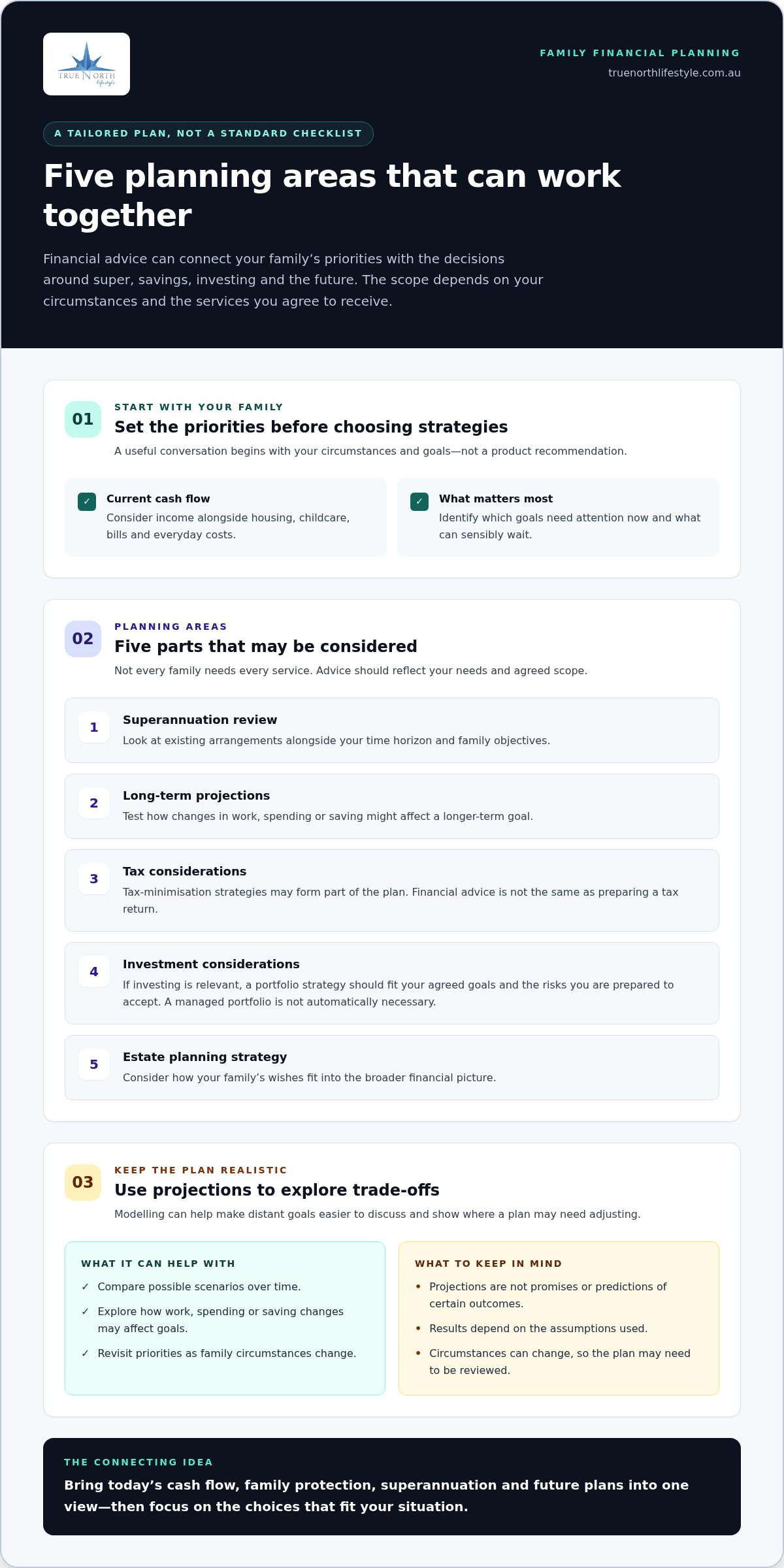
Financial advice is a tailored process for understanding what your family wants to achieve, considering your circumstances and weighing suitable strategies. It isn’t a standard checklist where every household needs every service. The scope should reflect your priorities and the services agreed for the engagement.
Depending on your needs, planning may bring together a review of superannuation, long-term projections, tax-minimisation strategies, investment considerations and estate planning strategy. These areas can affect one another. For example, a change to work or savings may influence your super contributions, while investment decisions should reflect your goals and tolerance for risk. Estate planning strategy can help you consider how your family’s wishes fit into the broader picture.
How can an adviser connect family goals with superannuation and investing?
A superannuation review can consider your existing arrangements alongside your time horizon and family objectives, rather than treating your fund as a separate decision. If investing is relevant, a portfolio strategy should reflect the goals you’ve agreed on and the risks you’re prepared to accept. A managed investment portfolio isn’t automatically necessary; advice should be proportionate to your circumstances. Read more about superannuation advice in the Sutherland Shire.
Tax considerations may form part of the strategy, but financial advice isn’t the same as preparing a tax return. The focus is on how financial choices may fit together and what to consider in light of your objectives.
What can long-term projections show a young family?
Projections can help you test assumptions over time, such as how a change in work, spending or saving might affect a longer-term goal. They offer a structured way to compare possible scenarios and see where your plan may need adjusting. They aren’t promises or predictions of certain outcomes: results depend on the assumptions used, and circumstances can change.
This can make a distant goal easier to discuss in practical terms. A projection-led approach can help you assess trade-offs, revisit priorities and consider possible longer-term effects. See Sydney retirement modelling guidance for a related example of how modelling can support planning.
As you define the scope of advice, ASIC’s MoneySmart guide on how to choose a financial adviser offers practical considerations for comparing advice. True North Lifestyle provides tailored financial advice for young families Miranda households can use to connect these planning areas. Explore True North Lifestyle’s financial strategy.
How to compare financial advisers for a Miranda family
A useful comparison looks beyond a general promise of personalised advice. Focus on what the engagement covers, how recommendations are developed, what they cost and what support follows. ASIC’s MoneySmart explains different types of financial advice, which can help you understand the guidance you’re considering.
Use these areas to organise your comparison. Review the scope, process and fee information in writing so you understand what’s included before deciding.
Advice scope
Which goals and topics will the advice address? Check that the scope reflects your family’s priorities, rather than assuming every financial area is included.
Process
How will your circumstances, objectives and risk preferences inform the recommendations? Look for a clear explanation of the steps from understanding your situation to presenting a strategy.
Fees
What work does each fee cover, how is it charged, and are ongoing or portfolio management fees separate from initial advice costs?
Ongoing service
Is the engagement a one-off strategy, or does it include ongoing reviews and support? Understand what follow-up involves and whether it suits how your family wants to manage its plan.
Communication
Are explanations clear, and can you see how recommendations relate to your stated goals? Consider whether the communication style and level of support feel right for you.
What should families understand about advice fees and ongoing service?
Separate the cost of preparing initial advice from any continuing service or portfolio management charges. These may cover different work, so compare what each fee pays for, how it’s calculated and when it applies. There’s no single fee arrangement for every family. The important thing is understanding the scope and charges before you agree to proceed.
A one-off engagement may suit a defined decision or strategy, while ongoing advice may be relevant when you want regular support as circumstances change. Compare the service included, not just the label.
How can you assess whether advice is genuinely tailored?
Recommendations should reflect your family’s goals, current financial position and risk tolerance. You should be able to follow the reasoning and see how each recommendation connects to an objective you’ve discussed. If investment strategy is part of the scope, explore bespoke investment advice in Sydney for related information.
The right fit depends on your circumstances and the support you prefer. True North Lifestyle provides tailored financial advice for young families Miranda households can consider alongside these comparison points. Explore True North Lifestyle’s financial planning.
What to prepare before meeting a financial adviser in Miranda
You don’t need a perfect spreadsheet or a folder of every financial document. A rough picture of your household finances and a clear sense of what you want help with can make the first conversation more useful. As the discussion develops, you can identify which details matter most.
Which documents and details are useful for a first conversation?
Use this checklist as a starting point. Estimates are fine if you don’t have exact figures to hand.
- Household cash flow: Note take-home income and regular expenses, including housing, childcare, bills and savings.
- Superannuation: Bring recent statements or note your funds, balances and contribution details, if available.
- Debts and investments: List major debts and relevant investment details, such as accounts or assets you want considered.
- Existing insurance: Gather policy information or superannuation statements showing any cover you’re aware of.
- Upcoming commitments: Note expected changes, such as parental leave, a work change, a home purchase or education costs.
- Priorities: Write down one or two near-term concerns and longer-term goals, even if they’re still broad.
Keep sensitive personal and account information private. Don’t send it through unsecured channels; use an appropriate secure method when documents need to be shared.
How does a structured advice process move from goals to a plan?
A structured process begins with your circumstances and the outcomes you want to work towards. You and the adviser can then agree on the advice scope, consider suitable strategic options and identify what further information is needed. You can raise questions as you go; preparation is a starting point, not a test.
Where long-term projections are useful, modelling can explore assumptions and show how choices might affect competing goals. For example, it may help you compare savings priorities or consider how a change in work could alter your capacity to invest. These are scenarios for discussion, not assurances of a particular result. Long-term resilience may also involve considering how to preserve family assets over time, alongside your broader objectives.
Preparing in this way can make financial advice for young families Miranda families seek more focused and manageable. If you’re ready to discuss your goals and financial circumstances, start a conversation about tailored financial advice.
A tailored financial advice pathway for young families in Miranda
For families in Miranda 2228, a useful advice pathway should start with the decisions shaping life now, then connect them to longer-term priorities. True North Lifestyle provides tailored financial strategy for families in Miranda, bringing relevant parts of your financial picture into focus without assuming every household needs the same approach.
Depending on your circumstances and agreed advice scope, this may include long-term projections, a superannuation review, tax-minimisation strategies and estate planning strategy. These areas can be considered together. A change in work or savings may affect superannuation, while family priorities can influence how you think about investing and preserving wealth. Investment strategy and any ongoing portfolio management should be discussed in the context of your goals, risk considerations and the services you agree to receive.
How can financial modelling support a family’s changing plans?
Family plans rarely stay fixed. Work arrangements, housing decisions, education priorities and other commitments can shift over time. Scenario modelling can help you explore how different assumptions or choices might affect longer-term objectives, making trade-offs easier to understand before deciding what to prioritise.
A projection is a planning tool, not a promise of a particular result. Its value lies in showing how a plan responds to changing assumptions and where a review may be useful. Families can use projections to revisit their priorities as circumstances evolve, rather than relying on a single forecast.
What is a practical next step for a Miranda family?
Keep it simple. Before an initial discussion, write down your most important near-term decision and the questions you’d like answered. These might relate to balancing current commitments with future goals, understanding your superannuation or deciding what financial information to review first. You don’t need a complete plan before seeking guidance.
An initial conversation can help clarify what matters to your family, what advice scope may be relevant and what next steps could look like. That creates a considered starting point without requiring you to settle every decision at once.
If you’re ready to bring more structure to your family’s financial priorities, discuss your circumstances and goals with True North Lifestyle. A tailored approach to financial advice for young families Miranda can help you consider today’s choices alongside the future you’re working towards.
Take the next step towards greater financial clarity
A family plan doesn’t need to address every goal at once. Start by understanding your priorities, comparing advice scope and fees carefully, and choosing a strategy that can adapt as circumstances change. For families considering financial advice for young families Miranda, a tailored approach can connect decisions about superannuation, tax and longer-term goals with day-to-day needs.
True North Lifestyle works with families in Miranda and provides research-driven financial advice. Long-term projections can help you explore different scenarios, while superannuation strategy and tax-minimisation strategies can be considered alongside risk management and wealth preservation. The aim is greater clarity about your options, not a promise of a particular outcome.
Start by noting the financial decision on your mind and the questions you’d like to resolve. Then talk with True North Lifestyle about a financial strategy for your family. A considered conversation can help you organise the next steps and move forward with greater confidence.
Frequently Asked Questions
When should a young family in Miranda seek financial advice?
Consider advice when a major change or decision could affect your household finances. Welcoming a child, changing work arrangements, taking on a home loan or setting education goals can shift your cash flow, savings capacity and protection needs. You don’t need to wait until your finances feel complicated or you’ve accumulated significant assets. A conversation can help clarify priorities and identify which decisions deserve attention first.
What does financial advice for young families cover?
It can cover the financial questions most relevant to your family’s goals and circumstances. Depending on the agreed scope, this may include a superannuation review, long-term projections, tax-minimisation strategies, investment considerations, risk management and estate planning strategy. Not every family needs every strategy or an investment portfolio. Start by identifying what you want to achieve, then consider suitable options and how they fit together.
How do I choose a financial adviser in Miranda?
Compare the advice scope, planning process, fee arrangements, ongoing service and communication style. Review a clear written explanation of what work is included, how recommendations will relate to your goals and whether the engagement is one-off or ongoing. Consider whether the adviser’s approach suits your family’s circumstances and preferred level of support. ASIC’s MoneySmart guide to choosing a financial adviser can also help you prepare for comparisons.
Is financial advice worthwhile if we have a mortgage and young children?
It can be useful if you want to understand how home-loan commitments and family expenses affect other priorities. Advice may help you consider cash flow, existing insurance, superannuation and longer-term goals as connected parts of your financial picture. It won’t remove every trade-off or guarantee an outcome, but a tailored strategy can help you identify what to focus on now and what may be staged for later.
What should we bring to a first financial advice meeting?
Bring a simple snapshot of household income and expenses, superannuation statements, details of debts and any relevant investments or existing insurance. Note upcoming commitments, such as parental leave, a work change or education costs, and write down your main questions and goals. Estimates are useful if exact records aren’t handy. Don’t send sensitive personal or account information through unsecured channels; use an appropriate secure method when sharing documents.
How much does financial advice for a young family cost in Australia?
The cost depends on the advice required, the complexity of your circumstances and the services you agree to receive, so there isn’t one fee that applies to every family. Initial strategy work and ongoing advice or portfolio management may be charged separately. Before deciding, review a written explanation of the fees, what work each covers and whether any continuing service is included. Compare the scope and value, not just the fee structure.
Can a financial adviser help with superannuation and long-term family goals?
Yes. An adviser can review superannuation in the context of your family’s objectives and time horizon, and use long-term projections to explore how different assumptions or choices may affect future goals. True North Lifestyle provides superannuation strategy and modelling alongside relevant tax-minimisation, risk-management and wealth-preservation considerations. Projections are planning scenarios, not promises, and can be revisited as your circumstances and priorities change.


