
What if the right investment strategy isn’t the one with the least risk, but the one whose risks you can live with? If market falls could unsettle your retirement plans, it’s understandable to want clarity about how much risk may be appropriate. Effective investment risk management Sutherland Shire starts by connecting investment decisions with your goals, financial capacity and time horizon.
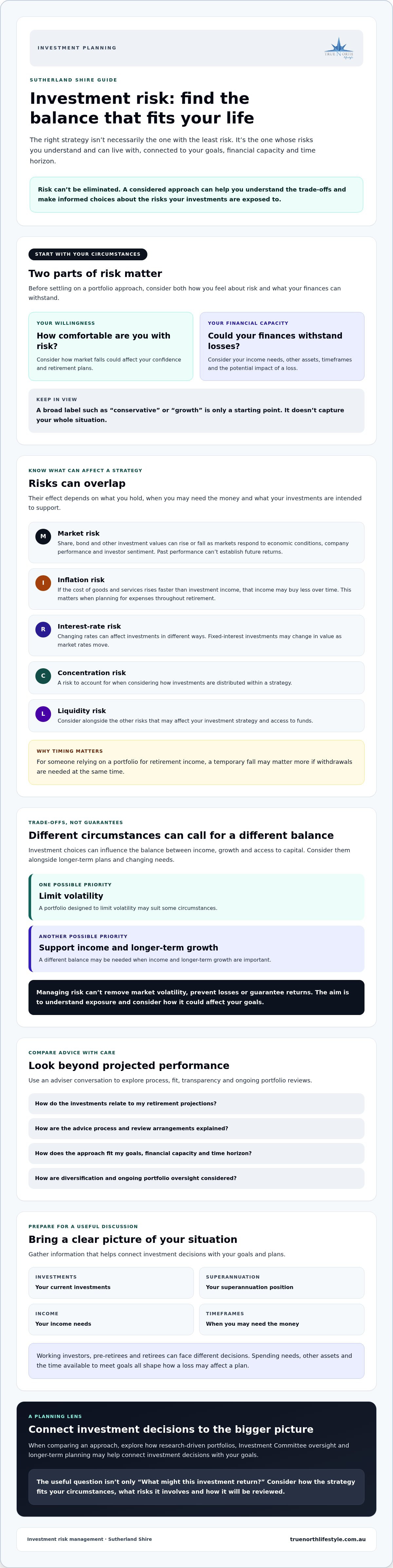
Risk can’t be eliminated, but it can be assessed and managed through a considered approach. The key is understanding the trade-offs. A portfolio designed to limit volatility may suit some circumstances, while a different balance may be needed to support income and longer-term growth.
This guide explains the main risks that can affect an investment strategy, including market movements, inflation and concentration, and how diversification and ongoing portfolio oversight may help manage them. You’ll also find practical questions to ask an adviser, from how your investments relate to retirement projections to how advice and review arrangements are explained. Use these points to compare advice and identify an approach that reflects your circumstances, rather than relying on a one-size-fits-all view of risk.
Key Takeaways
- Understand how market, inflation, interest-rate, concentration and liquidity risks can interact within an investment strategy.
- Assess both your willingness to take investment risk and your financial capacity to withstand losses before settling on a portfolio approach.
- Use investment risk management Sutherland Shire advice discussions to ask about process, fit, transparency and ongoing portfolio reviews, not just projected performance.
- Prepare for an adviser conversation by gathering a clear picture of your investments, superannuation, income needs and timeframes.
- Explore how research-driven portfolios, Investment Committee oversight and longer-term planning may help connect investment decisions with your goals.
Sutherland Shire Risk Management: Capabilities & Limits
Market uncertainty can feel more consequential when your investments are expected to support a future lifestyle or retirement plan. A fall in value may affect more than your portfolio balance. It can influence the income you draw, the timing of a major decision or how secure a long-term plan feels. That’s why investment risk management Sutherland Shire should begin with your circumstances, not a standard risk label.
Investment risk management means identifying, understanding and responding to the risks within an investment strategy. The aim isn’t to predict every market movement or avoid every loss. It’s to make informed decisions about the risks you’re exposed to and consider how they could affect your goals. Financial risk management provides a broad introduction to the field, while an individual investment strategy needs to account for the investor’s own priorities and financial position.
There are limits. Managing risk can’t remove market volatility, prevent losses or guarantee returns. Instead, it can help clarify the trade-offs involved in investment choices. For instance, an investor drawing income may need to consider how a downturn could affect both the value of their investments and the amount they can comfortably withdraw. Someone with a longer timeframe may have different needs, but still needs to understand the possibility of losses.
What does investment risk management mean for an individual investor?
Risk management is the process of making informed investment decisions by identifying potential risks, assessing their impact on your goals and choosing how to respond. It focuses on managing exposure, not controlling markets. Investment choices can influence the balance between income, growth and access to capital, so consider them alongside longer-term plans and changing needs.
A broad category such as “conservative” or “growth” can be a starting point, but it can’t capture your whole situation. Two people with similar investments may have different incomes, spending needs, other assets and timeframes. A useful discussion explores those details before considering what level or type of risk may be appropriate.
Why Sutherland Shire investors may seek tailored guidance
Working investors, pre-retirees and retirees can face different decisions, but there’s no single profile for people in the Sutherland Shire. One household may be building wealth while balancing current expenses; another may be planning when to draw on superannuation; a retiree may rely on investments to help fund regular spending. Each situation affects the time available to meet goals and the potential impact of a loss.
If you’re in Miranda 2228, Sydney 2000 or the wider Sutherland Shire, ask an adviser about their current meeting arrangements and location. True North Lifestyle provides financial planning and retirement strategy services through advisers in New South Wales. Tailored guidance can help clarify how investment decisions connect with your goals, but it can’t remove uncertainty or promise an outcome.
Understand the investment risks your strategy needs to account for
Investment risk isn’t a single score or simply the chance that markets will fall. Different risks can overlap, and their effect depends on what you hold, when you may need the money and what your investments are intended to support. For someone relying on a portfolio for retirement income, a temporary fall may matter more if withdrawals are needed at the same time.
The examples below are general illustrations, not forecasts or personalised financial advice. ASIC’s Moneysmart resource on Develop an investing plan is a useful starting point for considering risk, return and diversification together.
Market, inflation and interest-rate risks
- Market risk: Share, bond and other investment values can rise or fall as markets respond to economic conditions, company performance and investor sentiment. Past performance can’t establish what an investment will return in the future.
- Inflation risk: If the cost of goods and services rises faster than the income an investment produces, that income may buy less over time. This matters when planning for expenses that may continue throughout retirement.
- Interest-rate risk: Changing rates can affect investments in different ways. For example, fixed-interest investments may change in value as market rates move, while cash and savings returns may adjust. The effect depends on the investment and its terms.
These risks can interact. A portfolio might fall in value while the cost of living continues to affect spending power. For retirees, the discussion isn’t only about whether values fluctuate. It’s also about how income needs and planned withdrawals fit with those fluctuations.
Concentration, liquidity and timing risks
Concentration risk arises when a portfolio depends heavily on a narrow group of investments, companies or sectors. If that area performs poorly, there may be fewer other holdings to offset the effect. Diversification across investments can help spread exposure, though it can’t prevent losses.
Liquidity risk is the possibility that you can’t access or sell an investment quickly, or without accepting a less favourable price, when you need the money. Consider upcoming expenses and income needs alongside the investments themselves.
Sequence-of-returns risk describes how the timing of investment returns can affect a portfolio when withdrawals are being made. Early losses during a period of regular withdrawals may place different pressure on retirement savings than similar losses at another time. It’s one factor to explore in a retirement income discussion, not a prediction of what markets will do.
Considering these risks together can make investment risk management Sutherland Shire more relevant to your circumstances. If you’re reviewing how portfolio risks connect with longer-term projections, you can explore True North Lifestyle’s investment risk management approach.
How to assess investment risk advice before choosing an adviser
Good advice should make the reasoning visible. Compare advisers by how they understand your circumstances, explain trade-offs and review recommendations, rather than by confident return projections. For investment risk management Sutherland Shire, the central question is whether the proposed strategy connects with your goals, timeframe, income needs and other assets.
Two ideas matter here: willingness to take risk and capacity to withstand losses. Willingness is how comfortable you feel with investment values fluctuating. Capacity is whether your finances can absorb a loss without derailing essential spending or plans. They don’t always align. You might feel comfortable with market swings but have limited capacity for loss because you’ll soon need to draw income. An adviser should explore both, not rely on a questionnaire score alone.
Questions to ask about suitability and portfolio oversight
Use the first conversation to understand the process. Ask how your goals, investment timeframe and response to market fluctuations will inform the recommendations. Then ask what ongoing oversight involves and what might prompt a review, such as a change in your circumstances or a material change in the portfolio. Check that risks, limitations and potential trade-offs will be explained in writing.
- How does each proposed investment support my goals and income needs?
- How does the strategy account for my superannuation, other assets and timeframes?
- What could cause the portfolio to be reviewed, and what ongoing service is included?
- Where can I see the risks, assumptions and limitations in the advice?
Clear answers should help you understand not just what’s recommended, but why it may suit you and what could go differently. Moneysmart’s guidance on investment warning signs can also help you recognise pressure tactics or claims that deserve closer scrutiny. For another perspective on portfolio construction, read about bespoke investment advice in Sydney.
Check credentials, scope and fees before proceeding
Check the adviser’s current details on ASIC’s Financial Advisers Register, then consider the wider picture. Registration is a useful verification step, but it doesn’t by itself show whether an adviser’s approach or recommendations suit your needs. Ask what advice is included, how fees are calculated, what ongoing services cover and whether ongoing support is optional. Request clear written information before deciding to proceed.
Compare the whole advice process: how carefully your circumstances are considered, whether explanations are understandable, and how recommendations will be monitored. A considered discussion should leave you better equipped to weigh the trade-offs, without pressure to accept a particular investment or promised outcome.
Prepare for an investment risk management conversation in the Sutherland Shire
A little preparation can make an advice meeting more useful. You don’t need to arrive with every answer, but a clear picture of what you own, what the money needs to do and what concerns you can help keep the discussion grounded in your priorities. For investment risk management Sutherland Shire, the goal is to leave with a better understanding of the choices and trade-offs, not to make a rushed decision.
What to bring and clarify before an advice meeting
Gather a current overview of your finances using records you can share securely with the adviser. There’s no need to post account numbers or other sensitive details publicly. Useful information may include:
- A summary of investment holdings and relevant account statements.
- Superannuation statements, including details of investment options.
- An outline of income needs, regular expenses and any expected withdrawals.
- Key timeframes, such as when you may need to access funds or expect a change in circumstances.
Next, note what each investment is intended to support. It might be future retirement income, a planned expense or longer-term wealth preservation. Write down the decisions on your horizon, the market movements that worry you most and the trade-offs you could accept. For example, consider how you feel about balancing income, access to funds and potential growth. Your answer helps frame the conversation, but doesn’t predetermine a suitable strategy.
If you’re also thinking about protecting assets and maintaining financial resilience over time, this overview of wealth preservation strategies may provide useful context.
How to evaluate recommendations after the meeting
Take time to read the recommendations and check that they connect clearly with the goals and information you discussed. The advice should explain the proposed strategy, its major risks and limitations, and the reasons behind the recommendations. Consider whether it addresses your income needs, timeframes and existing investments, rather than treating each decision in isolation.
Before proceeding, make sure you understand the practical details:
- What steps would be involved in implementing the recommendations?
- How and when will the portfolio be reviewed, and what could prompt an earlier review?
- What fees apply, what do they cover and are ongoing services optional?
- Which terms, assumptions or potential outcomes need further explanation?
You’re entitled to ask for unfamiliar language to be explained plainly. If something doesn’t make sense, request clarification and take the time you need to consider the information. To discuss how portfolio risk may connect with your longer-term plans, explore investment risk and portfolio sustainability modelling.
How True North Lifestyle approaches investment risk management
Investment decisions make more sense when they’re considered alongside the life they’re intended to support. True North Lifestyle connects risk management with bespoke portfolio construction and longer-term planning, helping frame portfolio choices in relation to individual goals and circumstances. Its approach includes research-driven investment portfolios, with bespoke portfolio construction overseen through an in-house Investment Committee.
The focus may include low-volatility and income-focused strategies for wealth preservation and growth. These are approaches to consider, not guarantees or default solutions. Their suitability depends on factors such as your income needs, investment timeframe, existing assets and capacity to absorb losses. No portfolio approach can remove investment risk or ensure a particular return.
Connect portfolio decisions with longer-term goals
Retirement modelling and long-term projections can help put investment decisions in context. For example, modelling may support a discussion about how different portfolio assumptions relate to future income needs and planned withdrawals. Portfolio sustainability modelling can also inform conversations about how a strategy may hold up under different conditions. These tools can clarify trade-offs, but rely on assumptions and can’t guarantee a particular outcome.
If you’re considering investment decisions as part of a wider retirement plan, explore this guide to retirement planning in Sydney for related context.
Take a considered next step with a local advice team
A first conversation can help you outline what you want your investments to achieve, what concerns you have about risk and what advice may be relevant. It’s also a chance to clarify the scope of the service, how recommendations are developed and what ongoing portfolio oversight involves. You can bring questions and take time to consider any recommendations before deciding how to proceed.
For people in Miranda 2228, Sydney 2000 and the wider Sutherland Shire, investment risk management is most useful when it connects portfolio decisions with personal goals and longer-term plans. A measured discussion can help you understand the options and their limitations, without pressure to pursue a particular strategy.
Discuss your investment goals with True North Lifestyle.
Build a clearer path for your investment decisions
Investment risk management Sutherland Shire is most useful when it connects portfolio choices with your goals, financial capacity and time horizon. Understanding how market, inflation, interest-rate, concentration and liquidity risks may affect your plans can help you ask more focused questions and assess advice beyond performance claims.
Before deciding, clarify how recommendations relate to your income needs and other assets, how the portfolio will be reviewed, and what risks and trade-offs you should understand. A considered strategy can’t remove volatility or guarantee returns, but it can give you a clearer framework for making investment decisions.
True North Lifestyle’s approach combines research-driven portfolios, oversight through an in-house Investment Committee, and investment risk management and portfolio sustainability modelling. These provide a basis for discussing how a strategy may fit your circumstances, not a promise of a particular outcome.
If you’re ready to explore your options, discuss your investment goals with True North Lifestyle. A thoughtful conversation can be a steady first step towards decisions that feel better aligned with the future you’re planning for.
Frequently Asked Questions
What is investment risk management?
Investment risk management is the process of identifying, understanding and responding to risks within an investment strategy. It considers how possible losses or changing conditions could affect your goals, income needs and timeframes. An investor might review how their portfolio is exposed across different asset types and whether they’ll need to access funds soon. The aim is to make informed decisions, not to predict every market movement.
Can an adviser eliminate investment risk?
No adviser can eliminate investment risk, prevent all losses or guarantee investment returns. An adviser can help you understand exposures, consider how investments relate to your circumstances and explain possible trade-offs. For example, a strategy with lower volatility may still lose value or may not meet every income or growth objective. Ask what risks remain, how they’re monitored and what could prompt a review of your strategy.
How do I choose an investment adviser in the Sutherland Shire?
Compare the advice process, suitability, transparency and ongoing oversight, not just performance claims. Ask how the adviser considers your goals, timeframe, income needs, other assets and capacity to withstand losses, and how recommendations will be explained in writing. For advice in Miranda 2228, Sydney 2000 or the wider Sutherland Shire, check the adviser’s current details on ASIC’s Financial Advisers Register, then clarify the advice scope, fees and review arrangements before proceeding.
What is the difference between risk tolerance and risk capacity?
Risk tolerance is how comfortable you feel with investment values fluctuating or falling. Risk capacity is how much loss your financial situation could withstand without seriously affecting essential spending or important plans. The two can differ: you may feel calm about market falls but have limited capacity if you’ll soon need to draw income from your investments. Advice should consider both, alongside your goals and time horizon.
How often should an investment portfolio be reviewed?
There isn’t one review schedule that suits every investor. Agree with your adviser on how often the portfolio will be reviewed and what events could prompt an earlier check, such as a change in income needs, goals, timeframes or personal circumstances. Reviews can help assess whether the strategy still fits, but they shouldn’t be confused with reacting to every market movement. Clarify what ongoing oversight includes and how it works.
Is a low-volatility investment strategy suitable for everyone?
No. A low-volatility approach may appeal to someone seeking to limit fluctuations, but it can still experience losses and may not suit every goal, timeframe or income requirement. Consider how it balances potential growth, income needs, access to funds and your capacity for loss. True North Lifestyle’s stated focus includes low-volatility and income-focused strategies, but whether either approach is appropriate depends on your individual circumstances.
What should I bring to an investment advice meeting?
Bring a current overview of your investments, superannuation, income needs and relevant timeframes. Statements or summaries can help, along with notes on planned withdrawals, upcoming decisions, goals and concerns about market fluctuations. You don’t need to share account numbers publicly; provide sensitive records through an appropriate, secure process. A clear picture of your circumstances can help the adviser explain how recommendations relate to your priorities and what questions remain.


