

The village with the lowest entry price may not be the one that best supports your retirement plan. Retirement village financial advice Miranda residents seek should look beyond the amount needed to move in and consider how ongoing fees, contract terms and exit arrangements could affect income, assets and access to cash over time.
It’s understandable to focus first on affordability. But a move can reshape your wider finances, including how long your savings may need to last and what funds remain available for future needs. This guide explains how to compare village options against your goals and circumstances, and what to discuss with a financial adviser before deciding.
We’ll cover the financial questions to raise about entry contributions, recurrent charges, deferred management fees and exit entitlements, as well as how retirement modelling, superannuation and portfolio reviews may help you assess the longer-term picture. Village contracts can be complex, so financial advice should sit alongside independent legal review, not replace it. The aim is a clearer, more considered choice, made with the right support.
Key Takeaways
- Assess affordability across income, assets, ongoing obligations and future needs, rather than relying on the entry contribution alone.
- Use the same comparison questions for each village to weigh lifestyle fit, payment structure, recurrent charges and exit terms.
- Prepare for retirement village financial advice Miranda by gathering village information, draft contracts and household financial records where available.
- Ask how retirement modelling, superannuation review and investment strategy could inform your decision without treating projections as certainty.
- Check possible Centrelink implications with Services Australia, and seek independent legal review of contract terms before deciding.
Retirement villages near Miranda: why the financial decision goes beyond the move
A retirement village may offer a lifestyle and support that feel right, but the financial decision also needs to preserve enough flexibility for the years ahead. For people comparing options in Miranda 2228 and the wider Sutherland Shire, the entry contribution is only one part of the picture. A move can change how much cash is readily available, how retirement income is arranged and what choices remain if circumstances change.
Retirement villages generally provide independent living, which is different from residential aged care. The distinction matters because the services and financial arrangements aren’t the same. For broader context, see this overview of the aged care system in Australia.
What a retirement village decision can change financially
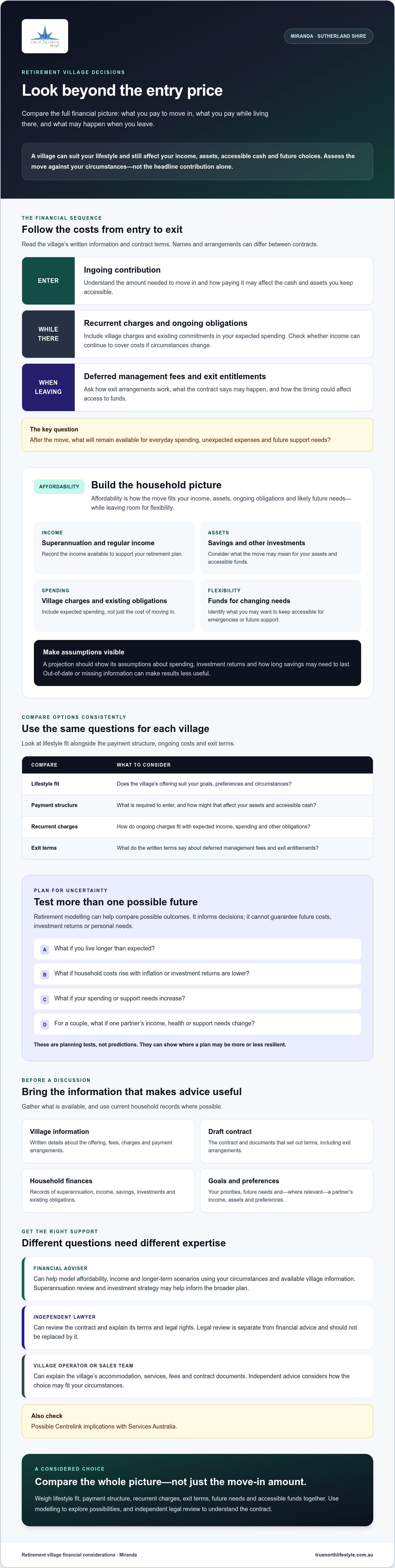
Look at the full financial sequence: what you pay to enter, the charges you’ll meet while living there, and what the contract says may happen when you leave. Terms such as an ingoing contribution, recurrent charges or an exit entitlement can mean different things in different contracts. Check the village’s written information rather than relying on a verbal summary.
Then consider your position after the move. How much will remain accessible for everyday spending, unexpected expenses or future support? Will your income still cover ongoing costs if your needs change? Your household’s goals, health considerations and any partner’s income, assets and preferences all shape the answer. There’s no single village model that suits everyone.
Which professionals help with which parts of the decision?
A financial adviser can help model affordability, income and longer-term scenarios using your financial circumstances and the information available about a village. Retirement modelling may help you compare possible outcomes and test how a move could affect your assets and future plans. It can inform a decision, but it can’t guarantee future costs, investment returns or personal needs.
For retirement village financial advice Miranda residents can discuss how a proposed move fits their broader financial plan. Contract interpretation and advice about legal rights are separate matters: ask a suitably qualified lawyer to review the contract and explain its terms before you sign.
Keep the roles clear. A village operator or sales team can explain its accommodation, services, fees and contract documents, but that information relates to the village’s offering. Independent financial advice considers how the choice may fit your circumstances, while legal advice addresses the contract itself. Using both helps you assess the whole decision without relying on one source for every answer.
How to assess retirement village affordability across your retirement
Affordability isn’t a single entry figure. It’s whether the move fits your income, assets, ongoing obligations and likely future needs while leaving enough flexibility for the unexpected. A retirement plan can look manageable under one set of assumptions and tighter under another. The aim is to understand the trade-offs, not to treat a projection as a promise.
Map income, assets and cash flow before comparing villages
Start with a clear picture of your household finances. Gather details of:
- Superannuation and any regular income
- Savings and other investments
- Expected spending, including village charges and existing obligations
- Funds you may want to keep accessible for emergencies or changing support needs
Use current records where possible, and make assumptions visible. For example, a projection should show what it assumes about spending, investment returns and how long your savings may need to last. If information is missing or out of date, the result may be less useful. A superannuation review and long-term retirement modelling can help organise these inputs into a clearer view of cash flow over time.
Test the decision against different future scenarios
Rather than relying on a single forecast, compare a range of reasonable scenarios. What might change if you live longer than expected, household costs rise with inflation, investment returns are lower, or your spending needs increase? For a couple, consider how the plan would look if one partner’s income, health or support needs changed. These are planning tests, not predictions. Their value is in showing where the plan may be more or less resilient.
Whole-of-retirement cash-flow modelling helps show how today’s housing choice may shape tomorrow’s income, accessible savings and options.
ASIC’s Moneysmart's guide to aged care costs covers aged-care costs and payment options. Residential aged care is different from a retirement village, so use the guide for broader context rather than as a substitute for checking a village’s own documents and charges.
For more on the wider planning picture, see Retirement Planning Sydney: A Strategic Guide to Financial Longevity. If you’re considering retirement village financial advice Miranda residents can use to test a decision against their circumstances, explore retirement modelling and long-term projections as part of your planning conversation.
Compare retirement village options in Miranda using more than headline fees
A village’s advertised fee alone cannot establish its whole-of-retirement affordability. The payment structure, ongoing charges and departure arrangements all matter, and their impact depends on your circumstances and the specific contract. A consistent comparison helps you weigh the trade-offs between options around Miranda without assuming one arrangement will suit every household.
Use the same framework for each village. Record what the documents say, and note any details you still need confirmed in writing:
- Lifestyle fit: Is the location convenient for your regular activities, family and services? Do the accommodation, accessibility and community suit your preferences and likely needs?
- Payment structure: What payments are due to enter, and how are they described in the written documents?
- Ongoing charges: What services or costs do regular charges cover, and how could they change under the contract?
- Exit terms: What happens when you leave, including the process for resale, any deductions and the timing of payments?
- Financial flexibility: After meeting the costs, would you retain enough accessible funds for unexpected expenses or changing needs?
Ask consistent questions about fees and contract terms
Request a written breakdown of payments at entry, during residence and on departure. Ask how the departure or resale process works, what could affect the amount returned, and when payment may occur. Don’t compare verbal estimates as if they were contract terms. NSW Fair Trading’s information on NSW retirement village contracts can help you understand the documents to review. Have a suitably qualified lawyer explain the contract’s legal effect before signing.
Keep the comparison fair. Put the same questions to each operator, use current written material and mark any unanswered points for follow-up. Don’t assume similar-sounding fees or terms operate in the same way across different contracts.
Balance lifestyle fit with financial flexibility
Cost matters, but so does how well a village supports the life you want. Consider location, available services, accessibility and community alongside the financial terms. Then test whether the arrangement leaves room in your broader plan for future expenses and changes in household needs.
For retirement village financial advice Miranda residents can use to consider these trade-offs, an adviser may model how the options fit your income, assets and longer-term plans. Related reading on Wealth Preservation Strategies: Protecting Your Financial Future in Australia may also help frame broader planning questions. Explore retirement modelling and financial planning as a possible next step, alongside independent legal review of the contract.
Prepare for a retirement village financial advice meeting in Miranda
A little preparation can make an adviser discussion more focused. You don’t need every document finalised. Bring what you have, note what’s still unclear and be ready to explain what matters most to you about the move.
Gather your information and questions
- Collect household financial records: current superannuation and investment information, income details and regular expenses. Include your partner’s details where relevant.
- Bring village documents: written fee schedules, disclosure documents and draft contracts you’ve received. Keep a note of any verbal explanations that you’d like checked against the paperwork.
- Set out your priorities: for example, the lifestyle you’re seeking, the income you need to maintain and how much accessible money you’d like to retain.
- List your questions: ask what the advice will cover, what falls outside its scope, and which questions should go to a lawyer or another professional.
For retirement village financial advice Miranda residents can consider, a clear picture of your goals and finances helps make the discussion more relevant. A financial adviser can explain how retirement modelling may assess affordability and possible future scenarios; a suitably qualified lawyer should advise on the contract’s legal meaning.
Compare the advice, not just the meeting
Before proceeding, ask for clear information about the advice process and any fees, how recommendations will be tailored to your goals and risk tolerance, and what time horizon the projections cover. Check how assumptions are chosen, what the modelling can’t show, and whether alternative scenarios will be considered. Ask what implementation involves and whether ongoing service is available, and on what terms.
A useful explanation should make the reasoning understandable, including how the recommendation may change if circumstances or assumptions change. You should feel comfortable asking questions and taking time to consider the information before making a decision.
It’s also sensible to check the adviser’s relevant qualifications and current authorisation using ASIC’s Financial Advisers Register. Confirm that the adviser is authorised to provide the type of personal financial advice you’re seeking, and clarify who is responsible for each part of the work.
If a village decision is approaching, consider discussing personalised retirement modelling to see how the choice may fit your income, assets and longer-term plans. Discuss retirement modelling and long-term projections as a considered next step; this doesn’t replace independent legal review of village documents.
Build a retirement village decision into a broader financial plan
A village decision can affect more than your housing costs. It may change how you draw on superannuation, organise investments and preserve funds for future needs. Consider it as one part of your retirement strategy, alongside your income needs, priorities and the financial arrangements that support your household.
What tailored retirement modelling can clarify
Retirement modelling can bring these moving parts together. By testing different assumptions about income, assets, spending and longevity, it can help show how a village option might fit within your broader plan. It doesn’t predict exact outcomes, and its usefulness depends on the information provided and assumptions used.
A superannuation review and investment strategy may also help assess how your resources could support your plans over time. The right recommendations depend on your goals, personal circumstances and the agreed scope of advice. Ask how the modelling treats village payments and ongoing costs, what assumptions it uses, and how changes in your circumstances could affect the picture.
Centrelink treatment can depend on the arrangement, current rules and your individual circumstances. Don’t assume that one person’s outcome will apply to you. Check current eligibility and assessment details directly with Services Australia, and discuss relevant financial considerations with an adviser as part of your wider planning.
Take the next step with a clear view of your options
A considered process can help keep the decision manageable:
- Compare village options using their written information.
- Model how different choices may affect income, assets and future needs.
- Have a suitably qualified lawyer review the contract and explain its legal terms.
- Revisit your financial plan if your circumstances, priorities or needs change.
For retirement village financial advice Miranda residents are considering, an initial discussion can help clarify whether retirement modelling and related financial strategy are relevant to your situation. Bring your questions and any village documents you have, and ask what advice would cover before deciding how to proceed. True North Lifestyle’s modelling and strategy services may be worth exploring if they fit your needs; there’s no predetermined recommendation, and financial advice doesn’t replace independent legal review.
Discuss your retirement strategy with True North Lifestyle.
Make your next move with a clearer financial picture
A retirement village decision is about more than choosing where to live. Compare the written terms, consider how payments may affect accessible funds, and test the options against your income, assets and future needs. Retirement modelling can help you explore scenarios, but projections rely on assumptions and aren’t a guarantee of outcomes. Have a suitably qualified lawyer review the contract, and check any Centrelink questions with Services Australia.
For retirement village financial advice Miranda residents may want to consider how the move fits within their wider plan. True North Lifestyle’s services include retirement modelling and long-term projections, alongside superannuation review, tax-minimisation strategies and wealth preservation. Bespoke investment portfolios are overseen by an in-house Investment Committee. The right advice will depend on your circumstances and the agreed scope of support.
If you’d like to explore whether personalised modelling could help clarify your options, discuss your retirement strategy with True North Lifestyle. A considered next step can help you move forward with greater confidence.
Frequently Asked Questions
What does a financial adviser do when I am considering a retirement village?
A financial adviser can help assess how a move may affect your income, assets, accessible savings and longer-term plans. Retirement modelling can compare scenarios using information about your finances and the village’s charges, while a superannuation or investment review may form part of the wider discussion. The advice depends on your circumstances and agreed scope. For retirement village financial advice Miranda residents should also seek independent legal advice about contract terms.
Can a financial adviser help me compare retirement village contract options?
Yes. An adviser can help compare the financial implications of different payment structures, ongoing charges and departure arrangements, and model how these may fit your goals and resources. Provide the written documents for each option so the comparison uses consistent information. A financial adviser isn’t a substitute for a lawyer: ask a suitably qualified lawyer to interpret the contract, explain your legal position and identify terms you should understand before signing.
How much money do I need to afford a retirement village near Miranda?
There’s no single amount that applies to every person or village near Miranda. Your budget needs to account for the entry payment, ongoing charges and possible costs or deductions when leaving, as well as your other spending and future needs. Ask each village for current written details, then consider how much income and accessible money would remain. Retirement modelling can help test affordability against your household’s finances, but it can’t guarantee future outcomes.
What should I compare before choosing a retirement village in the Sutherland Shire?
Compare lifestyle and finances together. Consider location, services, accessibility and community fit, then review each village’s written payment information, recurring charges and exit arrangements. Ask the same questions of every operator so you can make a fair comparison, and note any answers that are unclear or not provided in writing. Your circumstances and the specific contract affect the financial implications, so have a lawyer review the contract before you commit.
Does moving into a retirement village affect Centrelink or the Age Pension?
It may affect your Centrelink or Age Pension assessment, but the outcome depends on your personal circumstances, the arrangement and current rules. Don’t assume the same treatment applies to every village contract or household. Check how your proposed move may be assessed directly with Services Australia, using up-to-date information about your assets, income and accommodation arrangement. A financial adviser can discuss related planning considerations, but general information can’t determine your individual entitlement.
Should a lawyer review a retirement village contract before I sign it?
Yes. Ask a suitably qualified lawyer who is independent of the village to review the contract before you sign. They can explain the legal meaning of its terms, including payment arrangements and what may happen when you leave. A financial adviser can model how the stated costs could affect your broader plan, but that doesn’t replace legal interpretation. If something is unclear, request an explanation and take time to understand the written terms before proceeding.
When should I seek financial advice about a retirement village move?
Seek advice while you’re comparing options, before committing to a contract or making a substantial payment. That gives you time to gather written village information, understand the financial trade-offs and consider how the choice fits your longer-term plans. Bring household financial records and any draft documents available. An adviser can discuss whether retirement modelling may help assess your circumstances; arrange a separate legal review before signing, and revisit your plan if your needs change.


