
Your public sector super is one part of the retirement income you’ll rely on. Understanding how your scheme benefit may translate into income, and how it fits with savings, investments and lifestyle plans, can feel complex. A sound approach to retirement planning for public servants Miranda starts by connecting those pieces rather than looking at super in isolation.
It’s reasonable to want clarity before deciding when to retire, how to access super or whether to retain or combine accounts. The right choices depend on your specific scheme and circumstances. For people born on or after 1 July 1964, preservation age is 60, but accessing super also requires meeting a condition of release. Age Pension age is 67, so your plan may need to account for the years between.
This article explains what to consider across defined benefit and accumulation schemes, super access, tax, other assets and potential Age Pension eligibility. Retirement modelling can bring expected income and personal goals together in a long-term projection, helping you compare options and plan next steps in Miranda and the Sutherland Shire.
Key Takeaways
- Start with the retirement lifestyle you want, then identify how your scheme benefit and other household resources may support it.
- Understand how defined benefit and accumulation arrangements differ, and how your own scheme’s rules apply.
- Use retirement planning for public servants Miranda to connect your goals with a long-term view of income, assets and key decisions.
- Prepare for a strategy review by gathering scheme statements, super records, savings, debts and an outline of planned spending.
- See how super review, tax strategy, portfolio planning and Centrelink considerations may fit into a coordinated retirement plan.
Retirement planning for public servants in Miranda: start with your goals
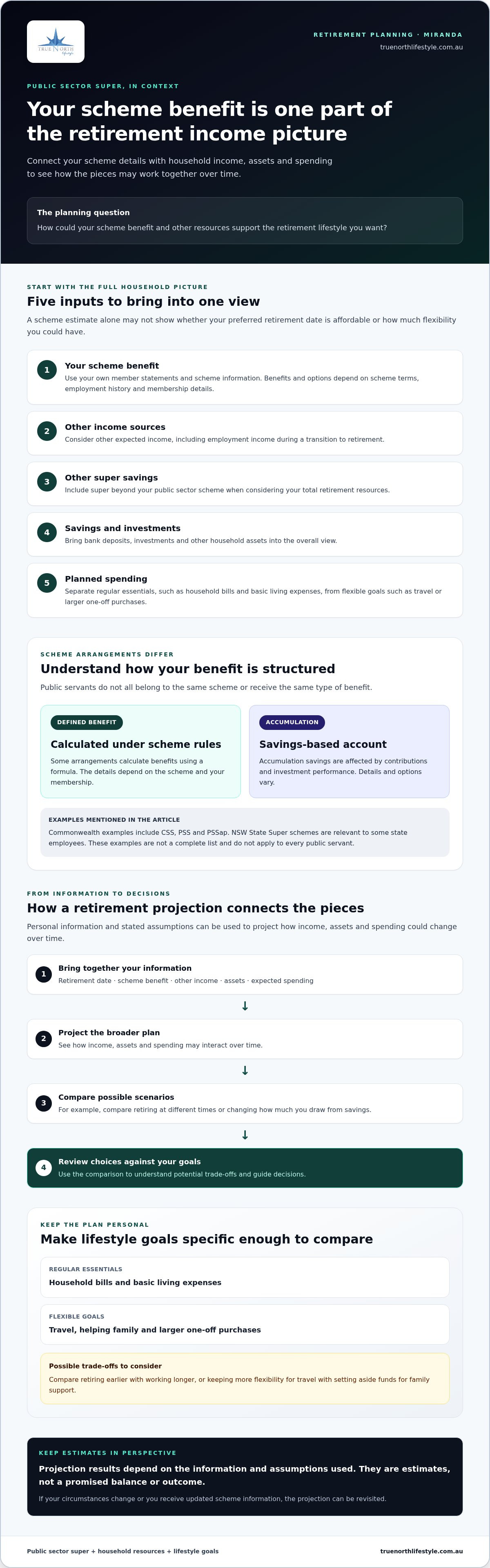
Public sector super can feel complex as retirement approaches. Your benefit may depend on your scheme, employment history and membership details, so another public servant’s experience may not reflect your own. A scheme statement can explain your benefit, but it won’t show how your household’s income, assets and plans fit together.
Begin with the life you want to fund. Consider when you’d like to retire, where you expect to live and how you want to spend your time. List regular essentials separately from flexible goals such as travel or helping family. For Miranda and Sutherland Shire residents, this gives a retirement planning discussion a practical starting point: your priorities, scheme information and wider financial position in one view.
What makes public servant retirement planning different?
Public servants don’t all belong to the same scheme or receive the same type of benefit. Rules and entitlements can vary with employer, service history and scheme membership. Some arrangements calculate benefits using a formula, while others are accumulation-based, with savings affected by contributions and investment performance. A defined benefit pension isn’t universal.
Your scheme explains how its benefit works. A complete retirement income plan considers how that benefit may sit alongside other super, savings, investments and household resources. For broader background on the Australian system, see this overview of Superannuation in Australia.
Retirement modelling uses your personal information and stated assumptions to project how income, assets and spending could change over time. It can help show how your scheme benefit relates to your goals, but the result is an estimate, not a promise.
Which retirement goals should shape the plan?
Make your priorities specific enough to compare. Think about your preferred retirement timing, housing plans, travel, family support and regular day-to-day spending. Separate essential costs, such as household bills and basic living expenses, from discretionary goals, such as extended travel or larger one-off purchases. This makes trade-offs easier to see if your projected resources don’t support every goal at once.
For example, compare retiring earlier with working longer, or keeping more flexibility for travel with setting aside funds for family support. You don’t need to settle every decision immediately. First identify what matters most and which choices need closer attention. For a wider view of planning around income and lifestyle over time, explore this Sydney retirement planning strategic guide.
This is the starting point for retirement planning for public servants Miranda households can shape around their circumstances: define the life you want, then assess how your scheme and other resources may support it.
How public sector super fits into your retirement income plan
Your scheme benefit is important, but it isn’t the same as your total retirement resources. A household plan may also include other super savings, bank deposits, investments, employment income during a transition to retirement and other expected income. The practical question is how these pieces may work together to fund spending over time.
Projected retirement income depends on your scheme terms, personal assets and the assumptions used in the projection. A benefit estimate on its own may not answer whether a preferred retirement date is affordable or how much flexibility you could have for travel and other goals.
How do public sector super schemes differ?
Public sector membership isn’t uniform. Commonwealth examples include the CSS, PSS and PSSap, while NSW State Super schemes are relevant to some state employees. These examples aren’t a complete list and don’t apply to every public servant. Depending on the arrangement, a benefit may be calculated under defined benefit rules or held in an accumulation account, but the details and options vary.
Use your own scheme’s member statements and governing material to understand the terms that apply to your membership and service history. A superannuation review can place that information alongside your other savings and assets. For a local perspective on reviewing super, read the Sutherland Shire superannuation advice guide.
How can a retirement projection bring the pieces together?
A retirement projection can bring your planned retirement date, scheme benefit, other income sources, assets and expected spending into one view. It can compare scenarios, such as retiring at different times or changing how much you draw from savings, to show how choices may affect the broader plan. The results depend on the information and assumptions used, and aren’t a promised balance or outcome.
Those assumptions matter. If your circumstances change or you receive updated scheme information, the projection can be revisited to see what the new details may mean. This gives you a clearer basis for decisions without treating an estimate as certainty. Services Australia also provides general information in its guide to planning for your retirement.
For retirement planning for public servants Miranda residents can shape around their own scheme and household, connect member-specific details to a long-term view of income and assets. Explore retirement modelling and superannuation advice to see how those elements can be considered together.
Does your public servant super scheme make retirement advice unnecessary?
If your scheme provides detailed member information, that can help you understand its rules and your benefit. Personal financial advice has a different role: it considers how decisions about that benefit connect with your household’s other finances and retirement priorities. Some people are comfortable managing those connections themselves; others value a joined-up review, particularly when several decisions interact.
Scheme guidance explains the benefit and rules that apply to your membership; an individual retirement strategy considers how those details fit your wider financial life.
| Area | Scheme information | Personal financial advice |
|---|---|---|
| Membership and benefit | Explains scheme terms, member details and benefit information as set out in the relevant material. | Considers the scheme benefit alongside other super and household resources. |
| Retirement income | Provides information about the scheme’s benefit and applicable options. | Models income sources, assets and spending against retirement timing and lifestyle goals. |
| Wider financial decisions | Provides scheme-specific information. | May assess how tax, investments, Centrelink considerations and estate planning strategy relate to the overall plan. |
What can scheme information answer, and what may it not cover?
Your scheme’s official material is the reference point for membership, benefit calculations, access conditions and other scheme-specific details. Household questions are broader: how your benefit may work with a partner’s income, savings, investments, spending needs and preferred retirement date.
A scheme benefit can be important without being the whole household plan. A personal review brings separate financial pieces into one view, while the scheme’s governing terms remain the authority on your membership.
When may a broader retirement review add value?
A joined-up review may be useful if you or your partner have multiple super interests, several income sources, substantial savings or investments, or different ideas about when to retire. It can also help identify questions about the tax implications of potential choices and how Centrelink assessments may relate to your circumstances. Eligibility and assessment rules should be considered individually against current requirements.
Not everyone needs the same level of support. If your circumstances are straightforward and you’re comfortable making the connections yourself, scheme information may answer many questions. If choices overlap, retirement modelling and superannuation review can help clarify the trade-offs. For more on tax considerations, read this Australian retirement tax planning guide. This distinction is central to retirement planning for public servants Miranda: scheme guidance informs your decisions, while your personal circumstances determine how the wider plan fits together.
A practical checklist before choosing a retirement strategy in Miranda
Preparation can make retirement decisions easier to organise. You don’t need every answer before starting. Bring together reliable records, identify what’s unclear and compare realistic options before acting on scheme or super choices.
What information should you gather before modelling?
Collect what’s readily available, then note any gaps. Useful information includes:
- Current scheme statements and records of relevant employment or membership history.
- Statements for other super accounts, savings and investments, along with details of debts.
- A practical outline of household spending, separating regular essentials from optional plans.
- Your preferred retirement date or dates, lifestyle priorities and any expected changes to work or income.
- Questions about benefit choices, access conditions, tax treatment or Centrelink assessments that need current, individual consideration.
Use your scheme’s current member material for scheme-specific terms, and current official government information for rules that may apply to your circumstances. Write down questions rather than relying on assumptions, especially where access, tax or benefit choices are involved.
Which decisions deserve careful scenario testing?
Use this sequence to prepare for a structured review:
- Clarify your goals. Write down when you’d like to retire and what you want your income to support.
- Gather the records. Bring together scheme, super, savings, investment, debt and spending information.
- Identify uncertainties. List unanswered questions, missing figures and assumptions you’re unsure about.
- Compare scenarios. Explore different retirement dates, spending levels and work patterns, then consider how each might interact with your scheme and other resources.
There isn’t one universally best scenario. A later retirement date may change the period your savings need to support, while reduced hours could affect income or scheme arrangements depending on your circumstances. Tax, Centrelink and super access questions also need to be assessed against current rules and your personal details.
For retirement planning for public servants Miranda residents can approach with greater clarity, retirement modelling connects your records and priorities to long-term projections. Arrange a tailored retirement modelling conversation to explore the scenarios that matter to you.
Build a public servant retirement plan with True North Lifestyle in Miranda
A considered plan starts with your circumstances, not a standard retirement template. True North Lifestyle provides retirement modelling and financial advice that bring your goals and relevant financial information into focus. Long-term projections can help explore how your public sector super and other resources may support the retirement you want.
What can a tailored retirement modelling process clarify?
Modelling compares projected income and available resources with the lifestyle goals you’ve identified. For example, it can help you explore how different retirement dates or spending assumptions may affect the plan, and where a gap or trade-off might warrant closer attention. The value is in seeing a range of possibilities, not treating one projection as a prediction.
Depending on your circumstances, a superannuation review may sit alongside tax-minimisation strategies, portfolio planning and Centrelink structuring. Each part is considered in context: relevant scheme terms, personal information and current rules all inform the analysis. Modelling supports clearer decisions, but it can’t guarantee investment performance, a particular retirement income or a specific outcome.
What are sensible next steps for Miranda public servants?
Gather the scheme records and other financial information you already have. Then write down the questions you most want answered, such as how a preferred retirement date compares with an alternative, how your scheme benefit fits with other income, or which tax and Centrelink matters need individual assessment. Clear questions help focus the conversation on decisions that matter to you.
For public servants in Miranda and the Sutherland Shire, retirement modelling and super review provide structured support for examining those questions together. The plan is shaped around your circumstances, priorities and relevant scheme information, with room to revisit assumptions as details change.
If you’re ready to explore your options, discuss your retirement planning with True North Lifestyle and begin shaping a strategy around your goals.
Take the next step towards a clearer retirement plan
Your public sector scheme is an important part of retirement, but decisions about timing, income and lifestyle make more sense alongside your household’s wider finances. Start with your goals, check the details that apply to your scheme, then compare scenarios before making significant choices.
For retirement planning for public servants Miranda, long-term projections can help show how expected income and assets may align with your priorities. True North Lifestyle brings retirement modelling together with superannuation review and optimisation, with broader planning considered where relevant to your circumstances. Projections can clarify options, but they can’t guarantee a particular investment or retirement outcome.
If you’re ready to turn your questions into a structured plan, discuss your retirement planning with True North Lifestyle. Financial planning services are available to clients in Miranda and across New South Wales. A clear next step can make the decisions ahead feel more manageable.
Frequently Asked Questions
Do public servants in Australia all receive a defined benefit pension?
No, public servants don’t all receive a defined benefit pension. Super arrangements vary according to employer, scheme membership and employment history. Some schemes calculate benefits using defined benefit rules, while accumulation accounts build through contributions and investment returns. Your own scheme statement and governing material are the best sources for member-specific details. Knowing your scheme type helps, but doesn’t by itself show how your benefit fits with your household’s other retirement resources.
Can I get financial advice if I am a member of a public sector super scheme?
Yes. Being a member of a public sector super scheme doesn’t prevent you from receiving personal financial advice. Scheme material helps explain the benefit and rules that apply to your membership, while advice can consider how those details connect with other super, savings, investments, tax considerations and retirement goals. Advice isn’t automatically necessary for every member. It may be useful if you’re weighing several options or want a clearer view of how your household finances fit together.
How does retirement planning for public servants in Miranda work?
Retirement planning for public servants Miranda begins by clarifying your goals, then reviewing relevant scheme information alongside your other financial resources. Retirement modelling can project income, assets and planned spending under different assumptions, helping you compare choices such as retirement timing or spending needs. A broader review may also consider superannuation, tax, investments and Centrelink matters where relevant. The process is shaped around your circumstances, and projections support decisions rather than promise a particular outcome.
Can I access my public sector super when I choose to retire?
Not necessarily. Access depends on the rules of your scheme and the super access conditions that apply to you. For people born on or after 1 July 1964, preservation age is 60, but reaching that age alone doesn’t generally provide access. A condition of release is also required, such as permanent retirement or ceasing an employment arrangement after turning 60; access is also generally available at age 65. Check current scheme and official guidance before acting.
What information should I bring to a retirement planning meeting?
Bring your latest scheme statement and relevant employment or membership records, along with statements for any other super accounts. If available, gather details of savings, investments, debts and household spending. Note your preferred retirement timing, lifestyle priorities and expected changes to work or income. A written list of questions is useful too, particularly about access conditions, benefit choices, tax or Centrelink. If some records are missing, note what you’re unsure about so the discussion can focus on the gaps.
Will my public servant super affect my Age Pension eligibility?
It may affect an Age Pension assessment, but having public sector super doesn’t automatically mean you will or won’t qualify. Eligibility is assessed under current Services Australia rules, which can consider your circumstances and financial position. Age Pension age is 67, and income and asset assessment rules may apply differently depending on individual details and how a benefit is held or accessed. Check current thresholds and assessment rules for your situation before making decisions based on an assumed entitlement.
Is retirement modelling a guarantee of how much money I will have?
No. Retirement modelling is a projection, not a guarantee of future income, investment returns or account balances. It uses information about your scheme, assets, expected income, spending and other assumptions to compare possible scenarios. If those inputs change, the results may change too. Use a projection to understand potential trade-offs and questions to investigate, not as a promise that a particular outcome will occur. Updated scheme details and changed circumstances can be incorporated into a later review.
Should I combine my public sector super with other super accounts?
Not without first understanding the consequences for your specific scheme and circumstances. Combining accounts may seem simpler, but a public sector benefit can have different terms from an accumulation account, and moving or transferring benefits may affect options, tax treatment or entitlements. Review current scheme information and consider how any change fits your wider retirement plan before taking action. A superannuation review can help compare the accounts and identify questions that need individual assessment.


