
What if a sound investment strategy starts with your life, not a prediction about the market? If you’re considering investment advice Sutherland Shire residents can use to make more confident decisions, start by identifying what your money needs to support, now and in the years ahead.
It’s reasonable to feel unsure about how much risk is appropriate, or whether a recommendation fits your circumstances. Those questions matter when investment decisions may affect your retirement income. Good advice brings your goals, timeframe and comfort with risk into the same conversation.
This article explains what considered investment advice involves, how an adviser can connect portfolio decisions with personal goals, and what to bring to an initial discussion. You’ll also see how retirement modelling, superannuation review and risk management can help shape a tailored strategy, and why it may need to be revisited as your circumstances change. The aim is a clearer plan and a better basis for deciding what comes next.
Key Takeaways
- Use your goals, timeframe and financial circumstances to clarify what you want your investments to support.
- Understand how research can guide portfolio construction and ongoing reviews without promising a particular return.
- Compare investment strategies by their approach to risk, fees, research and reviews, rather than short-term market predictions.
- Prepare for a discussion by gathering details about your income needs, superannuation, assets, debts and existing investments.
- See how investment advice Sutherland Shire can connect bespoke portfolio construction with retirement modelling, superannuation and wealth preservation.
What investment advice in the Sutherland Shire can help you achieve
Deciding what to do with savings, superannuation and other investments can feel difficult when each choice affects your plans differently. You might want your money to grow, need income in retirement or be unsure how much risk is appropriate. A considered plan brings these decisions together instead of treating each investment in isolation.
Investment advice is guidance tailored to your financial goals, timeframe, risk tolerance and personal circumstances, helping you make informed decisions about your investments. It differs from general information, which can explain investment concepts but may not account for your assets, liabilities or income needs. For a foundation, explore Understanding Investment Principles, then consider how those concepts apply to your situation. Advice can support sustainable growth, income planning, risk management and clearer decisions, but it can’t guarantee investment outcomes or remove market uncertainty.
What does an investment adviser consider before recommending a strategy?
A useful discussion looks beyond the investments you already hold. It considers your goals, assets and liabilities, income needs, expected timeframes and the purpose of each pool of money. Someone approaching retirement may need a different balance of growth and accessible income from a business owner building wealth over a longer horizon.
Risk has two sides. Your capacity for loss is how much financial loss your circumstances could withstand without disrupting essential plans. Your emotional comfort is how you might respond to market movements. These factors should be understood before a strategy is shaped, alongside the scope of advice you agree to receive.
Why local investment advice may matter to Sutherland Shire residents
In Miranda and across the Sutherland Shire in Sydney, households can be at very different stages: running a business, accumulating assets, planning a transition out of work or preparing to draw on superannuation. Local advice can make conversations more accessible, but your strategy still needs to reflect your individual priorities, not assumptions about where you live.
Priorities can change as business plans, family needs or retirement timing evolve. Ongoing advice can help you understand whether your investment approach still fits and revisit it when your circumstances change. That continuity brings order to decisions that might otherwise feel disconnected, while keeping the focus on what you want your wealth to support.
How a tailored investment strategy is researched, built and reviewed
A sound portfolio follows a clear process, rather than reacting to market headlines. The steps move from understanding your circumstances to setting objectives, assessing risk, constructing a portfolio and reviewing it over time. Each step gives the next one a purpose.
- Understand your circumstances: bring together your assets, income needs, existing investments and relevant timeframes.
- Define objectives: clarify what the portfolio needs to support, such as long-term growth, future income or wealth preservation.
- Assess risk: consider both your capacity to absorb losses and the market movements you can tolerate.
- Construct and monitor: use research to inform asset allocation, then review whether the portfolio remains aligned with your objectives.
How research and risk assessment shape portfolio construction
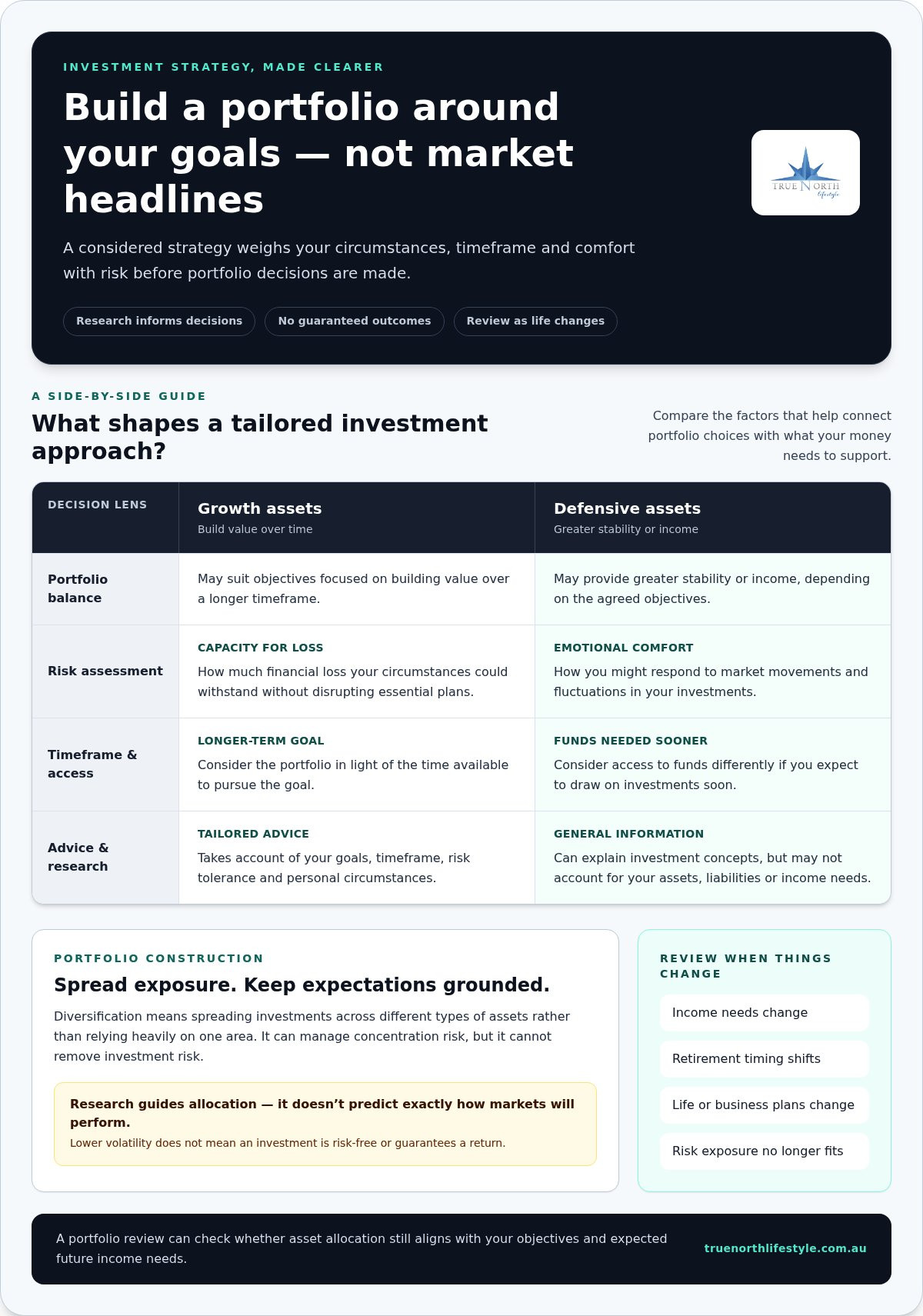
Research helps assess whether a proposed allocation suits the agreed objectives; it doesn’t predict exactly how markets will perform. A portfolio may combine growth assets, which aim to build value over time, with defensive assets that can provide greater stability or income. The balance depends on factors such as your timeframe, need for access to funds and willingness to accept fluctuations.
For example, someone who expects to draw on part of their investments soon may need to consider access to funds differently from someone investing for a longer-term goal. Diversification means spreading investments across different types of assets rather than relying heavily on one area. Diversification can manage concentration risk, but it cannot remove investment risk. Lower volatility also doesn’t mean an investment is risk-free or guarantees a return.
When should an investment strategy be reviewed?
A review may be useful when your income needs change, your retirement timing shifts or a major life or business change affects your plans. It can also help assess whether your portfolio’s risk exposure and asset allocation still match your objectives. Retirement modelling and long-term projections can show how investment decisions may fit with expected future income needs.
For people seeking investment advice Sutherland Shire, an ongoing review can help distinguish a meaningful change in your circumstances from short-term market noise. True North Lifestyle’s bespoke portfolio construction is supported by ongoing oversight from its in-house Investment Committee. Read about investment portfolio advice to understand how portfolio decisions can fit into a broader plan.
How to compare investment advice and portfolio strategies
A useful comparison looks beyond recent returns or confident market forecasts. Consider whether a strategy makes sense for your circumstances, explains its trade-offs and has a clear review process. If you’re comparing investment advice in the Sutherland Shire, these criteria can help you focus on what matters.
| What to compare | What a clear approach should explain |
|---|---|
| Goals | How recommendations relate to your objectives, time horizon and income needs. |
| Risk approach | How your capacity for loss and comfort with market fluctuations shape the strategy. |
| Research process | How evidence informs portfolio construction and asset allocation, without suggesting returns are certain. |
| Fees and costs | What the advice covers, how fees are charged and which services are ongoing. |
| Review arrangements | How your circumstances, portfolio and progress towards objectives are revisited. |
What makes investment advice genuinely tailored?
Tailored advice makes a clear connection between your objectives and each recommendation. Your assets, income needs, timeframe and risk tolerance should all inform the strategy. A portfolio designed for someone seeking income soon may differ from one intended for a longer-term goal. A bespoke portfolio is shaped around those needs, not a promise of a particular outcome.
Compare the reasoning, not just the proposed investment mix. Assess a strategy against your circumstances and long-term aims, rather than whether it appears to anticipate short-term market movements. Retirement modelling adds context by showing how an investment approach may align with projected income needs and longer-term objectives.
How should you understand advice fees and ongoing management?
Initial advice work may involve understanding your position and developing a strategy. Ongoing advice can involve revisiting that strategy as your circumstances change, while investment portfolio management relates to oversight of the portfolio itself. These services have different scopes, so it’s important to understand what each includes.
Before proceeding, understand what services are included, how fees are structured, what ongoing management involves and how reviews are arranged. These details help you compare value, rather than relying on a fee figure alone. For a related perspective, explore wealth preservation strategies in Australia and consider how preserving assets fits with your broader investment objectives.
Preparing for investment advice in the Sutherland Shire
A little preparation can make a conversation about investment advice Sutherland Shire more focused, but you don’t need every document perfectly organised before you begin. A rough overview of your finances, priorities and concerns is a useful starting point. The aim is to explain what you want your money to support, not to arrive with all the answers.
What information helps clarify your investment goals?
Bring what you have available, or make a simple written summary. It can help to include:
- Your goals and timeframes: note what you’re investing for and when you may need access to the money.
- Income needs and future expenses: outline the income you may need, planned major costs and expected changes, such as retirement.
- Superannuation details: include fund statements and information about your current super arrangements.
- Assets, debts and investments: list property, savings, investment holdings, debts and other financial commitments.
- Your concerns and priorities: write down what matters most, what feels uncertain and how much fluctuation you think you could tolerate.
Even approximate information can help identify what needs further discussion. If you’re approaching retirement, for example, note when you hope to finish work and whether you expect to draw income from investments, superannuation or both. This gives retirement projections a practical starting point.
Questions to ask about risk, reviews and advice scope
Use your discussion to understand how recommendations will be developed and explained. Questions might include:
- How will portfolio risk be assessed and described in everyday language?
- How will liquidity, diversification and access to funds be considered?
- How could investment decisions fit with retirement projections and expected income needs?
- How might tax considerations influence the strategy?
- What does a portfolio review cover, how often is it planned, and how are changes in my circumstances addressed?
- How will the advice scope, fees, recommendations and implementation steps be documented?
Clear answers help you understand both the strategy and the process around it. You should be able to see what the advice covers, what decisions remain yours and how progress will be reviewed. Bring your questions in writing if that helps you feel prepared.
For an overview of how investment decisions can connect with other financial goals, explore investment advice from True North Lifestyle.
How True North Lifestyle brings investment advice together with your plans
For people seeking investment advice in the Sutherland Shire, the key is understanding how portfolio decisions relate to the life they’re intended to support. True North Lifestyle provides financial planning and retirement strategy services to individuals and businesses in Miranda, connecting bespoke portfolio construction with retirement modelling, superannuation review and wealth preservation planning.
This integrated view connects decisions that are often considered separately. The investment strategy can be shaped around your objectives and risk considerations, while superannuation and expected retirement income needs form part of the wider picture. Portfolio construction is overseen by an in-house Investment Committee, with ongoing oversight to keep the strategy under consideration as circumstances and markets change. This doesn’t remove uncertainty or guarantee a particular result; it provides a structured basis for decisions.
Connecting portfolio decisions with retirement projections
Long-term projections can help explore possible financial pathways, such as how different retirement dates or income needs may affect your plans. These scenarios can be considered alongside investment strategy and superannuation, helping clarify the assumptions behind each pathway. Projections depend on inputs and assumptions, so they’re tools for informed discussion, not promises of future outcomes.
This connection is useful when priorities shift, too. A change in work plans or retirement timing may prompt a closer look at how the portfolio supports future income and wealth preservation. For broader context, explore the retirement planning in Sydney and superannuation advice in the Sutherland Shire articles alongside this discussion.
A considered next step for local investors
Before an initial advice conversation, consider writing down what you want your investments to support, what feels uncertain and which decisions you’d like to understand better. You don’t need a perfect plan. A clear account of your priorities gives the discussion a practical starting point.
The aim is greater clarity, not pressure or exaggerated promises. A considered conversation can help you understand your options, how investment advice relates to retirement projections and what steps may suit your circumstances.
Build a clearer investment direction
A considered investment plan starts with your goals, not a market prediction. The right strategy should reflect your timeframe, income needs and comfort with risk, while giving you a clear way to review decisions as life changes. When comparing advice, look at how recommendations are researched, explained and connected to your circumstances.
For people seeking investment advice Sutherland Shire, it also helps to view portfolio decisions alongside retirement modelling, superannuation and wealth preservation. True North Lifestyle provides financial planning and retirement strategy services in Miranda, with bespoke portfolio construction and oversight through an in-house Investment Committee. Retirement modelling and long-term projections can inform these discussions, while recognising that projections depend on assumptions and can’t guarantee outcomes.
You don’t need every detail resolved before taking a first step. Bring your priorities, questions and a broad picture of your current position. Discuss your investment goals with True North Lifestyle and explore a strategy shaped around what you want your wealth to support.
Frequently Asked Questions
What does an investment adviser do in Australia?
An investment adviser helps you make investment decisions that reflect your goals and financial circumstances. This may involve understanding your assets, income needs, timeframe and risk tolerance, then developing recommendations within the agreed advice scope. Advice can also consider how your investments relate to superannuation, retirement income and wealth preservation. The aim is to provide a clear rationale for decisions, not to predict markets or promise a particular return.
How do I choose an investment strategy that suits my goals?
Choose a strategy by first clarifying what the money needs to support, when you may need it and how much investment fluctuation you can accept. Consider your income needs, existing investments, superannuation, debts and capacity to absorb potential losses. A suitable approach should explain how its asset mix and risk management relate to your objectives. Compare the reasoning and review process, rather than relying on short-term performance or market forecasts.
Is investment advice worth it if I am nearing retirement?
Investment advice can be useful as retirement approaches because decisions about growth, access to funds and future income become closely connected. Retirement modelling can help examine possible financial pathways based on your retirement timing, assets and income needs. The value is in understanding the assumptions and trade-offs, not receiving certainty about future returns. Advice can also help you consider whether your current investment approach remains aligned with your changing priorities.
Can investment advice include superannuation and retirement planning?
Yes. Investment advice can be considered alongside superannuation review and retirement planning, so portfolio decisions are viewed in the context of your broader financial goals. For example, long-term projections can help explore how investment choices may relate to the timing and level of income you’ll need. True North Lifestyle provides services in Miranda, connecting portfolio construction with retirement modelling and superannuation optimisation.
How often should an investment portfolio be reviewed?
A portfolio should be reviewed according to your advice arrangements and circumstances, rather than in reaction to every market movement. A change in income needs, retirement timing, work or family priorities may prompt a review. The discussion can assess whether your portfolio’s risk exposure and investment mix still align with your objectives. Agreeing what reviews cover and how changes are addressed helps you understand when a strategy may need to be reconsidered.
What should I bring to an investment advice appointment?
Bring information that gives a broad picture of your finances and goals. This may include superannuation details, existing investment statements, a list of assets and debts, income and regular commitments, plus any expected major expenses. Note your investment timeframes and concerns about risk, access to funds or market movements. You don’t need every document perfectly organised; an honest summary of your priorities can help make the conversation productive.
How are financial advice fees and investment management fees different?
Financial advice fees relate to the advice and strategy work agreed with you, such as developing a plan or modelling retirement scenarios. Investment management fees relate to services involved in constructing and overseeing an investment portfolio. The scope and charging arrangements can differ, so understand what each fee covers, which services are ongoing and how reviews work. Make sure the costs and arrangements are clearly explained before deciding how to proceed.
Can an investment strategy guarantee returns or prevent losses?
No investment strategy can guarantee returns or prevent all losses. Markets can move unpredictably, and investment values may fall as well as rise. Diversification and risk management can help address concentration and portfolio risks, but they can’t remove investment risk. A considered strategy sets expectations around uncertainty, reflects your circumstances and is reviewed against your goals. Long-term projections can help explore scenarios, but their results depend on assumptions and aren’t promises.


