

Success requires structure. While many retirees fear their savings will disqualify them from government support, the reality is that your asset composition often matters more than your total net worth. In 2026, nearly one-third of part-pensioners find their payments reduced due to assessable wealth thresholds, yet many remain unaware of how to strategically maximise Centrelink age pension entitlements through precise portfolio modelling. This is not about complexity for its own sake; it is about achieving a state of quiet certainty in an ever-shifting regulatory environment.
We understand the underlying anxiety caused by the $3 taper rate and the fear of depleting your capital in a high-cost city like Sydney. You deserve a plan that replaces confusion with a clear, logical path forward. This guide will show you how to structure your assets and income to optimise your 2026 eligibility while protecting your financial longevity. We will examine the specific interaction between superannuation and the pension, offering a research-driven framework to help you bridge the gap and maintain a sustainable lifestyle throughout your retirement years.
Key Takeaways
- Understand the dual-test architecture. Gain clarity on how the assets and income tests interact to determine your specific fortnightly payment.
- Strategic asset classification. Learn how to utilise the family home exemption and other exempt assets to help you maximise Centrelink age pension entitlements.
- Optimise deemed income. Discover how the 2026 deeming rates affect your assessable income and how to structure your portfolio to mitigate their impact.
- Leverage gifting and re-contributions. Navigate the complex rules surrounding financial gifts and partner-based superannuation strategies to enhance your overall position.
- Build a bespoke roadmap. Transition from uncertainty to a structured plan through professional modelling that accounts for Sydney’s unique cost-of-living pressures.
Understanding the Centrelink Age Pension Framework in 2026
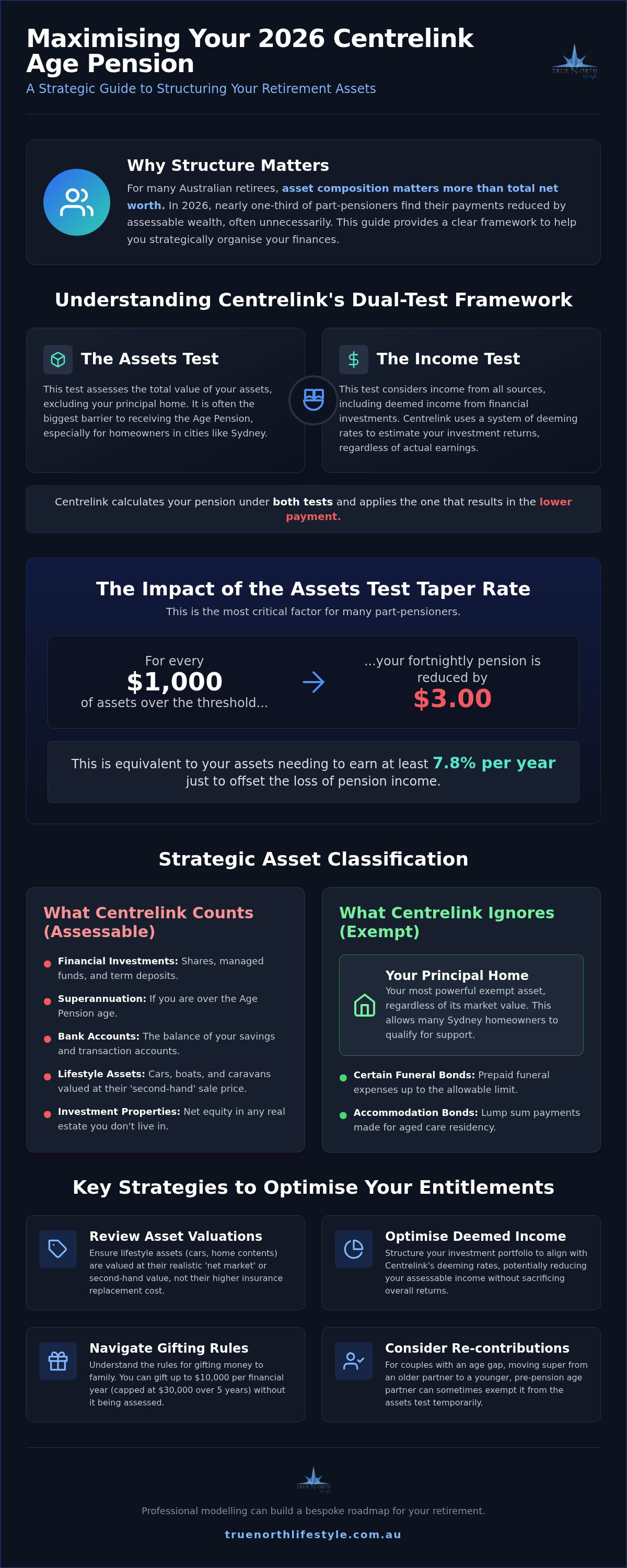
Clarity replaces anxiety. For many Australians, the transition into retirement is clouded by the perceived complexity of government thresholds and reporting obligations. The Age Pension serves as a fundamental pillar within Australia's social security system, designed to provide a safety net that ensures a basic standard of living. However, it is far more than a simple handout; it is a sophisticated, means-tested mechanism that requires precise navigation to yield its full benefit. To maximise Centrelink age pension entitlements, you must first understand that the system operates on a dual-test architecture: the Income Test and the Assets Test.
Services Australia calculates your potential payment under both sets of criteria. They then apply the test that results in the lower pension rate. This "lowest common denominator" approach means that a single lifestyle choice or investment shift can have a disproportionate impact on your fortnightly cash flow. True optimisation is not merely about chasing the highest possible payment; it is about creating a structured, predictable income stream that supports your financial longevity. By aligning your private wealth with these government benchmarks, you create a more resilient retirement foundation.
Eligibility Requirements for 2026
Stability begins with meeting the baseline criteria. As of 2026, the qualifying age for the Age Pension remains 67 for both men and women. Beyond age, residency rules dictate that you must generally have been an Australian resident for at least ten years, with at least five of those years being continuous. Maintaining your eligibility requires a disciplined approach to compliance. You must report changes in your financial circumstances, such as shifts in share prices or bank balances, to Services Australia within 14 days to avoid overpayments or unnecessary penalties. This ongoing transparency ensures your strategy remains grounded in real-world data.
The Stabilising Effect of the Pension
The pension acts as a vital buffer. While your private portfolio may be subject to the ebbs and flows of global markets, the Age Pension provides a guaranteed, CPI-adjusted income stream that remains unaffected by volatility. This provides a profound psychological benefit, allowing you to stay the course with your long-term investments during periods of economic uncertainty. In high-cost regions like Sydney and the Sutherland Shire, retirees often overlook the pension because their high property values make them feel "too wealthy" for support. However, because the principal home is generally exempt from the assets test, even those in multi-million dollar residences in Miranda can often qualify for significant part-payments with the right structural approach.
Strategic Asset Test Reduction: Lowering Your Assessable Wealth
Precision creates opportunity. For many retirees in Sydney, the assets test represents the most significant barrier to government support. Under the current rules, every $1,000 of assets you hold above the full pension threshold reduces your fortnightly payment by $3. This "taper rate" is aggressive; it effectively means your assets must earn at least 7.8% per annum just to offset the loss of pension income. To maximise Centrelink age pension entitlements, you must distinguish between what the government counts and what it ignores. While financial investments and superannuation are assessable, your principal place of residence remains a powerful exempt asset, regardless of its market value.
Strategy involves realistic valuation. Many retirees inadvertently penalise themselves by overvaluing lifestyle assets such as cars, boats, and home contents. Centrelink does not require the replacement value used for insurance; they require the "net market value," which is essentially what you would receive at a second-hand sale. Lowering these valuations to realistic levels is a simple, legitimate way to reduce your assessable total. If you find your wealth sits just above a threshold, bespoke portfolio construction can help you reorganise these holdings to improve your eligibility without compromising your long-term capital growth.
Managing surplus cash requires a disciplined approach. Holding large sums in a bank account often triggers the harshest part of the assets test. Reviewing the official Age Pension eligibility rules reveals that how you choose to "spend" or "reposition" that cash can fundamentally alter your retirement income. Whether you are considering a necessary lifestyle purchase or a strategic investment, the timing and structure of these moves are critical to maintaining your financial longevity.
The Family Home and Renovations
Your home is a strategic sanctuary. In suburbs like Miranda, where property values are high, investing in your primary residence is one of the most effective ways to shift assessable cash into an exempt environment. Upgrading a kitchen or adding a deck doesn't just improve your quality of life; it legally reduces your assessable asset pool. Additionally, the downsizer contribution rules allow you to move proceeds from a home sale into superannuation, which, if managed alongside a younger spouse's account, can further shield assets from Centrelink's view.
Pre-paid Funerals and Burial Plots
Small moves provide collective stability. As of 1 July 2026, the exempt limit for eligible funeral bonds has increased to $16,250. Investing in a pre-paid funeral or a burial plot removes these funds from the assets test entirely. While the primary benefit is the emotional peace of mind it offers your family, the secondary advantage is the immediate reduction in your assessable wealth. For those sitting on the edge of a pension threshold, this modest adjustment can be the catalyst that secures a higher fortnightly payment.
Income Test Optimisation: Balancing Superannuation and Pension
Income is often the hidden hurdle. While the assets test captures the headlines, the income test frequently determines the final fortnightly payment for those with complex portfolios. Centrelink does not necessarily look at the actual interest or dividends you receive; instead, they apply a set of rules known as "deeming". This system assumes your financial assets earn a specific rate of return, regardless of their actual performance. To maximise Centrelink age pension payments, you must understand how to align your actual earnings with these assumed rates to ensure you aren't being unfairly penalised by the 50-cent-per-dollar taper rate.
Strategic balance is essential. Financial assets, including superannuation held in the pension phase, are subject to deeming. However, superannuation held in the accumulation phase is generally exempt from both tests until you reach Age Pension age. Even after reaching this milestone, the choice of where your capital sits can dictate your eligibility. While the official Age Pension assets test rules often dominate the conversation, the income test requires equal vigilance, particularly when managing drawdowns to avoid "income spikes" that could temporarily suspend your entitlements.
Deeming Rates in 2026
Assumptions drive the outcome. As of July 2026, the lower deeming rate is 1.25% for the first $66,800 of a single person’s financial assets, or $110,600 for a couple. Anything above these thresholds is deemed to earn 3.25%. If your investments are sitting in low-interest bank accounts earning less than these rates, you are effectively being assessed on income you aren't actually receiving. This is where bespoke investment advice Sydney becomes invaluable. By constructing a portfolio that seeks to outperform these deeming rates, you can retain more of your actual earnings without reducing your government support.
Work Bonus Incentives
Productivity remains rewarded. The Work Bonus is a powerful tool for retirees who wish to maintain a connection to the workforce, perhaps through part-time consulting in the Sydney CBD. In 2026, the first $300 of fortnightly employment income is excluded from the income test. If you don't work, this amount accumulates in a "Work Bonus bank" up to a maximum of $11,800. This allows retirees to take on short-term contracts or seasonal work without seeing an immediate reduction in their pension, providing a flexible way to supplement their lifestyle while maintaining their financial safety net.
Advanced Strategies: Re-contribution and Gifting Rules
Structure creates resilience. Moving beyond the foundational tests requires a shift toward proactive financial engineering. To maximise Centrelink age pension entitlements, you must look at how wealth is distributed within your household and how it is transferred to the next generation. Advanced strategies are not about circumventing the rules; they are about utilising the specific provisions within the law to ensure your capital works as efficiently as possible. This involves a disciplined approach to gifting and a sophisticated understanding of how partner age gaps can be used to your advantage.
Gifts to family are often driven by emotion, yet they must be governed by logic. Under current 2026 regulations, you can gift up to $10,000 in a single financial year without triggering a penalty. However, you are also capped at $30,000 over a rolling five-year period. If you exceed these limits, Centrelink applies the "Deprivation Rule". The excess amount remains on your record as an assessable asset for five years, effectively freezing your pension rate despite the money no longer being in your bank account. Managing these transfers with precision ensures you can support your children without compromising your own financial longevity.
The Re-contribution Strategy for Couples
Age gaps offer strategic breathing room. For couples where one partner is younger than the Age Pension age, the re-contribution strategy is a powerful lever. By withdrawing superannuation from the older partner and contributing it into the younger spouse's accumulation account, those funds are temporarily removed from Centrelink's assessment. Because super in the accumulation phase is generally exempt for those under age 67, this move can "hide" significant assets, often moving a couple from a part-pension to a full pension. This process also allows for a refresh of the tax-free components within your super, which is a core element of tax planning for retirement Australia.
Lifetime Annuities and Asset Test Relief
Certainty is the ultimate retirement luxury. Lifetime annuities have evolved into a sophisticated tool for those seeking to mitigate "longevity risk" while simultaneously reducing their assessable assets. Under current social security rules, only 60% of the purchase price of an eligible lifetime annuity is typically assessed under the assets test. This immediate 40% reduction can be the difference between receiving a reduced payment and qualifying for the maximum entitlement. For a "Steady Navigator," this strategy provides a guaranteed, CPI-linked income stream that remains stable regardless of how long you live or how the market performs. If you are ready to move from uncertainty to a defined path, professional Centrelink structuring can help you model these outcomes with precision.
Beyond Calculations: Modelling Your Ideal Lifestyle in Sydney
Numbers alone fail. While a basic spreadsheet can tally your current assets, it cannot account for the intricate, shifting variables of Australian legislation or the specific cost-of-living pressures inherent to life in Sydney. Professional retirement modelling is the bridge between a collection of accounts and a sustainable lifestyle. At True North Lifestyle, our approach integrates Centrelink structuring into a holistic wealth preservation strategy, ensuring that every tactical move to maximise Centrelink age pension entitlements also serves your long-term capital stability. This is about more than just a fortnightly payment; it's about the security of knowing your capital is protected against the unknown.
Navigating the "maze" of Services Australia requires more than just technical knowledge; it requires an authoritative guide who has already done the heavy lifting. The paperwork and reporting obligations can be overwhelming, but with a structured plan, the process becomes transparent and manageable. We focus on the human outcome, transforming complex data into a clear, visual roadmap that you can oversee with confidence. By delegating the technical rigour to a seasoned expert, you step into a role of informed oversight rather than administrative burden.
Bespoke Portfolio Construction
Clarity is bespoke. Sydney retirees face unique challenges, from high property maintenance costs to the social expectations of life in the Sutherland Shire and Miranda. Your investment strategy must produce higher cash flow projections than the national average to maintain your quality of life in these high-cost environments. By aligning your private holdings with your pension goals, we can minimise volatility and ensure your strategy remains resilient as deeming rates and thresholds fluctuate. Regular reviews are the heartbeat of a successful retirement, allowing us to adjust your trajectory as the economic environment evolves.
Taking the Next Step with True North Lifestyle
Confidence replaces doubt. Our advisers in Miranda and the Sydney CBD are dedicated to your personal journey, moving you from the role of an anxious saver to that of a confident retiree. We provide the research-driven oversight needed to anchor your finances in a fluctuating environment, ensuring you feel protected and understood at every stage. You don't have to navigate this transition alone or wonder if you've missed a critical threshold. Organise a consultation to model your retirement future.
Secure Your Path to a Structured Retirement
Clarity is the foundation of a peaceful retirement. By aligning your assets with the 2026 thresholds and understanding the nuances of the dual-test approach, you move from a state of uncertainty to one of quiet confidence. You've seen how strategic moves, such as realistic asset valuations or re-contribution strategies, can help you maximise Centrelink age pension entitlements without sacrificing your lifestyle. These aren't just calculations; they are the building blocks of your financial longevity.
The most robust plans are those that account for the unique cost-of-living pressures in Sydney. At True North Lifestyle, we specialise in retirement modelling and Centrelink structuring, providing a research-driven approach to wealth preservation. With local offices in Miranda and the Sydney CBD, our advisers offer the expert guidance needed to navigate complex government rules. We handle the heavy lifting so you can focus on the lifestyle you've worked hard to build.
Secure your financial future with a bespoke retirement strategy from True North Lifestyle.
You deserve a retirement that feels as stable as it is rewarding. Let us help you map out a well-defined path toward a certain future.
Frequently Asked Questions
How much can I have in assets and still get the Age Pension in 2026?
Your asset limit depends on whether you own your home and your relationship status. As of July 2026, a single homeowner can hold up to $733,500 in assessable assets before their part pension reduces to zero. For a couple who own their home, the combined asset cut-off point is $1,102,500. If you are a non-homeowner, these thresholds are higher to account for the lack of exempt residential equity.
Does my family home count towards the Centrelink assets test?
Generally, your principal place of residence is an exempt asset and is not included in the assets test. This remains true regardless of the home's market value, which is a significant strategic advantage for retirees living in high-value suburbs across Sydney. However, if your home is situated on more than two hectares of land, the excess land may be counted as an assessable asset unless specific agricultural or long-term residency exemptions apply.
Can I give money to my children to increase my Age Pension?
You can gift money, but you must stay within the strict $10,000 per financial year limit. Centrelink also enforces a secondary cap of $30,000 over any rolling five-year period. If you exceed these amounts, the excess is treated as a "deprived asset." This means the money will continue to be counted under both the assets and income tests for five years from the date of the gift, potentially preventing you from being able to maximise Centrelink age pension entitlements.
How does the re-contribution strategy work for couples?
This strategy exploits the age difference between partners to shield superannuation from the means test. Superannuation held in the accumulation phase is not assessable until the owner reaches Age Pension age. By withdrawing funds from an older partner's account and re-contributing them into a younger spouse's accumulation account, a couple can legally reduce their assessable asset pool. This move often helps retirees bridge the gap to a higher fortnightly payment while maintaining their total household wealth.
What are the current deeming rates for financial investments?
As of 1 July 2026, the lower deeming rate is 1.25% and the upper rate is 3.25%. For a single person, the first $66,800 of financial assets is deemed at the lower rate, while for couples, the first $110,600 is deemed at 1.25%. Any financial assets held above these thresholds are assumed to earn 3.25%. These rates are used to calculate your assessable income, regardless of the actual interest or dividends your investments produce.
Can I get the Age Pension if I am still working part-time?
Yes, the Work Bonus incentive allows you to earn employment income without it immediately reducing your pension. You can earn up to $300 per fortnight from work, and this amount is completely excluded from the income test. If you earn less than $300, the remainder is added to a Work Bonus bank, which can accumulate up to $11,800. This is an excellent way to supplement your lifestyle in Sydney while keeping your pension intact.
What is the difference between a full pension and a part pension?
A full pension is the maximum fortnightly rate paid to those whose assets and income fall below the "free area" thresholds. As your wealth or earnings increase beyond these limits, your payment is reduced by either the assets test or the income test. The resulting lower amount is your part pension. Once your assets or income reach the final cut-off points, your eligibility for any payment ceases entirely.
How often does Centrelink update the asset and income thresholds?
Thresholds for the assets and income tests are typically indexed on 1 July each year to reflect changes in the Consumer Price Index. While these limits move annually, the actual Age Pension payment rates are adjusted twice a year, on 20 March and 20 September. Staying informed about these dates is essential for precise retirement modelling and ensuring your strategy remains aligned with the latest government benchmarks.


