
A standard will is often the most expensive gift you can leave your family. It provides a sense of closure, yet it frequently leaves your hard earned assets vulnerable to the "tax man" and the unpredictable nature of future family breakdowns. You have spent a lifetime building your legacy; it deserves a structure that actually preserves it. By incorporating a testamentary trust into your estate planning strategy, you move beyond simple distribution into the realm of sophisticated wealth protection that capitalises on the strategic opportunities established in early 2026.
We understand the quiet anxiety that comes with intergenerational wealth transfer, particularly the fear of seeing an inheritance diminished by avoidable taxes or external legal claims. You want certainty that your assets stay where they belong. This guide will show you how to secure your family's future with superior tax efficiency and robust asset protection. We will clarify the roles of Trustee and Appointor, providing a clear, structured plan for a legacy that remains within your family for generations to come.
Key Takeaways
- Learn how a testamentary trust facilitates tax-efficient income distribution to minor beneficiaries at adult rates, significantly reducing your family's future tax burden.
- Discover how this structure acts as a robust financial vessel, shielding inherited assets from external claims such as divorce or legal disputes.
- Understand the cost-benefit ratio of trust-based Wills compared to simple distributions, focusing on long-term wealth preservation over decades.
- Gain clarity on selecting your Trustee and Appointor to ensure your legacy is steered by reliable hands and structured oversight.
- Explore how integrating estate strategy with retirement modelling provides a realistic projection of the wealth you will eventually transfer.
What is a Testamentary Trust? Defining the Strategic Vessel
Legacy requires structure. A testamentary trust is a discretionary trust established within your Will that remains dormant until your passing. It's not a mere legal formality; it's a strategic vessel built to safeguard the wealth you've spent a lifetime accumulating. Instead of assets passing directly to your beneficiaries, they're held within this protective environment, managed by a Trustee according to the specific terms you've set out.
This structure provides a vital stabilising effect during a period of emotional upheaval. By choosing this path, you replace the inherent risks of a direct inheritance with a clear, orderly framework. In jurisdictions like New South Wales, these trusts can typically operate for up to 80 years. This means your foresight can provide a secure financial foundation for multiple generations, ensuring your family's lifestyle is preserved well into the future.
The Key Roles: Trustee, Appointor, and Beneficiary
Clarity brings confidence. To understand how this vessel functions, you must recognise the three distinct roles that provide its balance:
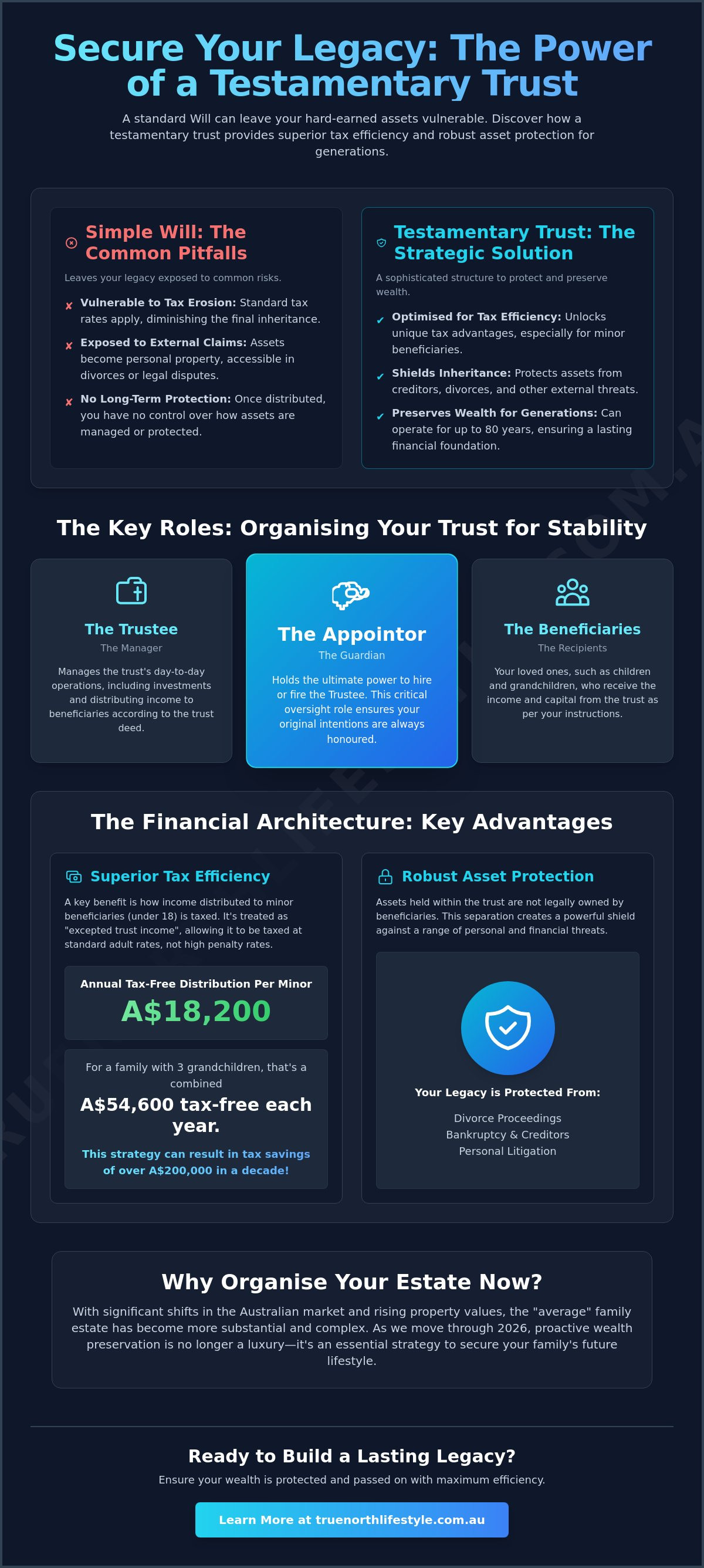
- The Trustee: This is the individual or entity responsible for the day-to-day management of the trust. They make the decisions regarding investments and how income is distributed among your loved ones.
- The Appointor: Often referred to as the "ultimate power," the Appointor acts as the guardian of the trust. They have the authority to hire or fire the Trustee, ensuring the trust's original intent is always honoured.
- The Beneficiaries: These are the people you wish to provide for, such as your children or grandchildren. They receive the income and capital generated by the trust's assets.
Why 2026 is the Critical Year to Organise Your Estate
Economic conditions change. As we move through 2026, the Australian market is witnessing a significant shift in how families view their wealth. With property prices in major hubs like Sydney reaching new heights, the "average" family estate is now more substantial and complex than ever before. Wealth preservation is no longer just for the ultra-wealthy; it's a necessary step for anyone wanting to protect their family's future.
At True North Lifestyle, we've observed that estate planning strategy is now a primary driver of retirement modelling. Families are increasingly focused on how their superannuation and property can be transitioned to the next generation without being eroded by external claims or unnecessary tax. Organising a testamentary trust now ensures that your family's journey remains on course, regardless of the fluctuating environment.
The Financial Architecture: Tax Efficiency and Asset Protection
Structure provides safety. While a simple Will acts as a set of instructions, a testamentary trust functions as a sophisticated financial shield designed to optimise every dollar you pass on. It allows for the strategic movement of wealth in a way that minimises the "tax leak" that often occurs when assets transition between generations. By establishing this robust legal framework, you ensure that the wealth you've built isn't eroded by the unpredictability of the Australian tax system or the volatility of personal litigation.
Maximising the Tax-Free Threshold for Minor Beneficiaries
The most immediate advantage lies in the treatment of minor beneficiaries. Under Section 102AG of the Tax Act, distributions from these trusts are classified as "excepted trust income." Excepted trust income is the specific legal classification that allows distributions to minors to be taxed at standard adult rates rather than the high penalty rates typically applied to children's unearned income.
Consider the impact on a family legacy. If you have three grandchildren, a Trustee could potentially distribute up to A$18,200 to each of them annually without any tax being paid on that income. This creates a combined tax-free threshold of A$54,600 per year. Over a decade, this strategy can result in tax savings exceeding A$200,000 when compared to distributing that same income to an adult beneficiary already in the top marginal tax bracket. It's a powerful tool for funding education or long-term savings without the "tax man" taking a significant slice.
Shielding Assets from Divorce and Litigation
Protection is about creating distance. A direct inheritance becomes the personal property of the beneficiary, making it a target for creditors in the event of bankruptcy or a "matrimonial asset" in the event of a divorce. A trust changes this dynamic entirely. Because the trust owns the assets, not the individual, a legal "wall" is established between the family's capital and the beneficiary's personal risks.
Understanding how testamentary trusts work is essential for anyone managing significant Sydney property or investment portfolios. In the Family Court of Australia, assets held within a well-structured trust are often viewed differently than direct gifts, providing a much higher level of protection during property settlements. For beneficiaries in high-liability professions, such as surgeons or company directors, this structure is non-negotiable. It ensures that a professional mistake doesn't result in the loss of their family's intergenerational wealth. Integrating these protections into your broader estate planning strategy ensures that your wealth remains a blessing rather than a legal burden.
Testamentary Trusts vs. Simple Wills: A Strategic Comparison
Simple Wills offer speed. They provide an immediate transfer of ownership, effectively handing the keys to your beneficiaries the moment probate is granted. However, this convenience often comes at the cost of long-term protection. A testamentary trust, by contrast, establishes a controlled distribution model. It allows for a gradual release of wealth, ensuring that the inheritance isn't consumed by youthful indiscretion or external legal claims. While the upfront legal costs are higher, the decades of potential tax savings often outweigh the initial investment for families with significant assets.
Honesty is essential here. A complex trust isn't the right fit for everyone. If your estate is relatively small, or if you don't have minor children or beneficiaries with specific protection needs, a simple Will remains the most efficient path. It avoids the administrative overhead of annual accounts and allows for a clean break. The choice between these two paths depends entirely on the complexity of your financial landscape and the specific outcomes you wish to guarantee for your heirs.
Control vs. Convenience: Finding the Right Balance
Managing a trust requires ongoing commitment. You must account for annual tax returns and administrative fees, which can feel burdensome if the estate is modest. The "Steady Navigator" approach typically favours the trust structure for estates valued over A$1 million. At this level, the annual tax savings usually eclipse the administrative costs. Consider a family in Miranda with a family home valued at A$1.8 million and a combined super balance of A$600,000. For them, a simple Will leaves A$2.4 million exposed. A trust provides a structured environment where that wealth can grow, protected from the "tax leak" we discussed previously, while providing a clear framework for the next generation.
The Impact on Superannuation and Death Benefits
Superannuation is a unique asset. It doesn't automatically form part of your estate and sits outside the reach of a standard Will. To bring these funds into your protective structure, you may need a "Superannuation Proceeds Trust" within your Will. This specific sub-trust manages the tax implications for the "taxable component" of your super, especially when passing funds to adult children who are no longer financial dependents. It's a vital component of wealth preservation, as it prevents a significant portion of your super from being paid to the ATO in death benefits tax. Your superannuation binding death benefit nomination must align perfectly with your trust strategy to ensure the funds actually flow into the intended protective vessel.
Design and Implementation: Organising Your Trust for Stability
Stability is built on preparation. Transitioning to a testamentary trust involves more than just a signature; it requires a methodical, five-step implementation process designed to move your legacy from a conceptual desire for protection to a functional reality. This structured approach ensures that every asset is accounted for and every role is filled by a capable hand, replacing the inherent anxiety of the unknown with a sense of calm and order.
- Step 1: Conduct a comprehensive audit. You must document all assets and liabilities, including property, shares, superannuation, and life insurance policies.
- Step 2: Identify your Appointors and Trustees. Select the "steady hands" who will manage the trust and hold the ultimate power of oversight.
- Step 3: Define beneficiary classes. Look beyond the immediate horizon by including future grandchildren to maximise the trust's typical 80-year lifespan.
- Step 4: Model the potential outcomes. Consult with a professional to perform retirement modelling and project the specific tax-minimisation benefits for your heirs.
- Step 5: Finalise the legal framework. Engage a specialist estate planning solicitor to draft the bespoke legal documents that reflect your specific strategic vision.
Choosing the Right Appointor: The Most Powerful Role
Trust is the foundation. While the Trustee manages the day-to-day, the Appointor holds the ultimate authority to hire or fire that Trustee. You must choose someone who implicitly understands your family vision and possesses the stability to act in the beneficiaries' best interests. Succession planning is equally vital; your Will should clearly state who takes over the Appointor role if your first choice passes away. While a family member often brings personal connection, a professional Appointor can offer a "no-nonsense" neutrality that prevents internal disputes during complex wealth transfers.
Ongoing Management: What Happens After You Pass?
Legacy is not accidental. It is the result of deliberate, research-driven construction that continues long after the trust is activated. Once established, a testamentary trust requires annual tax returns and formal minutes of meetings to maintain its legal integrity and tax-effective status. True North Lifestyle assists the next generation by providing ongoing bespoke portfolio construction and risk management modelling within the trust structure. This ensures the inherited wealth remains sustainable and aligned with the original family goals. To begin this process, explore our estate planning strategy services to see how we model your family's financial future.
Integrating Estate Planning into Your Total Retirement Model
Vision requires integration. At True North Lifestyle, we believe estate planning is the definitive cornerstone of the "Steady Navigator" philosophy. It's not a standalone legal task to be ticked off and forgotten; it's the final, vital stage of a comprehensive retirement journey. By viewing a testamentary trust through the lens of your total financial model, you ensure that your legacy isn't just a set of instructions, but a fully funded, functional reality that performs exactly as intended when your family needs it most.
Retirement modelling provides the mathematical foundation for this transition. It allows us to project your capital requirements throughout your own lifetime while determining with high-level precision what will remain for the next generation. This process involves "stress-testing" your portfolio against variables like inflation and market volatility, giving you the quiet certainty that the wealth flowing into your trust is sustainable. You move away from the anxiety of "what if" toward a structured, confident path where every dollar has a defined purpose and a protected destination.
Wealth Preservation Beyond Your Own Lifetime
Longevity planning is the key to enduring success. It ensures that the transition of wealth doesn't compromise your own lifestyle while simultaneously preparing the trust for decades of operation. We utilise research-driven, "low volatility" investment strategies to protect the trust's capital base, minimising the sequence of returns risk that can often erode an inheritance in its early years. This disciplined approach to portfolio construction focuses on steady, reliable growth rather than flashy, high-risk speculation. Learn more about our wealth preservation strategies to understand how we safeguard capital for the long term.
Clarity and Confidence for Miranda and Sydney Families
Local expertise brings a unique layer of understanding. For families in Miranda and across the Sutherland Shire, the intersection of high property values and complex superannuation requires a bespoke touch. We understand the specific market conditions of Sydney and how they impact your intergenerational strategy. This is about more than just numbers; it's about the human outcome of your hard work. We invite you to step into a role of confident oversight through a professional consultation, where we can map out a strategy that reflects your values and protects your loved ones. Book a retirement modelling session to secure your family’s legacy and begin the journey from uncertainty to a well-defined, protected future.
Securing Your Family's Future with Strategic Oversight
True wealth is about more than accumulation; it's about the certainty that your legacy will remain intact for those who follow. A testamentary trust offers a level of tax efficiency and asset protection that a simple Will cannot match, particularly when navigating the complexities of the Sydney property market. By shifting from a standard distribution model to a structured vessel, you provide your children and grandchildren with a stable financial foundation that is shielded from external risks and optimised for long-term growth.
Our team at True North Lifestyle brings the discipline of research-driven retirement modelling and deep expertise in wealth preservation to every estate strategy. From our advisory offices in the Sydney CBD and Miranda, we help you replace complexity with a clear, well-defined path forward. Secure your family’s future with a bespoke estate planning strategy that reflects your vision and values. You've done the heavy lifting of building your wealth; now, let's ensure it stays protected for generations to come.
Frequently Asked Questions
What is the main difference between a testamentary trust and a normal trust?
The primary difference lies in the timing of activation. A testamentary trust is established within a Will and only comes into existence upon the testator's death, whereas a standard family trust is created during your lifetime. This distinction allows the testamentary version to access unique tax treatments for minor beneficiaries that are unavailable to ordinary inter vivos trusts.
How much does it cost to set up a testamentary trust in Australia?
Costs for establishing these structures vary based on the complexity of your financial landscape and the number of trusts required. While the initial legal investment is higher than a standard Will, the long-term tax savings and asset protection benefits often provide a substantial return on that expenditure. You should consult with an estate planning solicitor to receive a bespoke quote tailored to your specific requirements.
Can a testamentary trust be challenged in court like a normal Will?
Yes, a testamentary trust can be subject to legal challenges. Because the trust is a fundamental component of your Will, it can be contested under family provision legislation if a claimant feels they haven't been adequately provided for. Ensuring your Will is professionally drafted and "stress-tested" against potential claims is a vital step in your broader wealth preservation strategy.
Is a testamentary trust better than a simple Will for a small estate?
A simple Will is often more appropriate for modest estates where the administrative costs of a trust might erode the capital. We typically find that the benefits of a testamentary trust become most apparent for estates valued above A$1 million. At this level, the annual tax-minimisation opportunities generally exceed the ongoing costs of accounting and tax compliance.
Who should I appoint as the Trustee of my testamentary trust?
You should appoint a Trustee who possesses both financial literacy and a deep understanding of your family vision. This could be a surviving spouse, an adult child, or a professional corporate trustee. The role requires a "steady hand" to manage investments and make impartial distribution decisions that align with the trust's original intent and your family's long-term stability.
What are the tax benefits of a testamentary trust for my grandchildren?
The tax advantages are significant due to the "excepted trust income" status discussed earlier. This allows minors to access the full A$18,200 tax-free threshold, meaning a Trustee can fund education or lifestyle expenses using the trust's earnings without triggering penalty tax rates. It's a highly efficient mechanism for intergenerational wealth transfer that keeps more capital within the family circle.
How long does a testamentary trust last in New South Wales?
In New South Wales, these trusts are governed by the rule against perpetuities, which limits their lifespan to 80 years. This long duration allows the structure to protect and grow assets across multiple generations, providing a stable horizon for bespoke portfolio construction. It ensures that your foresight continues to benefit your descendants well into the future.
Can I change my testamentary trust after I have signed my Will?
You can amend the terms of your trust at any time provided you still have testamentary capacity. This is usually achieved by drafting a new Will or a codicil to your existing document. Regularly reviewing your estate planning strategy with a professional ensures the trust remains aligned with your current assets, family circumstances, and any changes in Australian tax law.


