

A 4.2% annual inflation rate is more than just a headline statistic. For many Sydney retirees, it represents a direct and persistent erosion of the lifestyle they worked decades to build. Successfully protecting assets from inflation in 2026 requires moving beyond traditional "safe" havens that no longer provide a real return above rising costs. You likely feel the weight of this shift every time you review private health premiums or consider the future costs of aged care. It’s natural to worry that your capital might not last thirty years when the purchasing power of every dollar is shrinking before your eyes.
This guide will show you how to shield your retirement capital and maintain your purchasing power using research-driven Australian investment strategies. We will examine which assets serve as genuine hedges against price rises and how bespoke modelling can provide the clarity you need to ensure your income remains stable. By aligning your portfolio’s internal rate of return with your specific lifestyle costs, you can move forward with the confidence that your financial foundation is secure despite the RBA’s current 4.35% cash rate environment.
Key Takeaways
- Understand why headline inflation figures often understate the true cost of living for Sydney retirees, particularly regarding private health and aged care expenses.
- Identify the "cash trap" where seemingly safe term deposits fail to keep pace with rising prices, necessitating a more robust strategy for protecting assets from inflation.
- Learn which specific Australian asset classes, such as infrastructure and companies with pricing power, offer the most effective long-term hedges against currency erosion.
- Discover how to leverage the 15% tax environment within superannuation and bespoke tax-minimisation strategies to maximise your real, inflation-adjusted income.
- See how research-driven portfolio modelling and rigorous stress-testing can replace economic anxiety with a structured, sustainable roadmap for your retirement.
Understanding Inflation’s Impact on Your Australian Lifestyle
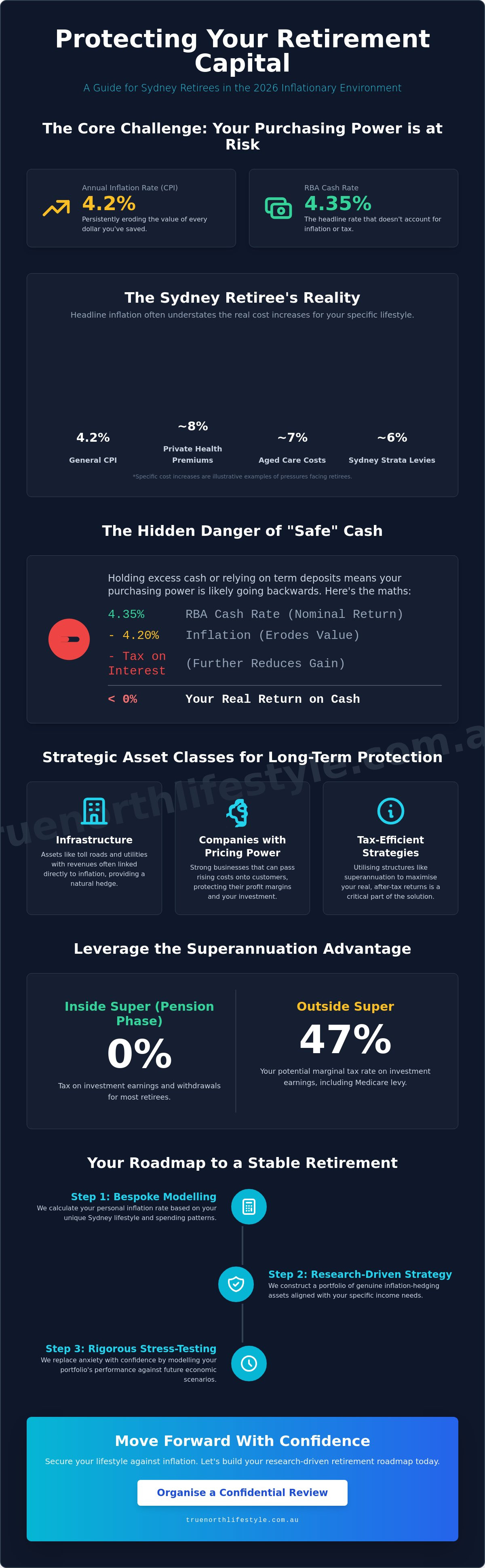
Protection is paramount. Inflation is not a temporary hurdle but a persistent shift in the economic landscape of 2026. In the 12 months to April 2026, the Consumer Price Index (CPI) rose by 4.2 per cent, remaining stubbornly above the Reserve Bank’s target range. While this figure serves as a national benchmark, it rarely captures the lived experience of self-funded retirees in Sydney. Successfully protecting assets from inflation requires moving beyond these broad averages to address the specific pressures on your private capital.
The true danger lies in the costs that headline figures often overlook. For a high-net-worth retiree, inflation isn't just about the price of milk or fuel; it's found in the rapid escalation of private health insurance premiums, rising strata levies on harbourside apartments, and the increasing cost of premium aged care services. When these essential lifestyle expenses outpace the general CPI, your purchasing power diminishes. This erosion is the primary metric of retirement failure. Maintaining a stable lifestyle for thirty years requires an effective inflation hedge that generates real returns above these specific, high-end price rises.
The Sydney Premium: Why Local Context Matters
Location dictates your economic reality. Living in the Sutherland Shire or the Sydney CBD involves a cost structure that national statistics simply cannot reflect. Sydney’s unique property market and service sector often move independently of the broader Australian economy, carrying a "premium" that can squeeze even well-funded portfolios. We focus on your personal inflation rate. This is a bespoke calculation based on your actual spending patterns, from local council rates to the specific luxury services you enjoy. By understanding this local context, we replace generic assumptions with a research-driven strategy tailored to your life in New South Wales.
Longevity Risk: The Intersection of Time and Inflation
Time amplifies every economic fluctuation. Longevity risk is the very real danger of outliving your money in a world that becomes more expensive every year. It's a sobering mathematical reality that even a steady 3 per cent inflation rate can effectively halve the value of a dollar over a 25-year retirement. With the RBA cash rate currently at 4.35 per cent as of May 2026, the margin for error has tightened significantly. You need to see the long-term horizon with total clarity. Utilizing professional retirement modelling allows you to visualise these impacts today, ensuring your portfolio is constructed to sustain your lifestyle for decades, not just years.
The Hidden Danger of "Safe" Cash in a High-Cost Environment
Safety is often an illusion. During the market fluctuations of early 2026, the psychological urge to "flee to cash" is understandable. It feels like a protective measure against volatility. However, for those focused on protecting assets from inflation, excessive cash holdings can actually become the greatest risk to long-term sustainability. While your bank balance remains stable, the actual value of that capital is being quietly dismantled by the rising cost of living in Sydney.
The "Cash Trap" is a mathematical reality. With the RBA cash rate sitting at 4.35 per cent as of May 2026, many retirees assume their savings are finally working for them. This nominal figure is misleading. To understand your true financial position, you must calculate your real rate of return: take your nominal interest rate, subtract the 4.2 per cent inflation rate, and then subtract the tax you pay on those earnings. For many, this calculation reveals a negative result. You aren't just standing still; you're effectively paying for the privilege of holding cash while your purchasing power evaporates.
Term Deposits vs. Inflation: A Losing Battle?
Bank deposit rates rarely lead the market. In 2026, we’ve observed that financial institutions often lag behind the Consumer Price Index when setting their rates, ensuring their margins remain protected while yours are squeezed. Cash serves a vital purpose for immediate liquidity, such as maintaining a "bucket" for the next two years of spending, but it is a destructive long-term strategy for your core capital. To truly protect your portfolio from inflation, your assets must be positioned in vehicles capable of growth that exceeds these persistent price rises. We often find that a superannuation review is the first step in identifying where cash is being over-utilised at the expense of your future security.
The Opportunity Cost of Conservatism
Fear has a high price tag. A "defensive" posture in your 60s frequently leads to a financial crisis in your 80s because the portfolio lacks the growth required to keep pace with thirty years of compounding costs. Every dollar held in cash that could have been in a growth-oriented asset represents a lost opportunity to outpace the CPI. Real return is the only metric that preserves a lifestyle. By shifting focus from nominal stability to real-world purchasing power, you can ensure your capital remains robust enough to support your needs well into the future.
Strategic Asset Classes for Long-Term Purchasing Power
Growth is non-negotiable. While cash provides immediate liquidity, protecting assets from inflation requires a deliberate shift toward growth-oriented vehicles that can outpace the 4.2 per cent rise in consumer prices. For the Sydney retiree, this means prioritising "Income Growth" over the traditional safety of "Fixed Income." By focusing on assets that naturally adjust their revenue alongside inflation, you ensure your portfolio's internal rate of return remains robust enough to support your lifestyle over a thirty-year horizon.
A sophisticated portfolio often includes a defensive sleeve of Inflation-Linked Bonds (ILBs). Unlike traditional bonds, the principal value of an ILB is indexed to the CPI, providing a direct mathematical shield against rising costs. However, these are merely one component of a broader strategy. To truly protect your super's purchasing power, you must embrace assets that possess inherent pricing power. You don't just want a static income; you need one that evolves alongside the economy.
Equities with Pricing Power
Pricing power is everything. We look for companies in sectors like healthcare or essential services that can pass on increased input costs to consumers without sacrificing volume. In the Australian context, these high-quality equities offer more than just capital appreciation. The combination of sustainable dividend growth and the unique benefit of franking credits provides a powerful, tax-effective income stream that tends to rise as prices do. A dividend growth strategy acts as a natural hedge, ensuring your annual drawdowns maintain their real-world value regardless of economic shifts in 2026.
Real Assets and Infrastructure
Tangible assets provide stability. Within the 2026 Sydney landscape, the property market remains a formidable store of value, though direct ownership often carries high entry costs and management burdens. Many retirees find that liquid Australian Real Estate Investment Trusts (A-REITs) offer a more manageable alternative, providing exposure to commercial and industrial sectors with built-in rent escalators. Similarly, infrastructure assets are essential to our national economy. These often include:
- Toll Roads: Revenue is typically linked to the CPI through concession agreements.
- Utilities: Regulated price increases often account for inflationary pressures.
- Renewable Energy: Long-term contracts frequently include inflation-adjustment clauses.
These assets serve as a cornerstone of strategic construction, providing reliable cash flows that aren't easily eroded by a high-cost environment. By balancing these real assets with growth equities, you build a portfolio designed to sustain your purchasing power for the long term.
The long-term stability of infrastructure assets often relies on precise engineering and transport planning. To learn more about the technical expertise behind these essential services, discover ML Traffic Engineers Australia.
Optimising Superannuation and Tax Strategies Against Inflation
Efficiency is essential. While asset allocation is the engine of growth, your tax structure is the hull that protects your progress. In 2026, the 15 per cent tax environment within the superannuation accumulation phase remains a critical weapon for protecting assets from inflation. When compared to the higher marginal tax brackets, which can reach 45 per cent for income over $190,001, the concessional nature of superannuation significantly reduces the "tax drag" on your investment returns. Every dollar saved in tax is a dollar that remains in your portfolio to compound against the 4.2 per cent rise in the cost of living.
Strategic management of your contributions is equally vital. As of 1 July 2025, the Superannuation Guarantee rate reached 12 per cent, providing a consistent boost for those in the late stages of their career. For those still working but looking to bolster their position, Transition to Retirement (TTR) strategies allow for the simultaneous draw-down of a pension and the salary-sacrificing of income. This creates a circular flow that can lower your overall tax bill while maintaining your lifestyle. Implementing sophisticated tax-minimisation strategies ensures that your "real" keep-home pay is maximised, providing the liquidity needed to meet rising Sydney expenses without depleting your core capital.
The Power of Pension Phase
Tax-free growth is the ultimate goal. Once you move into the retirement phase, the tax rate on both investment earnings and capital gains drops to 0 per cent. This shift is transformative for your inflation-adjusted returns. By eliminating tax entirely within this phase, you effectively increase your net return without taking on additional market risk. It is important to navigate the Transfer Balance Cap (TBC) limits carefully in 2026 to ensure you are maximising this tax-free environment. Reducing the friction of taxation is mathematically equivalent to increasing your investment performance, providing a sturdier shield against purchasing power erosion.
Superannuation Re-contribution for Couples
Preservation extends to the next generation. Re-contribution strategies involve withdrawing funds from superannuation and re-contributing them as non-concessional payments, which are capped at $120,000 for the 2025-2026 financial year. This process allows couples to rebalance their accounts and convert "taxable" components into "tax-free" components. This is a vital step in long-term estate planning, as it can significantly reduce the tax liabilities for non-dependant beneficiaries in the future. By proactively managing these components now, you protect the longevity of your family wealth. To ensure your structures are fully aligned with your long-term goals, a professional superannuation review & optimisation can identify the specific adjustments needed for your situation.
Bespoke Modelling: Your Roadmap to a Stable Retirement
Clarity brings peace. In an economic environment where the cost of living in Sydney remains volatile, a static financial plan is no longer sufficient. We believe that protecting assets from inflation requires a transition from traditional, rigid projections toward dynamic cash flow modelling. This research-driven methodology allows us to replace the inherent anxiety of the unknown with a structured, logical path forward. By focusing on the human outcome of your financial strategy, we ensure your capital is positioned to support your specific lifestyle for thirty years or more.
Our approach to bespoke portfolio construction is rooted in rigorous testing. We don't simply hope for the best; we model the worst. By "stress testing" your portfolio against various high-inflation scenarios, we can visualise how your capital would behave if the current 4.2 per cent inflation rate persisted or if the RBA cash rate shifted unexpectedly. This process provides the emotional reassurance that your lifestyle is sustainable, allowing you to step into a role of confident oversight rather than constant worry. You deserve a partner who has already done the heavy lifting, providing a reliable anchor in a fluctuating 2026 landscape.
Simplifying the Complex: The True North Lifestyle Process
Data drives decisions. We move beyond generic retirement assumptions by modelling your actual Sydney lifestyle costs into your long-term projections. Whether it's the escalating cost of international travel, private health premiums, or planned family gifting, every variable is accounted for within your personal model. This structured data transforms financial complexity into a manageable roadmap. For Miranda residents, our advisers act as an authoritative guide, navigating the nuances of the local market to ensure your wealth preservation strategy remains aligned with your personal goals.
Taking the First Step Toward Clarity
Action replaces uncertainty. When you visit our Miranda or Sydney offices for an initial consultation, you can expect a methodical review of your current position. We focus on understanding your aspirations before we ever discuss the numbers. This alignment between your lifestyle goals and your investment strategy is the foundation of retirement success. Protecting assets from inflation is a technical challenge, but the ultimate goal is the quiet certainty that your future is secure. To begin the process of simplifying your financial world, organise a consultation with a Sydney financial advisor today and discover the power of bespoke modelling.
Securing Your Purchasing Power for the Decades Ahead
Confidence is earned through rigorous preparation. Successfully protecting assets from inflation in 2026 requires moving beyond the perceived safety of cash and embracing a portfolio that prioritises real, after-tax returns. By leveraging the tax-free environment of the pension phase and selecting assets with inherent pricing power, you ensure your capital remains robust against rising Sydney costs. The goal is not merely to survive market cycles, but to maintain the lifestyle you’ve worked so hard to build.
Our research-driven Investment Committee provides the oversight necessary to maintain low-volatility, income-focused portfolios. Through specialist retirement modelling for Sydney families, we replace the stress of conflicting economic forecasts with a clear, dynamic roadmap. You don't have to navigate these complexities alone. With the right structure, you can feel empowered to make informed choices that protect your longevity and your legacy. Secure your retirement lifestyle with a bespoke financial strategy and step into your future with quiet certainty.
Frequently Asked Questions
Is gold a good hedge against inflation for Australian retirees in 2026?
Gold can serve as a store of value during periods of currency erosion, yet it lacks the yield required by most retirees to fund their daily expenses. While it is a traditional inflation hedge, it does not produce dividends or rent. In the 2026 economic environment, Sydney retirees often find more utility in Australian equities with pricing power or infrastructure assets that provide a growing income stream to meet rising costs.
How does the 2026 inflation rate affect my Centrelink Age Pension?
The Australian Government indexes the Age Pension twice yearly, in March and September, to help payments keep pace with the cost of living. Following the 4.2 per cent CPI increase recorded in April 2026, the single rate rose to $1,200.90 per fortnight, while couples now receive a combined $1,810.40. These adjustments are designed to maintain your basic purchasing power, though they may not cover the full "Sydney premium" on luxury services or private health.
Should I pay off my mortgage or invest in the stock market during high inflation?
Eliminating debt provides a guaranteed "return" by removing interest obligations, which is particularly relevant with the RBA cash rate at 4.35 per cent. However, if your mortgage is already at a low fixed rate, investing in growth assets might offer a higher real return over the long term. This decision requires bespoke modelling to compare the cost of debt against the potential for protecting assets from inflation through a diversified portfolio.
What is the "Sequence of Returns" risk and why is it worse during inflation?
Sequence of returns risk is the danger of experiencing poor investment performance early in your retirement while you are simultaneously withdrawing capital. Inflation compounds this risk because you are forced to withdraw larger dollar amounts to maintain your lifestyle as prices rise. This double impact can deplete your portfolio significantly faster than anticipated, making research-driven risk management essential for portfolio sustainability in 2026.
Can I change my superannuation investment mix to protect against rising prices?
You have the flexibility to adjust your superannuation investment options at any time to better align with the current economic landscape. Shifting from a high concentration of cash or traditional fixed interest toward infrastructure, real assets, or inflation-linked bonds can provide a more robust shield. A comprehensive superannuation review is often the best way to determine if your current mix is capable of protecting assets from inflation over a thirty-year horizon.
How much do I need to retire in Sydney at 60 given current inflation trends?
The "lump sum" required for a Sydney retirement varies greatly, but the city's unique costs for private health and strata levies mean that national averages often fall short. With inflation at 4.2 per cent, a portfolio that seemed sufficient three years ago may now require significant optimisation. We utilise dynamic cash flow modelling to determine the exact capital you need to sustain your specific lifestyle in the Sutherland Shire or Sydney CBD.
What are inflation-linked bonds and should they be in my portfolio?
Inflation-linked bonds are defensive securities where the principal value is indexed to the Consumer Price Index. These assets provide a direct mathematical link to inflation, ensuring that your capital value rises alongside the cost of living. They can be a valuable component of a defensive sleeve for retirees who seek stability without the "cash trap" risks associated with traditional term deposits in a high-inflation environment.
How often should I review my retirement model to account for price changes?
Reviewing your retirement model at least once every twelve months is vital in the current 2026 climate. Rapid shifts in the RBA cash rate and persistent inflationary pressures mean that a plan created two years ago may no longer be accurate. Regular reviews allow you to adjust your drawdowns and tax strategies, ensuring you remain a "Steady Navigator" of your financial future regardless of broader economic volatility.


